Showing posts with label Chile. Show all posts

Friday, July 31, 2026

Ancient DNA confirms historical accounts of how smallpox got to the Americas. Really!

Again the AAAS gets caught spreading stereotypes or biases!

By repeating a narrative it does not become a truth! Or as Oscar Wilde once said: "The truth is rarely pure and never simple" quoted from Oscar Wilde's 1895 play The Importance of Earnest.

It also appears that the researchers were biased. Why would they enter the year 1492 CE as the start dated for the sequenced ancient genomes in their abstract (see below)? The arrival of Christopher Columbus in the Americas? Is this a pretense of exactness or demagoguery?

This research is based only on two individuals found in one cemetery in Chile! This study also involves some serious estimation work on the evolution of the virus. Was this properly validated?

Maybe the Europeans of 16th and 17th century did not think that smallpox was so contagious anymore. Very likely, these Europeans did not understand that the indigenous population might be more vulnerable to this virus.

What diseases were spread from indigenous people to the early arriving Europeans?
"The primary and practically sole major disease widely accepted by historians and scientists to have passed from the Americas (including South America) back to early European arrivals is syphilis (specifically non-venereal or venereal treponemal variants that adapted into the European syphilis epidemic of the 1490s)." (Google Search)
Syphilis in the 16th century was significantly severe, disfiguring, and frequently deadly. (Google Search)

Or why did not other, more contagious diseases evolve in South America or the American continent before the arrival of Europeans?

"Sometime around the turn of the 17th century, two people died in northern Chile. Their disease-ravaged bodies were bundled in layers of textiles, buried in an Indigenous cemetery, and naturally mummified by the desert environment. Now, scientists have identified their killer: smallpox. The virus’ genome found in their bones and described today in Science represents the first molecular evidence of the disease in the colonial Americas, confirming historical accounts of the disease arriving with European contact and eventually killing millions of Indigenous inhabitants. ...

surprising hints that the smallpox virus’ evolution might have slowed down between the 16th and 18th centuries ...

the Chilean strain differed from modern smallpox, but thinks it was likely less virulent. ...

Archaeologists had previously described some of the mummies as having skin lesions, which they attributed to arsenic exposure. But smallpox could also leave such lesions. ...

Evolutionarily, the Chilean strain sits between pox viruses circulating during the Viking age and a virus isolated by Poinar’s team from a Lithuanian child mummy who died between 1643 and 1665 C.E. It likely diverged from other smallpox lineages around 1296 C.E., and went extinct before the early 20th century.
By estimating how long it would take for the strain’s hallmark genetic variants to evolve and combining that with radiocarbon dates from one of the mummy’s hairs, the scientists deduced that the outbreak in northern Chile occurred between 1492 and 1631 C.E."

"... Smallpox was one of the deadliest diseases introduced to the Americas during European colonization. The rapid spread of the disease across North, Central, and South America is estimated to have resulted in the deaths of three to four million people, particularly among Indigenous populations with no prior immunity. ...

Bruno González and colleagues identified ancient smallpox virus DNA in two mummified Indigenous Inca-Early Colonial-era individuals recovered from northern Chile, who lived between 1492-1631 CE."

Caveat: I did not read the research article.

From the editor's summary and abstract:
"Editor’s summary
Smallpox was introduced to the Caribbean by European colonialists before quickly spreading south. Romero González et al. sequenced ancient smallpox genomes from two likely Incan individuals from Chile dated between about 1492 and 1631 CE. Skin lesions on these mummified remains were previously attributed to arsenic exposure, but they are also consistent with smallpox infection.
Phylogenetic analyses suggested that this smallpox strain was most closely related to ancient European lineages that went extinct before the 20th century. These represent the earliest smallpox genomes found in the Americas and help set a timeline for gene loss during the evolution of this deadly virus. ...

Abstract
Smallpox was a major driver of population collapse in the Americas after European contact, yet the genetic identity of the causal strains remains unknown.
Here, we report the first ancient smallpox genomes in the Americas, dating to approximately 1492–1631 common era (CE), recovered from two Inca-Colonial individuals in northern Chile.
These genomes form a now-extinct lineage that diverged around 1296 CE, after the splitting of early medieval European strains but before the emergence of modern variola lineages, providing direct molecular evidence for smallpox introduction through European colonization.
We further identify a constant tempo of gene inactivation until the late 16th century, followed by a phase of constraint and a subsequent rebound in substitution rates, linking variola virus evolution to major shifts in human demography and epidemiology."

Ancient DNA confirms historical accounts of how smallpox got to the Americas Science | AAAS "“Landmark” paper finds disease originated with European contact"

Monday, March 23, 2026

New archaeological dating of ancient Chilean site reopens controversy of first human colonization of South America

Amazing stuff! How exact a science is stratigraphy?

"It is among the most hotly contested topics in archaeology: When did people first arrive in the Americas? A few decades ago, there was consensus that people began populating North America no earlier than about 13,000 years ago, as evidenced by well-dated spearheads with characteristic fluted bases known as Clovis points, named for the city in New Mexico near the archaeological site where they were first identified in 1929.
Then, in the 1970s, an archaeologist named Tom Dillehay claimed to have dated stone tools and other artifacts found at a site in southern Chile to 14,500 years ago—a time when much of North America would have still be covered in impassable glaciers.

Few gave the claims from that site, known as Monte Verde, much credence until an independent cadre of researchers visited it in 1997 and confirmed the dates . The result sent shockwaves through the archaeological community and overturned the so-called “Clovis first” paradigm in favor of a new “pre-Clovis” one. This interpretation spurred scientists to retool their hypotheses for how and when people entered the continent; a coastal migration hypothesis has since gained popularity in its wake. Several other sites throughout the Americas have since been dated to before 13,000 years, and the matter appeared settled. ...

A study published last week in Science saw one such “pre-Clovis” skeptic revisiting Monte Verde—or sites close to it, as the original dig site has since been destroyed—and redating the sediment layers from which the supposedly human made artifacts were said to have come.  ...

In the authors’ analysis, the key layers aren’t 14,500 years old, but instead only 8200 to 4200 years old. The confusion, they argued in the paper, was caused by younger sedimentary material being deposited below older layers by a river’s flow, which scrambled the region’s stratigraphy.

Why did it take so long to uncover this? “The simple answer is that the archaeological site is quite remote and was not visited by many archeologists, geomorphologists, or Quaternary geologists (studying the past 2.6 million years) who could have identified the prominent volcanic ash, the exposed wood bed that is the source for the 14,000-year-old radiocarbon ages, and identified that the site is situated on an abandoned floodplain that had to be younger than the landscape surface,” ...

Critically, these dates from Monte Verde have no impact on the other pre-Clovis sites that have been independently dated, but the brouhaha could lead to enhanced scrutiny and calls for their dates to be replicated. ..."

From the editor's summary and abstract:
"Editor’s summary
There is much debate surrounding the dates of human occupation in the Americas. One site that places South American timing in the pre-Clovis period is Monte Verde II in Chile. This site, however, was mostly only studied by a single group, meaning that replication of the dating has been lacking. Surovell et al. independently examined the site using current approaches and a broader scope and concluded that the site could not be older than 8200 years, significantly younger than the previously determined 14,500 years ...

Abstract
Our understanding of the timing of the human colonization of South America has been anchored by the Monte Verde II site in Chile, reported to date to ~14,500 years before the present (B.P.) and regarded as one of the most secure pre-Clovis archeological sites.
We report the first independent investigation of Monte Verde in the nearly 50 years since initial excavations. We argue that radiocarbon and luminescence dates from alluvial exposures, in combination with the identification of a tephra dated to 11,000 years B.P. stratigraphically underlying the archaeological component, suggest that Monte Verde cannot be older than the Middle Holocene (8200 to 4200 years B.P.). With colonization no longer anchored by Monte Verde, our revised chronology supports a more recent date of human arrival to South America."

ScienceAdviser

A later debut for humans (Perspective, open access) "Stratigraphic analysis resets the time of human arrival in Monte Verde, Chile"


Fig. 1. Map of the study area.


Fig. 2. Ages of geologic deposits and the Monte Verde site.


Sunday, December 14, 2025

Celebrations erupts across Chile as conservative and pro-Trump candidate José Antonio Kast wins election

I suppose good news, but I am not familiar with the winner! It appears this will be a peaceful transition of power!
Hopefully, the next president José Antonio Kast can work out something with President Trump!

Monday, September 01, 2025

Astronomers find unique radio beacon in galaxy NGC 4945

Amazing stuff!

"Astronomers have discovered a new celestial object, a compact radio beacon located in the galaxy NGS 4945, about 12 million light-years away. Its light is polarized at an almost impossible level that hints at a perfectly aligned magnetic field. The object has been nicknamed "Punctum"; it’s a signal so clean and precise that it stands out like a lighthouse beam cutting through fog.

In a groundbreaking new study, astronomers ... first spotted the new celestial object using the Atacama Large Millimeter/submillimeter Array (ALMA), during Band 3 observations (92-104 GHz) of the starburst galaxy NGC 4945. At the time, researchers were observing the bright, active core of the galaxy when they came across something unexpected. ..."

From the abstract:
"We report the discovery of a highly polarized millimeter (mm) continuum source in the central region of NGC 4945, identified through ALMA Band 3 observations. This starburst Seyfert 2 galaxy contains numerous compact mm sources, yet only one - located approximately 3.4" (~60 pc) from the galactic center and unresolved with ~0.1" resolution - exhibits an unusually high polarization degree of 50%  14%, likely originating from non-thermal synchrotron radiation. The source is faint, yet clearly detected in two separate epochs of observation taken 14 days apart, with flux of 0.104  0.018 and 0.125  0.016 mJy, as well as in earlier ALMA observations, showing no variability at any timescale. The spectral index remains stable within large uncertainties, -1.8  2.5 and -1.3  2.5.
The source, which we further refer to as Punctum due to its compactness, revealed no clear counterparts in existing X-ray or radio observations. Assuming association with the central region of NGC 4945, we estimate upper limits for its luminosity of ~1  10 erg s in the 3-6 keV X-ray band (from archival Chandra data) and ~5  10 erg s at 23 GHz (from archival ATCA data).
A comparison of the radio, mm (including polarization), and X-ray properties with known astrophysical sources emitting synchrotron radiation, such as accreting neutron stars, supernova remnants, and non-thermal galactic filaments, revealed no clear match in any of these scenarios. The exact nature of this highly polarized source remains undetermined."

Astronomers find unique radio beacon in galaxy NGC 4945


Monday, June 23, 2025

World’s most powerful telescope reveals best images yet of universe

Recommendable! One of the missions of this new telescope is to find asteroids that could potentially hit earth (then you have a real climate crisis if the asteroid is big enough and it's not anthropogenic).

Friday, June 13, 2025

Mapping the Universe at the Rubin Observatory in Chile

Very recommendable! Amazing stuff! This is one of the largest digital cameras ever built. It can capture a golf ball on the moon and shoots images very fast.

Friday, May 02, 2025

Chiles TikTok Sängerin Katteyes weint um ihre Brustimplantate

Brustimplantate sind nicht ohne Risiko! Wie alt war die Sängerin (heute 21 Jahre alt) als sie diese kosmetische Operation durchführte?

Sunday, January 05, 2025

Sunday, December 29, 2024

Waltzing binary stars found near a supermassive black hole at the center of our Milky Way galaxy

Amazing stuff!

"Astronomers studying the murky center of our Milky Way galaxy have discovered something they never expected: a pair of young stars orbiting each other near the supermassive black hole that is our galaxy’s dark heart. The observation comes as a surprise because astrophysicists had thought that the black hole’s intense gravity would either rip the stars in such a pair apart or squash them together.

The supermassive black hole at the galaxy’s center has a mass four million times that of the Sun; a dense cluster of stars buzzes around its edge. Many of them are old stars that migrated there over billions of years, but others are unexpectedly young and it is not known how they got there. The newest member is D9, discovered by astronomers using the European Southern Observatory’s Very Large Telescope. They noticed that its light shifted back and forth in frequency in a regular way every 372 days, just as happens with binaries as the orbiting stars move toward and away from Earth, Doppler-shifting their light. They concluded that within its dusty shroud, D9 hides a star just 2.7 million years old with 2.8 times the mass of our Sun and a companion of just 0.7 solar masses. ..."

"“Black holes are not as destructive as we thought,” ... Binary stars, pairs of stars orbiting each other, are very common in the Universe, but they had never before been found near a supermassive black hole, where the intense gravity can make stellar systems unstable.

This new discovery shows that some binaries can briefly thrive, even under destructive conditions. D9, as the newly discovered binary star is called, was detected just in time: it is estimated to be only 2.7 million years old, and the strong gravitational force of the nearby black hole will probably cause it to merge into a single star within just one million years, a very narrow timespan for such a young system. ..."

ScienceAdviser

Young double-star system discovered near our Galaxy’s giant black hole (open access) "Surprising find could force rethink of astrophysics at Milky Way’s center"


First ever binary star found near our galaxy’s supermassive black hole (original news release, contains link to research paper)


An international team of researchers has detected a binary star orbiting close to Sagittarius A*, the supermassive black hole at the centre of our galaxy. It is the first time a stellar pair has been found in the vicinity of a supermassive black hole. The discovery, based on data collected by the European Southern Observatory’s Very Large Telescope (ESO’s VLT), helps us understand how stars survive in environments with extreme gravity, and could pave the way for the detection of planets close to Sagittarius A*.


Sunday, October 13, 2024

New surveys of the ski for near earth asteroids and comets

Good news! It has been a long while that the earth was hit by a large asteroid, which would likely trigger a real climate crisis not the man made fantasy climate crisis were are told every day!

"... to discover and characterize most of the potentially hazardous asteroids and comets that come within 30 million miles of Earth’s orbit. These are collectively known as near-earth objects, or NEOs.

NEO Surveyor consists of a single scientific instrument: a 50 centimeter (nearly 20 inch) diameter telescope that operates in two heat-sensing infrared wavelengths. It will be capable of detecting both bright and dark asteroids, which are the most difficult type to find.

After launch, NEO Surveyor will carry out a five-year baseline survey to find at least two-thirds of the near-Earth objects larger than 140 meters (460 feet). These are the objects large enough to cause major regional damage in the event of an Earth impact. By using two heat-sensitive infrared imaging channels, NEO Surveyor can make accurate measurements of NEO sizes and gain valuable information about their composition, shapes, rotational states, and orbits. ..."

"... The first asteroid was spotted in 1801, and it took two centuries to find a million more. In the first six months of operations, which begin in 2025, Rubin will double that number [but only for the southern hemisphere]. It is, in other words, a polymathic telescope; one that, among all its other tasks, will find asteroids of all shapes and sizes faster than any other spotter on Earth. ..."

Near-Earth Object Surveyor | NASA Jet Propulsion Laboratory (JPL) "An infrared space telescope designed to help advance NASA’s planetary defense efforts"


Wednesday, September 25, 2024

Extinct, millions of years old volcanoes: untapped sources of rare earth elements

Good news! Let the rare earth rush begin!

Remember “Rare earth elements aren’t that rare”

"Scientists have simulated the actions of a volcano to conclude that extinct volcanoes across the globe are likely full of rare earth elements that could help supply the world’s growing demand for these difficult to extract resources. ..."

".... “We have never seen an iron-rich magma erupt from an active volcano, but we know some extinct volcanoes, which are millions of years old, had this enigmatic type of eruption,” ...

... “Our findings suggest that these iron-rich extinct volcanoes across the globe, such as El Laco in Chile, could be studied for the presence of rare earth elements.” ..."

"... The researchers simulated volcanic eruptions in the lab by sourcing rocks similar to those from iron-rich extinct volcanoes. They put these rocks into a pressurised furnace and heated them to extremely high temperatures to melt them and learn more about the minerals inside the rocks.

This is how they discovered the abundance of rare earth elements contained in iron-rich volcanic rocks. ...

China has the biggest deposit of rare earth elements on the planet, while Europe's largest deposit of rare earths is in Sweden. Australia has a world-class deposit at Mount Weld in Western Australia and others near Dubbo and Alice Springs. ..."

From the abstract:
"A surging rare earth element (REE) demand calls for finding new REE resources. Iron oxide-apatite (IOA) deposits have substantial REE potential, but their REE enrichment mechanisms remain uncertain, hindering REE exploration. The dominant process of IOA deposit formation is also hotly debated. Here, we use novel layered piston-cylinder experiments to address these questions. Seventeen magmatic FeP–Si immiscibility experiments, across 800–1150 °C, and at 0.4 and 0.8 GPa, reproduced many natural textural (e.g., dendritic magnetite) and geochemical (e.g., DLFeP–LSiTi/Fe  < 1) features of IOA deposits. Magmatic-hydrothermal fluid bubbles and iron oxide-bubble pairs formed as well. The results strongly support FeP–Si immiscibility as a controlling factor in IOA deposits, although not mutually exclusive with other models. Light REE partition into FeP liquids, preferentially to heavy REE, explaining the light REE enrichment of IOA deposits. Some DLFeP–LSiREE values reach above 100, much higher than previously reported. Hence, any FeP rich rock that experienced magmatic Fe-Si immiscibility (e.g., IOA, nelsonites) is expected to be light REE enriched and should be considered as a REE exploration target."

Extinct volcanoes: untapped sources of rare earth elements


Figure 1 (a) Previous immiscibility experiments doped with trace elements, overlain by our new experiments (triangles, squares, and pentagons).  ... (b) The layered set-up of representative experiments.


Sunday, September 15, 2024

What really happened to the population of Easter Island

I believe, I was taught this theory in school too and my parents told me about it.

"The history of Easter Island has long served as an environmental fable.

"The popular “ecocide” theory claims that, during their escalating obsession with building the famous Moai statues, the native Rapa Nui people deforested their once-verdant island, creating an ecological crisis that led to population collapse, cannibalism, and a complete reordering of Rapa Nui society.

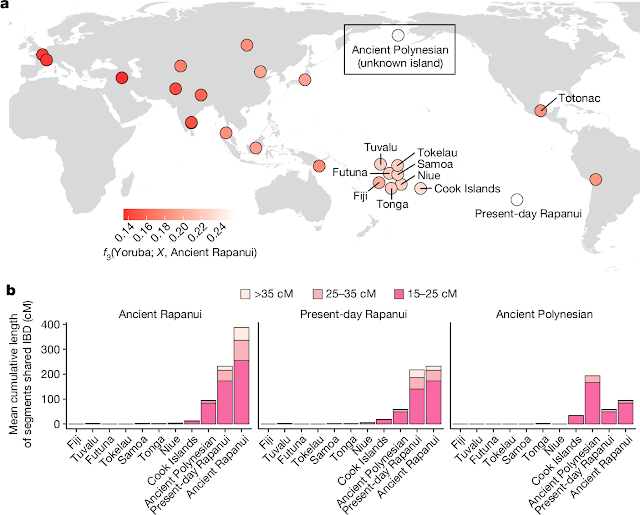
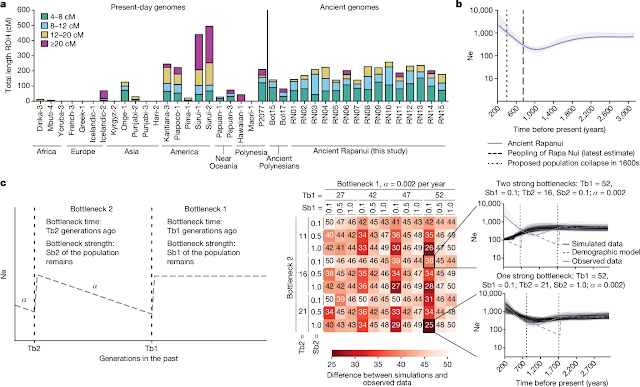
A new study raises serious doubts about this narrative. After analyzing the remains of 15 ancient islanders, researchers found no evidence of the drop in genetic diversity one would expect after a population collapse. In fact, the genomes suggest Easter Island’s population grew steadily until European contact. According to archaeogeneticists Stephan Schiffels and Kathrin Nägele, “the study concludes that there were never more than 3,000 people living on Rapa Nui — a number close to that observed by the first colonizers and far from a previous estimate of 15,000 inhabitants — implying that the hypothesized collapse was always a fantasy.” ..."

From the abstract:
"Rapa Nui (also known as Easter Island) is one of the most isolated inhabited places in the world. It has captured the imagination of many owing to its archaeological record, which includes iconic megalithic statues called moai. Two prominent contentions have arisen from the extensive study of Rapa Nui.
First, the history of the Rapanui has been presented as a warning tale of resource overexploitation that would have culminated in a major population collapse—the ‘ecocide’ theory.
Second, the possibility of trans-Pacific voyages to the Americas pre-dating European contact is still debated.
Here, to address these questions, we reconstructed the genomic history of the Rapanui on the basis of 15 ancient Rapanui individuals that we radiocarbon dated (1670–1950 ce) and whole-genome sequenced (0.4–25.6×). We find that these individuals are Polynesian in origin and most closely related to present-day Rapanui, a finding that will contribute to repatriation efforts. Through effective population size reconstructions and extensive population genetics simulations, we reject a scenario involving a severe population bottleneck during the 1600s, as proposed by the ecocide theory. Furthermore, the ancient and present-day Rapanui carry similar proportions of Native American admixture (about 10%). Using a Bayesian approach integrating genetic and radiocarbon dates, we estimate that this admixture event occurred about 1250–1430 ce."

Ancient Rapanui genomes reveal resilience and pre-European contact with the Americas (open access)


Fig. 1: Shared drift and identity by descent between Ancient Rapanui and present-day populations.


Fig. 2: ROH and Rapanui population size estimates through time.


Wednesday, May 22, 2024

LSST Camera arrives at Rubin Observatory in Chile

Good news! Let the astronomical/magical picture show begin!

"The 3200-megapixel LSST Camera, the groundbreaking instrument at the core of the NSF-DOE Vera C. Rubin Observatory, has arrived at the observatory site on Cerro Pachón in Chile.

When Rubin begins the Legacy Survey of Space and Time in late 2025, the LSST Camera will take detailed images of the southern hemisphere sky for 10 years, building the most comprehensive timelapse view of our universe we’ve ever seen. ..."

LSST Camera arrives at Rubin Observatory in Chile | symmetry magazine

The largest camera ever built for astrophysics has completed the long journey from SLAC National Accelerator Laboratory in California to the summit of Cerro Pachón in Chile.


Friday, April 26, 2024

Chile: 19,000-year-old biosphere with links to Mars discovered beneath desert floor

Amazing stuff!

"...
Gene sequencing revealed an abundance of diverse microbial communities across the different layers.

Most of the sequences were assigned to bacteria; 0.5% were archaea, single-celled microorganisms similar in structure to bacteria but evolutionarily distinct. Archaea are thought to constitute an ancient group between bacteria and eukaryotes or organisms whose DNA-containing cells contain a distinct nucleus. Three bacterial groups (phyla) dominated, accounting for over 90% of genetic sequences: Actinobacteria, Firmicutes, and Proteobacteria. ...
Ecologically speaking, the playa deposits are relatively young; sedimentation started about 19,000 years ago. However, the alluvial deposits are much older, with depths of 4.2 m dating back up to 3.8 million years. ..."

"Summary For a long time, the extremely dry soils of the Chilean Atacama Desert were considered completely lifeless. In one of its driest regions, a team of scientists ... from the GFZ German Research Centre for Geosciences, together with colleagues from the TU Berlin and the University of Antofagasta, Chile, has now uncovered a previously unexplored underground habitat. This was based on newly developed methods of molecular DNA analysis, which allow the focussed extraction and analysis of intracellular DNA. This comes from intact cells of living or dormant organisms, making it possible to detect viable and potentially active microbial communities which inhabit hyperarid soils down to a depth of 4.20 metres. The study, published in the journal PNAS Nexus, thus expands our understanding of biodiversity of a region where extreme conditions of drought, salinity and nutrient deficiency are close to the limits of life. The results also have implications for the search for life on other planets."

From the abstract:
"Desert environments constitute one of the largest and yet most fragile ecosystems on Earth. Under the absence of regular precipitation, microorganisms are the main ecological component mediating nutrient fluxes by using soil components, like minerals and salts, and atmospheric gases as a source for energy and water. While most of the previous studies on microbial ecology of desert environments have focused on surface environments, little is known about microbial life in deeper sediment layers. Our study is extending the limited knowledge about microbial communities within the deeper subsurface of the hyperarid core of the Atacama Desert. By employing intracellular DNA extraction and subsequent 16S rRNA sequencing of samples collected from a soil pit in the Yungay region of the Atacama Desert, we unveiled a potentially viable microbial subsurface community residing at depths down to 4.20 m. In the upper 80 cm of the playa sediments, microbial communities were dominated by Firmicutes taxa showing a depth-related decrease in biomass correlating with increasing amounts of soluble salts. High salt concentrations are possibly causing microbial colonization to cease in the lower part of the playa sediments between 80 and 200 cm depth. In the underlying alluvial fan deposits, microbial communities reemerge, possibly due to gypsum providing an alternative water source. The discovery of this deeper subsurface community is reshaping our understanding of desert soils, emphasizing the need to consider subsurface environments in future explorations of arid ecosystems."

19,000-year-old biosphere with links to Mars discovered beneath desert Abundant, diverse bacterial communities have been found deep beneath the almost uninhabitable surface of the Atacama Desert in Chile. The researchers who discovered them say they're likely 19,000 years old and could be linked to microbial life on Mars.

Newly discovered microbial communities beneath the Atacama Desert (original news release)


Persistent microbial communities in hyperarid subsurface habitats of the Atacama Desert: Insights from intracellular DNA analysis (open access)

Abundant, diverse microbial communities live deep under the surface of the hyper-arid Atacama Desert


The microbial composition of different subsurface depths


Thursday, April 04, 2024

SLAC completes construction of the largest digital camera ever built for astronomy

Good news for star gazers! 😊

"... “With the completion of the unique LSST Camera at SLAC and its imminent integration with the rest of Rubin Observatory systems in Chile, we will soon start producing the greatest movie of all time and the most informative map of the night sky ever assembled,” says Director of Rubin Observatory Construction and University of Washington professor Željko Ivezić. ...
To achieve that goal, the SLAC team and its partners built the largest digital camera ever constructed for astronomy. The camera is roughly the size of a small car and weighs around 3,000 kilograms (3 metric tons), and its front lens is over 5 feet across—the largest lens ever made for this purpose. Another 3-foot-wide lens had to be specially designed to maintain shape and optical clarity while also sealing the vacuum chamber that houses the camera's enormous focal plane. That focal plane is made up of 201 individual custom-designed CCD sensors, and it is so flat that it varies by no more than a tenth the width of a human hair. The pixels themselves are only 10 microns wide. ..."

SLAC completes construction of the largest digital camera ever built for astronomy | symmetry magazine Once set in place atop a telescope in Chile, the 3,200-megapixel LSST Camera will help researchers better understand dark matter, dark energy and other mysteries of our universe.

Engineering the world’s largest digital camera Building the Large Synoptic Survey Telescope also means solving extraordinary technological challenges.


Saturday, February 03, 2024

nuam: New Latin America Market multi-country stock exchange merger together with NASDAQ Aims to Increase International Investment

Good news! Will Argentina join next? This is not exactly news anymore, but nevertheless this could be a game changer.

"nuam exchange. a consolidation of markets in Colombia, Peru and Chile, has formed a technology partnership with Nasdaq to provide a single market across asset classes that will improve access to the region for international investors. ...
He explained that there is a lot of similarity and complementarity between Chile, Colombia and Peru beyond just their markets. They have been engaging in free trade agreements for many years and there has been a lot of cross-investment between corporations in the three countries. ...
Discussions to investigate ways of combining the three markets began in 2020 and the merger into one holding company was approved last year. nuam believes the merger will position the company as the second most relevant market in Latin America and in the global market infrastructure industry. ..."

"The first-ever multi-country merger of stock exchanges is coming to Latin America, and Nasdaq is providing the robust financial infrastructure technology to underpin the market."

New LatAm Market Aims to Increase International Investment - Markets Media


Friday, December 08, 2023