Recommendable!
Showing posts with label Albert Einstein. Show all posts
Showing posts with label Albert Einstein. Show all posts
Tuesday, September 01, 2026

Monday, April 13, 2026
A Macroscopic Magnet Precesses while in gyroscopic motion
Amazing stuff! Among others, Albert Einstein worked on this subject (see references).
"In 1861, physicist James Clerk Maxwell proposed that a magnet behaves to some extent like a spinning gyroscope, but his experiments never managed to demonstrate the effect. Since then, researchers have observed various manifestations of so-called gyromagnetism, mostly in specialized magnetic materials or with spinning magnets,
but now a research team has detected signatures of gyroscopic motion corresponding to Maxwell’s original ideas. The team used a microscopic magnetic sphere in a technique that, with improvements, could be employed for ultrasensitive magnetic-field detection, which could be useful for research on biological magnetism.
If you try to tilt a gyroscope spinning around a vertical axis, it will respond by tilting at 90° from the push direction, an effect that leads to precession in response to gravity—such as the slow loop executed by the axis of a spinning top.
An electron in a magnetic field behaves like a gyroscope in a gravitational field because the electron has a magnetic moment, which is associated with intrinsic angular momentum, or spin.
So you might expect that a material whose microscopic spins align—such as an ordinary ferromagnet—would have a macroscopic angular momentum and behave like a gyroscope. ...
Armed with much smaller magnets—spheres 40–60 µm in diameter ... They levitated a magnet by placing it inside a 2.5-mm-diameter hole bored into a piece of lead chilled below its superconducting transition temperature. Superconductors expel magnetic fields, so they can form stable magnetic traps. In this experiment, at equilibrium, the magnet’s magnetic moment aligns with a small, nearly horizontal field present in the trap. Following an excitation by the field, the magnet oscillates around its aligned equilibrium orientation for some 20 seconds.
The magnet’s motion can be excited into either of two perpendicular oscillations, horizontal and vertical, with distinct frequencies. But the magnet’s intrinsic angular momentum should generate precession that turns the two oscillations’ otherwise linear trajectories into narrow ellipses.
To detect these subtle motions, ... placed two extremely sensitive magnetometers above the levitated magnet, each sensitive to one of the two oscillation modes. By analyzing the two signals, the team determined the tiny amount of intrinsic angular momentum associated with the sphere’s magnetic moment. They also determined the sphere’s g factor, a number proportional to the ratio of a particle’s magnetic moment to its intrinsic angular momentum. The values determined for several spheres were within about 10% of the team’s estimates based on a simple theory accounting for the magnets’ sizes and composition. ...
that previous work has found similar effects in the oscillation of optically levitated nanoparticles driven either by an external force or by thermal noise. But demonstrating gyromagnetism that arises from the total internal spin of a particle “has eluded researchers for a very long time,” ..."
From the abstract:
"A nonspinning permanent ferromagnet is predicted to behave as a gyroscope at sufficiently low frequencies, which can be seen as a manifestation of gyromagnetism.
This yet unexplored regime, conjectured for the first time by Maxwell [A Treatise on Electricity and Magnetism (... 1873).], has recently been proposed for ultrasensitive magnetometry and for atomic like quantum stabilization of a levitated nanomagnet in a static field.
Here, we observe signatures of gyroscopic effects in the rotational dynamics of a nonspinning permanent ferromagnet levitated in a superconducting trap. Specifically, we detect spin-rotation coupling between different librational modes, leading to elliptical trajectories, in good agreement with theoretical predictions. From our measurements, we can infer both the intrinsic angular momentum of the levitated magnet and its gyromagnetic 𝑔"
Observation of Gyroscopic Coupling in a Nonspinning Levitated Ferromagnet (open access)

Spin around. The magnetic moment (orange arrow) of a levitated magnetic microsphere (black) executes elliptical motion (green and blue loops) in the presence of a magnetic field (not shown). In the absence of the gyromagnetic effects that arise from the magnet’s intrinsic angular momentum, the motions would be linear.
Sunday, February 16, 2025
Astronomers find exceptionally rare, strong and complete Einstein ring just a “cosmic stone’s throw” away from Earth
Amazing stuff!
"A serendipitous image taken by the European Space Agency’s Euclid telescope allowed astronomers to spot a stunning new example of an Einstein ring.
This extremely rare phenomenon occurs when a large space object acts like a lens and magnifies light from another object directly behind it. This was first predicted by Einstein’s general theory of relativity, which describes how the gravity of large objects, like galaxies, warp the spacetime fabric and alter the path of light. ...
The galaxy acting as a gravitational lens is called NCG 6505 and it lies 590 million light-years away from Earth, ‘a cosmic stone’s throw away,’ ... However, the light of the object it is magnifying lies more than 4.4 billion light-years away. This object has never been observed before and does not yet have a name. ..."
"... If the alignment is just right, the light from the distant source galaxy bends to form a spectacular ring around the foreground object. These Einstein rings are a rich laboratory for scientists. Studying their gravitational effects can help us learn about the expansion of the Universe, detect the effects of invisible dark matter and dark energy, and investigate the background source whose light is bent by dark matter in between us and the source. ...
By exploring how the Universe has expanded and formed over its cosmic history, Euclid will reveal more about the role of gravity and the nature of dark energy and dark matter. The space telescope will map more than a third of the sky, observing billions of galaxies out to 10 billion light-years. It is expected to find around 100 000 strong lenses, but to find one that’s so spectacular – and so close to home – is astonishing. Until now, less than 1000 strong lenses were known, and even fewer were imaged at high resolution. ..."
From the abstract:
"We report the discovery of a complete Einstein ring around the elliptical galaxy NGC 6505, at z = 0.042. This is the first strong gravitational lens discovered in Euclid and the first in an NGC object from any survey. The combination of the low redshift of the lens galaxy, the brightness of the source galaxy (IE = 18.1 lensed, IE = 21.3 unlensed), and the completeness of the ring make this an exceptionally rare strong lens, unidentified until its observation by Euclid.
We present deep imaging data of the lens from the Euclid Visible Camera (VIS) and Near-Infrared Spectrometer and Photometer (NISP) instruments, as well as resolved spectroscopy from the Keck Cosmic Web Imager (KCWI).
The Euclid imaging in particular presents one of the highest signal-to-noise ratio optical/near-infrared observations of a strong gravitational lens to date. From the KCWI data we measure a source redshift of z = 0.406.
Using data from the Dark Energy Spectroscopic Instrument (DESI) we measure a velocity dispersion for the lens galaxy of σ⋆ = 303 ± 15 km s−1. We model the lens galaxy light in detail, revealing angular structure that varies inside the Einstein ring. After subtracting this light model from the VIS observation, we model the strongly lensed images, finding an Einstein radius of 2.″5, corresponding to 2.1 kpc at the redshift of the lens. This is small compared to the effective radius of the galaxy, Reff ∼ 12.″3. Combining the strong lensing measurements with analysis of the spectroscopic data we estimate a dark matter fraction inside the Einstein radius of fDM = (11.1−3.5+5.4)% and a stellar initial mass-function (IMF) mismatch parameter of αIMF = 1.26−0.08+0.05, indicating a heavier-than-Chabrier IMF in the centre of the galaxy."
Euclid discovers a stunning Einstein ring (original news release)
Euclid: A complete Einstein ring in NGC 6505⋆ (open access)
Euclid image of a bright Einstein ring around galaxy NGC 6505

Close-up of the Einstein ring around galaxy NGC 6505


Thursday, November 21, 2024
Thursday, September 05, 2024
Einstein Papers Project's Newest Volume: Einstein Wrestles with Politics and Physics, 1929–1930
Recommendable!
At this pace, the Einstein Papers project will not be finished before the year 2100.
"The Collected Papers of Albert Einstein provides a rare opportunity for readers to move through Einstein's life at a leisurely pace, perusing all his writings, from his informal correspondence to his most carefully argued scientific theories. Volume 17, which covers the period from June 1929 to November 1930, was published by Princeton University Press on September 3, 2024.
Since 1987 the Einstein Papers Project, based at Caltech, has been releasing a volume of Einstein's correspondence and papers approximately every three years. Each volume documents, translates, and in many cases recovers previously lost writings, acting as a snapshot not only of Einstein's life at the time, but of all the scientific and political discussions swirling around him. ...
Volume 17 finds Einstein living mainly in Berlin, though traveling throughout Europe to attend conferences and receive honorary degrees. ...
this was "a watershed event for him, a time when he yet again seriously considered either leaving academia altogether—as he had done in the 1920s during vicious attacks in Germany against his person and his theory of relativity—or emigrating, as he would eventually do in 1933." ...
He continued his passionate work promoting pacifism and speaking out on behalf of Europe's Jewish population. Amidst all this, Einstein acquired a sailboat in early June 1929 and continued to listen to and perform music.
Volume 17 includes nine published scientific papers as well as unpublished papers and calculations Einstein developed in search of a unified field theory. "One nice discovery," Kormos-Buchwald says, "was a notebook containing ideas and elaborations of the teleparallel theory ...
Einstein was using an specialized form of geometry, telleparallelism, to try to bring together electromagnetism and gravitation in a single unified field theory. ... "Eventually Einstein's 'Unified Field Theory Based on a Riemannian Metric and Distant Parallelism' became his most comprehensive and self-contained exposition on the teleparallel approach, which he later abandoned," ...
the most challenging documents in the volume were related to Einstein's pacifist activism after the outbreak of violence in British-ruled Palestine in 1929. ...the eruption of intercommunal violence between Palestinian Arabs and Jews in that period was unfortunately only a portent of the decades of intense bloodshed that has occurred in the region hence and is still ongoing ...
"Einstein also continued to persevere in one of his earliest political involvements: his efforts to promote peace and international cooperation that had started a decade earlier,"... "He encouraged disarmament, conscientious objection, and apolitical pacifism. ... Only a few years later, Einstein abandoned unconditional pacifism, regarding Germany's threat to the world as too great. ..."

Thursday, June 20, 2024
Comments on: Open-Endedness is Essential for Artificial Superhuman Intelligence
Food for thought! The machine that reinvents itself, evolves and progresses.
I have little doubt that humanity is about to develop a form of artificial intelligence that goes even far beyond that of Albert Einstein and other exceptionally intelligent individuals of the past.
Natural evolution and the unfortunate situation that only a very few human individuals are endowed with superhuman intelligence are a severe constraint. And even Albert Einstein's intelligence was obviously limited, e.g. some of his views were very simplistic and naive (e.g. about socialism). I blogged here about it.
Caveat: I have not yet read this paper
From the abstract:
"In recent years there has been a tremendous surge in the general capabilities of AI systems, mainly fueled by training foundation models on internetscale data. Nevertheless, the creation of open ended, ever self-improving AI remains elusive. In this position paper, we argue that the ingredients are now in place to achieve openendedness in AI systems with respect to a human observer. Furthermore, we claim that such open-endedness is an essential property of any artificial superhuman intelligence (ASI). We begin by providing a concrete formal definition of open-endedness through the lens of novelty and learnability. We then illustrate a path towards ASI via open-ended systems built on top of foundation models, capable of making novel, human relevant discoveries. We conclude by examining the safety implications of generally-capable openended AI. We expect that open-ended foundation models will prove to be an increasingly fertile and safety-critical area of research in the near future."
Credits: The Gradient newsletter
Friday, May 31, 2024
Does Alone Time Make you Lonely? Here’s why it May be Good for you with Palki Sharma
Recommendable! Choosing occasional solitude can be a blessing! E.g. where did Albert Einstein find some of his inspirations?
Saturday, July 22, 2023
J. Robert Oppenheimer’s Defense of Humanity
I would say nobody ever wants to walk in the shoes of J. Robert Oppenheimer!
I don't know how many biographies, articles etc. were written about this man.
Just learnt (or refreshed my memory) that his 1927 PhD was from the University of Göttingen, Germany. At the time, Max Born led the theoretical physics group at this university. Unfortunately, this premier German university has little to offer on one of its most famous students (when using the university's own search engine). Disappointing!
His father grew up in Hanau, Germany, where my paternal grandparents lived for many years.
"From the moment the atomic bomb was dropped on Hiroshima in August 1945 until his death in 1967, J. Robert Oppenheimer was perhaps the most recognizable physicist on the planet. During World War II, Oppenheimer directed Los Alamos Laboratory, “Site Y” of the Manhattan Project, the successful American effort to build an atomic bomb. He went on to serve for almost 20 years as director of the Institute for Advanced Study in Princeton, N.J., home to some of the world’s leading scientists, including Albert Einstein. ..."

Sunday, June 11, 2023
Albert Einstein Explains Theory of Relativity | Albert Einstein Real Video | Colour Footage
What a gem! Einstein in his own words!
Friday, January 13, 2023
What was Albert Einstein's IQ?
This question has been asked at least a thousand and more times!
No matter how smart Einstein was regarding physics and math, he was also a naive and stupid socialist!
Thursday, September 23, 2021
Einstein's miracle year 1905
Recommendable, but 5 minutes is too short to do justice to the phenomenal scientific achievements by Albert Einstein in 1905 in four different seminal papers while he was still working at the Swiss patent office.
Friday, July 30, 2021
The Einstein Papers: Albert Einstein at 50
Recommendable! Incredible, this genius is dead since 1955, but his lifetime oeuvre has still not been published.
"The Einstein Papers Project at Caltech has released the 16th volume of its massive scholarly collection of Albert Einstein's scientific and nonscientific writings and correspondence. The volume covers the period from June 1927 to May 1929 and contains 1,600 letters by and to Einstein, many more than contained in previous volumes. This is due in part to the fact that Einstein turned 50 on March 14, 1929 and received a flood of congratulatory wishes. Some of the documents in the new volume pertain to a birthday present Einstein cherished the most: a single-cabin sailboat, named Tümmler, which means porpoise in German. ..."

Wednesday, April 01, 2020
Einstein’s letters illuminate a mind grappling with quantum mechanics
Recommendable, but we do not learn e.g. anything about Einstein's political views. I have blogged here about that Einstein was a foolish and naive socialist and here about his arrogant, misanthropic views about religion.
However,towards the end of the article, the article suggests that Einstein treated women miserably (ah, misogyny is so fashionable and politically correct): "That legend is not without tarnish though, as his letters occasionally reveal indications of misogyny. Most disconcerting to Einstein fans would be a letter from October 1925, in which Einstein berates his ex-wife, Mileva, for threatening to embarrass him with her memoirs. “Does it not enter your mind at all that no one would care one bit about such scribblings if the man that they were about had not, coincidentally, accomplished something special? If someone is a nobody, there is nothing to object to, but one should be truly modest and keep one’s trap shut. This is my advice to you.” Einstein then contends his remarks showed how good he was being to her — otherwise he would not be dispensing such sound advice. “Not only children need a smack now and again, but so do adults, and most especially women.”"
"This month Princeton released the latest volume of Einstein’s papers, covering the period May 1925–June 1927, while Einstein was at the University of Berlin."
Einstein’s letters illuminate a mind grappling with quantum mechanics | Science News: The latest volume of Einstein’s papers covers the infancy of quantum mechanics and new challenges to the theory of relativity.
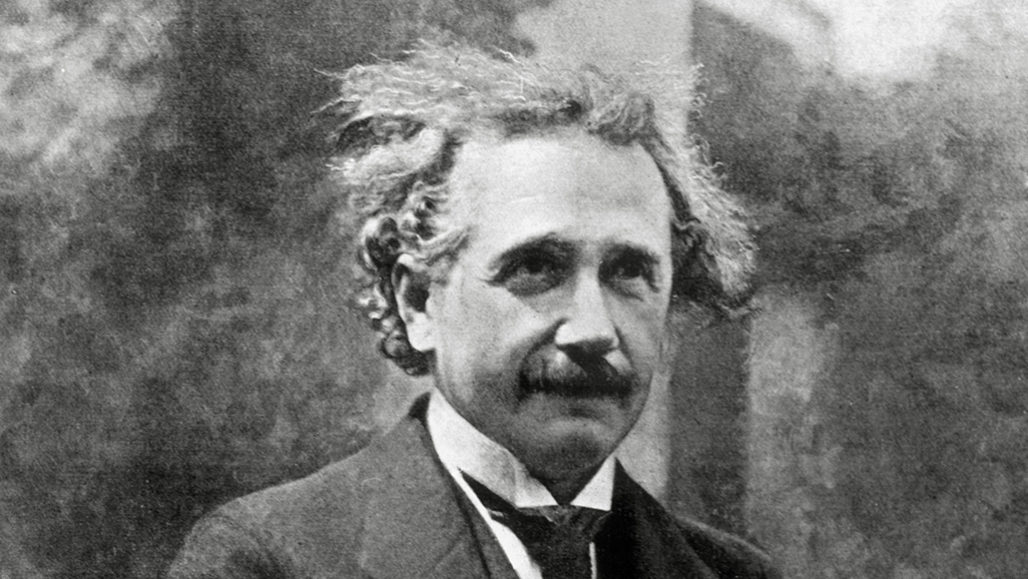
However,towards the end of the article, the article suggests that Einstein treated women miserably (ah, misogyny is so fashionable and politically correct): "That legend is not without tarnish though, as his letters occasionally reveal indications of misogyny. Most disconcerting to Einstein fans would be a letter from October 1925, in which Einstein berates his ex-wife, Mileva, for threatening to embarrass him with her memoirs. “Does it not enter your mind at all that no one would care one bit about such scribblings if the man that they were about had not, coincidentally, accomplished something special? If someone is a nobody, there is nothing to object to, but one should be truly modest and keep one’s trap shut. This is my advice to you.” Einstein then contends his remarks showed how good he was being to her — otherwise he would not be dispensing such sound advice. “Not only children need a smack now and again, but so do adults, and most especially women.”"
"This month Princeton released the latest volume of Einstein’s papers, covering the period May 1925–June 1927, while Einstein was at the University of Berlin."
Einstein’s letters illuminate a mind grappling with quantum mechanics | Science News: The latest volume of Einstein’s papers covers the infancy of quantum mechanics and new challenges to the theory of relativity.
Saturday, December 08, 2018
On Albert Einstein's God Letter
Posted: 12/8/2018
Preamble
I have previously blogged that Albert Einstein was a stupid socialist.
Briefly About The Letter
Written by Einstein at the age of 74 in 1954 (one year before his death) to Eric Gutkind after reading his book, Choose Life: The Biblical Call to Revolt. In early December 2018, this letter was sold at auction for $2.9 million.
Unfortunately, I do not remember ever having read this short letter before.
Was Einstein A Misanthrope?
In this short 1.5 page letter, Einstein writes (emphasis & commentary added):
Einstein Is Highly Overrated
The more I read about Einstein’s life outside of physics, I begin to sense that his nimbus and his popularity is highly overrated. Outside of physics, Einstein was certainly not such a genius!
Sources:
http://www.hillmanweb.com/reason/inspiration/einstein.html
Albert Einstein's 'God letter' sells for $2.9m
Preamble
I have previously blogged that Albert Einstein was a stupid socialist.
Briefly About The Letter
Written by Einstein at the age of 74 in 1954 (one year before his death) to Eric Gutkind after reading his book, Choose Life: The Biblical Call to Revolt. In early December 2018, this letter was sold at auction for $2.9 million.
Unfortunately, I do not remember ever having read this short letter before.
Was Einstein A Misanthrope?
In this short 1.5 page letter, Einstein writes (emphasis & commentary added):
- “... The word God is for me nothing more than the expression and product of human weakness ...”
- [So much arrogance and ignorance coming from Einstein! God is much more than a word! Believing in something like God is a strength of human beings not a weakness by any stretch of imagination. Was Einstein a misanthrope?]
- “... the Bible a collection of honorable, but still purely primitive, legends which are nevertheless pretty childish ...”
- [So much arrogance and ignorance coming from Einstein! The Bible contains some of the greatest stories about humanity ever written. There are too many to mention here and I am not a Bible expert, but the just the story of David & Goliath or Jesus wrote cast the first stone if you are innocent and so many more. Was Einstein a misanthrope?]
- “... No interpretation no matter how subtle can (for me) change this ...”
[Einstein is here referring to the other above quotes. So disappointing that Einstein was such a dumb man. Einstein had a huge attitude problem!] - “... For me the Jewish religion like all other religions is an incarnation of the most childish superstition ...”
[How infantile was Einstein at the end of his life? Were these expressions of severe senility or did he harbor such opinions most of his life?] - “... And the Jewish people to whom I gladly belong ... although they are protected from the worst cancers by a lack of power. Otherwise I cannot see anything “chosen” about them. ...”
[Again Einstein’s arrogance and ignorance is incredible. The Jewish people have e.g. contributed so much to civilization over thousands of years that Einstein’s contributions to physics are almost negligible in comparison.
Einstein Is Highly Overrated
The more I read about Einstein’s life outside of physics, I begin to sense that his nimbus and his popularity is highly overrated. Outside of physics, Einstein was certainly not such a genius!
Sources:
http://www.hillmanweb.com/reason/inspiration/einstein.html
Albert Einstein's 'God letter' sells for $2.9m
Monday, September 07, 2015
History Of E = MC2
Posted:
Trigger
Relevant quotes from above article (emphasis added):
- “In 1881 J. J. Thomson, later a discoverer of the electron, made the first attempt to demonstrate how this might come about by explicitly calculating the magnetic field generated by a moving charged sphere and showing that the field in turn induced a mass into the sphere itself. ”
- “... but in 1889 English physicist Oliver Heaviside simplified his work to show that the effective mass should be m = (4⁄3) E / c2, where E is the energy of the sphere’s electric field. German physicists Wilhelm Wien, famous for his investigations into blackbody radiation, and Max Abraham got the same result, which became known as the “electromagnetic mass” of the classical electron (which was nothing more than a tiny, charged sphere). Although electromagnetic mass required that the object be charged and moving, and so clearly does not apply to all matter, it was nonetheless the first serious attempt to connect mass with energy.”
- “When Englishman John Henry Poynting announced in 1884 a celebrated theorem on the conservation of energy for the electromagnetic field, other scientists quickly attempted to extend conservation laws to mass plus energy. Indeed, in 1900 the ubiquitous Henri Poincaré stated that if one required that the momentum of any particles present in an electromagnetic field plus the momentum of the field itself be conserved together, then Poynting’s theorem predicted that the field acts as a “fictitious fluid” with mass such that E = mc2. Poincaré, however, failed to connect E with the mass of any real body.”
- “The scope of investigations widened again in 1904 when Fritz Hasenöhrl created a thought experiment involving heat energy in a moving cavity. ... Then one of Austria’s leading physicists, he wrote a prize-winning trilogy of papers, “On the theory of radiation in moving bodies,” the last two of which appeared in the Annalen der Physik in 1904 and early 1905. ... A simple application of the “work–energy theorem,” which equates the difference in work produced by the forces to the cavity’s kinetic energy, allowed Hasenöhrl to conclude that blackbody radiation has mass m = (8⁄3) E / c2. In his second paper Hasenöhrl considered a slowly accelerating cavity already filled with radiation and got the same answer. After a communication from Abraham, however, he uncovered an algebraic error and in his third paper corrected both results to m = (4⁄3) E / c2. ”
- “One naturally wonders whether Einstein knew of Hasenöhrl’s work. It is difficult to believe that he did not, given that the bulk of the prize-winning trilogy appeared in the most prominent journal of the day.”
Takeaway
Like so many times before and after, an invention or discovery is not the work of a single human being.
As I have argued before on this blog, intellectual property rights urgently need to be reformed or even abolished. As a minimum, the duration of intellectual property rights should be dramatically shortened. Just because someone was the first or fastest to patent something is not justification enough.
Sunday, April 19, 2015
The Women Involved In E = MC2
Posted: 4/19/2015
Trigger
Just watched “Einstein's Big Idea The story behind the world's most famous equation, E = mc2”. Either this is a politically correct docudrama by PBS Nova or indeed women made significant contributions to the world’s most famous equation. I tend to agree with latter. This docudrama appears to be released first by Arte TV (see here).
Of course, there was the wife of Einstein, Mileva Maric, who is portrayed here as a trusted advisor to Einstein, but giving up her own academic career. I believe, much has been written about her role in Einstein’s career, however, it appears, she never published any scientific papers of her own for which Albert Einstein probably cannot be blamed.
Émilie du Châtelet
I have to admit, I probably never heard of this lady before or forgot about her. Emilie is presented here as having promoted a rather similar formula 250 years before Einstein.
This woman is special. Her father encouraged her curiosity in science and math. She had a close friendship with Voltaire. She defended a precursor of the above equation against Voltaire and Newton. She learnt about this precursor equation from Leibniz and Willem 's Gravesande. She helped to refute the since then obsolete scientific theory of Vis viva.
Reading the Wikipedia article on Emilie du Chatelet you also encounter another extraordinary German-Jewish female mathematician named Emmy Noether
Lise Meitner
A Austrian-Jewish scientist who made a major contribution to explain Otto Hahn’s experiment’s as nuclear fission and that Einstein’s equation can be applied here. The above docudrama shows how several prominent male scientists, such as Max Planck, helped to advance her scientific career.
Once you research the discovery of nuclear fission, you will come across the name of Ida Noddack, who already in 1934 pointed to nuclear fission as an explanation for Enrico Fermi’s experiments.
And with whom was Lise Meitner, Otto Hahn, and Fritz Strassmann or Rutherford and Enrico Fermi competing? With Irène Joliot-Curie, the daughter of Marie Curie.
Where Are We Going With This?
E.g. feminism is an ideology and a fiction! Intelligent women were never as oppressed by males as feminists have make us believe for now over a century or so.
Wednesday, October 01, 2014
Multiverse Questions!
Posted: 10/1/2014 Updated: 11/8/2014
Accepting The Multiverse
If we assume for arguments sake that the universe is not alone and that there are other verses out there parallel to our universe. Are there infinite verses or finite verses? I am inclined to believe in a multiverse.
Is our universe just one of many other verses, like our galaxy Milky Way is only one of many galaxies in our universe?
God In A Multiverse
Forget about any anthropomorphic aspects of God. As I wrote here before, God is probably more about multiversal principals like perhaps the Golden Rule for living beings on this planet than anything else.
God may also be an optimist, how else would you explain love, freedom, self-improvement, or happiness of living beings on this planet.
In a multiverse, God probably cannot be omnipresent, omniscient, or omnipotent or even interfere with human fate on a daily basis. God is probably no central planner and no micromanager.
Human Consciousness
Probably, never really understood by any human in history! Most humans would probably agree that consciousness exists. Probably, even atheists have a consciousness. I am not so sure about lefties, communists, authoritarians, socialists and others of this ilk.
Is it possible that the consciousness of living beings is an expression emanating from another verse? This would suggest that the multiverse permeates our universe in some form or way.
Immortality Of The Soul
We have known for thousands of years that many humans strongly believe in something after death. For at least several decades, we have known of increased research into near death experiences (NDE) or out of body experience, but according to Wikipedia Plato already mentions a soldier appearing to tell about his NDE, the Myth of Er.
Once multiversality is established, why should humans or animals or even plants not live on after death in some form or the other perhaps transcending from this universe to another verse.
Rethinking E = EMC2
Einstein’s most famous and most popular formula is in question. In a multiverse, matter may not matter any more (excuse my pun). Other verses may have different forms of matter or no matter at all.
Have you ever wondered:
- Why time goes only forward in our universe?
- Why there is an absolute temperature minimum such as 0 Kelvin in our universe?
- Why there is a speed limit of light in our universe?
- And so on …
Don’t these limits appear to be arbitrary in some way?
Thus, I would propose an equation like E = P. P stands for some principles not yet know to humans. It appears energy may be the only concept that may be observable in other verses.
Dark Matter & Energy
This was only discovered very recently. We humans still do not have a good understanding of it. Perhaps, these related to other verses.
Subatomic Particles
As I have blogged here previously, the subatomic particle zoo and the theories proffered by our physicists are not getting better or any closer to explaining these particles.
As I said above, perhaps matter does not really matter and there are some other principles at work here that still await to be discovered, perhaps by another human like Albert Einstein.
Saturday, August 02, 2014
Albert Einstein Was A Stupid Socialist
Posted: 8/2/2014
Trigger
Recently, for the first time in my life, I stumbled upon his essay “Why Socialism?”. Albert Einstein wrote this essay for the first issue of the socialist journal Monthly Review in May 1949.
In my teenage days I read with great admiration biographies etc. about Albert Einstein as, I believe, have done many of my contemporaries. I kind of was aware and familiar that Albert Einstein wrote non-scientific essays on topics like religion and so on, but I was totally unaware of this essay.
I don’t think it is widely known that he wrote such an essay! I suspect, it might even be hidden intentionally so as not to tarnish his reputation or make people think twice.
Ramifications
Well, if one of the humans thought to be one of the greatest and most prominent and most popular geniuses of the 20th century affirms that the future of humankind is a socialist society, then socialism received a huge, but undeserved boost.
Salient Excerpts From The Essay
The following list of quotes is in sequential order of appearance in the essay (emphasis and commentary added):
- “Is it advisable for one who is not an expert on economic and social issues to express views on the subject of socialism? I believe for a number of reasons that it is.”
[Very clever Albert!] - “They [The conquering peoples] seized for themselves a monopoly of the land ownership and appointed a priesthood from among their own ranks. The priests, in control of education, made the class division of society into a permanent institution and created a system of values by which the people were thenceforth, to a large extent unconsciously, guided in their social behavior.”
[Albert is espousing here socialist doctrines.] - “Since the real purpose of socialism is precisely to overcome and advance beyond the predatory phase of human development, economic science in its present state can throw little light on the socialist society of the future.”
[Albert, you did not read Friedrich Hayek or Ludwig von Mises? What a disappointment! You are definitely not an expert in economics! So are you qualified to talk about socialism?] - “Second, socialism is directed towards a social-ethical end. But the ends themselves are conceived by personalities with lofty ethical ideals and … are adopted and carried forward by those many human beings who, half unconsciously, determine the slow evolution of society.”
[Capitalism or free markets or laissez faire is not directed towards a social-ethical end? Common, Albert!
So the majority of humans behave or act “half-unconsciously” merely carrying out the ends conceived by “personalities” according to Albert Einstein? Wow, is this a lofty or elitist opinion of humans by Albert?] - “... let me record here a personal experience. I recently discussed with an intelligent and well-disposed man the threat of another war, which in my opinion would seriously endanger the existence of mankind, and I remarked that only a supranational organization would offer protection from that danger. ”
[Yes, in 1949 and as one of the promoters of the atomic bomb, Albert had every reasons to be afraid of another, major war possibly wiping out humankind. However, it was not the U.N., but the U.S. and NATO that prevented any such war and overall made this planet safer despite Stalin and Mao.] - “Man is, at one and the same time, a solitary being and a social being. ... But the personality that finally emerges is largely formed by the environment in which a man happens to find himself during his development, by the structure of the society in which he grows up, by the tradition of that society, and by its appraisal of particular types of behavior. The abstract concept “society” means to the individual human being the sum total of his direct and indirect relations to his contemporaries and to all the people of earlier generations. ... It is “society” which provides man with food, clothing, a home, the tools of work, language, the forms of thought, and most of the content of thought; his life is made possible through the labor and the accomplishments of the many millions past and present who are all hidden behind the small word “society.””
[For the sake of brevity, I had to abridge this long paragraph quite a bit. What Albert here refers to may apply to ants and termites, but not to human individuals who are capable of thinking for themselves etc.] - “It is evident, therefore, that the dependence of the individual upon society is a fact of nature which cannot be abolished—just as in the case of ants and bees. However, while the whole life process of ants and bees is fixed down to the smallest detail by rigid, hereditary instincts, the social pattern and interrelationships of human beings are very variable and susceptible to change. ... This explains how it happens that, in a certain sense, man can influence his life through his own conduct, and that in this process conscious thinking and wanting can play a part.”
[Albert tries to qualify, but poorly! Only in a certain sense can man influence his life or that thinking can play only a part otherwise humans are like “ants and bees”.] - “... In addition, during his lifetime, he acquires a cultural constitution which he adopts from society through communication and through many other types of influences. It is this cultural constitution which, with the passage of time, is subject to change and which determines to a very large extent the relationship between the individual and society. ... It is on this that those who are striving to improve the lot of man may ground their hopes: human beings are not condemned, ... to annihilate each other or to be at the mercy of a cruel, self-inflicted fate.”
[Albert who “those”, the above mentioned “personalities”? Are not most human beings as individuals trying to avoid this? An individual does not adopt a “cultural constitution” from society, but from other individuals.] - “If we ask ourselves how the structure of society and the cultural attitude of man should be changed in order to make human life as satisfying as possible, we should constantly be conscious of the fact that there are certain conditions which we are unable to modify.”
[A typical socialist or central planner question, Albert!] - “I have now reached the point where I may indicate briefly what to me constitutes the essence of the crisis of our time. It concerns the relationship of the individual to society. The individual has become more conscious than ever of his dependence upon society. ... Moreover, his position in society is such that the egotistical drives of his make-up are constantly being accentuated, while his social drives, which are by nature weaker, progressively deteriorate. All human beings, whatever their position in society, are suffering from this process of deterioration. Unknowingly prisoners of their own egotism, they feel insecure, lonely, and deprived of the naive, simple, and unsophisticated enjoyment of life. Man can find meaning in life, short and perilous as it is, only through devoting himself to society.”
[Incredible, Albert, what an ideology he came up with!] - “The economic anarchy of capitalist society as it exists today is, in my opinion, the real source of the evil. We see before us a huge community of producers the members of which are unceasingly striving to deprive each other of the fruits of their collective labor ... consumer goods as well as additional capital goods—may legally be, and for the most part are, the private property of individuals.”
- “... I shall call “workers” all those who do not share in the ownership of the means of production ... the worker produces new goods which become the property of the capitalist. The essential point about this process is the relation between what the worker produces and what he is paid, both measured in terms of real value. Insofar as the labor contract is “free,” what the worker receives is determined not by the real value of the goods he produces, but by his minimum needs ... It is important to understand that even in theory the payment of the worker is not determined by the value of his product.”
[Albert must have intensely studied Karl Marx’s Capital. Albert Einstein obviously proves that he has not the slightest clue about free market economics like most socialists. The humans are neatly divided into static classes. For an intelligent genius like Albert Einstein that is a sorry outcome!] - “Private capital tends to become concentrated in few hands, partly because of competition among the capitalists, and partly because technological development and the increasing division of labor encourage the formation of larger units of production at the expense of smaller ones. The result of these developments is an oligarchy of private capital the enormous power of which cannot be effectively checked even by a democratically organized political society. This is true since the members of legislative bodies are selected by political parties, largely financed or otherwise influenced by private capitalists who, for all practical purposes, separate the electorate from the legislature. The consequence is that the representatives of the people do not in fact sufficiently protect the interests of the underprivileged sections of the population. Moreover, under existing conditions, private capitalists inevitably control, directly or indirectly, the main sources of information (press, radio, education). It is thus extremely difficult, and indeed in most cases quite impossible, for the individual citizen to come to objective conclusions and to make intelligent use of his political rights.”
[A summary of the wisdom of Einstein? Monopoly capitalism? The genius never realized that free market economics is very dynamic and all it takes is domestic and foreign competition to keep large corporations in check or to allow information to be spread, something citizens of a democracy can surely accomplish.] - “The situation prevailing in an economy based on the private ownership of capital is thus characterized by two main principles: first, means of production (capital) are privately owned and the owners dispose of them as they see fit; second, the labor contract is free. Of course, there is no such thing as a pure capitalist society in this sense. In particular, it should be noted that the workers, through long and bitter political struggles, have succeeded in securing a somewhat improved form of the “free labor contract” for certain categories of workers. But taken as a whole, the present day economy does not differ much from “pure” capitalism.”
[Albert Einstein must have been sleeping tightly through Progressivism and the New Deal. It is actually shocking that he appeared to know so little about labor rights development in the U.S. during the first half of the 20th century.] - “Production is carried on for profit, not for use. There is no provision that all those able and willing to work will always be in a position to find employment; an “army of unemployed” almost always exists. The worker is constantly in fear of losing his job. Since unemployed and poorly paid workers do not provide a profitable market, the production of consumers’ goods is restricted, and great hardship is the consequence. Technological progress frequently results in more unemployment rather than in an easing of the burden of work for all. The profit motive, in conjunction with competition among capitalists, is responsible for an instability in the accumulation and utilization of capital which leads to increasingly severe depressions. Unlimited competition leads to a huge waste of labor, and to that crippling of the social consciousness of individuals which I mentioned before.”
[How did Albert come up with this stuff? What is wrong with hire, fire, and rehire? What is wrong if a worker quits his job to take e.g. a better paid job? The Great Depression was more a result of government failure than market failure. I guess, as an university professor Albert Einstein lived in an ivory tower.] - “This crippling of individuals I consider the worst evil of capitalism. Our whole educational system suffers from this evil. An exaggerated competitive attitude is inculcated into the student, who is trained to worship acquisitive success as a preparation for his future career.”
[Speaks for itself! No comment!] - “I am convinced there is only one way to eliminate these grave evils, namely through the establishment of a socialist economy, accompanied by an educational system which would be oriented toward social goals. In such an economy, the means of production are owned by society itself and are utilized in a planned fashion. A planned economy, which adjusts production to the needs of the community, would distribute the work to be done among all those able to work and would guarantee a livelihood to every man, woman, and child. The education of the individual, in addition to promoting his own innate abilities, would attempt to develop in him a sense of responsibility for his fellow men in place of the glorification of power and success in our present society.”
[Was Albert already demented? Has he never paid attention to what Lenin and Stalin were doing?
Like all socialists or authoritarians, Albert analyzed and declared to understood the problem and knew there was only one way to solve the perceived problem!] - “Nevertheless, it is necessary to remember that a planned economy is not yet socialism. A planned economy as such may be accompanied by the complete enslavement of the individual. The achievement of socialism requires the solution of some extremely difficult socio-political problems: how is it possible, in view of the far-reaching centralization of political and economic power, to prevent bureaucracy from becoming all-powerful and overweening? How can the rights of the individual be protected and therewith a democratic counterweight to the power of bureaucracy be assured?”
[Albert asks some very pertinent questions here, but lacks some deep thinking here or otherwise he would have concluded that socialism is but a conceit.] - “Clarity about the aims and problems of socialism is of greatest significance in our age of transition. Since, under present circumstances, free and unhindered discussion of these problems has come under a powerful taboo, I consider the foundation of this magazine to be an important public service.”
[This is the entire, last paragraph of Einstein’s essay.]
Conclusion
I am totally blown away and deeply disappointed that such a famous and prominent genius was such a terrible, naive, vulgar socialist! It is actually embarrassing!
Albert Einstein did not understand at all the great achievements of civilization, individual liberty, and free markets!
Don’t trust scientists or even genius scientists!
Subscribe to:
Posts (Atom)