Showing posts with label wonders of life. Show all posts

Thursday, December 18, 2025

A British couple wins a $1 million lottery jackpot twice in seven years

Amazing stuff! An act of divine intervention!

"A couple from Wales won a $1 million lottery jackpot for the second time in seven years, beating astronomical 24 trillion-to-1 odds while continuing their volunteer work with homeless people."

Thursday, December 18, 2025 - Join The Flyover


Richard Davies, 49,  and wife Faye Stevenson-Davies, 43 (Source). The champagne bottle is little puny! 😊


Friday, October 11, 2024

Bitten by a shark, one-armed surfer Bethany Hamilton to Speak at March for Life

She is a mother of four children! She is certainly qualified to speak at the March for Life!

Bethany Hamilton to Speak at March for Life

She is shown pregnant with her fourth child! (Date of photo believed to be Summer 2023)


Friday, May 17, 2024

How ‘Idle’ Egg Cells Defend Their DNA From Damage by toxic proteins for decades

Amazing stuff! Wonders of life!

"Recently, in a study published in Cell, researchers discovered how mouse oocytes keep DNA safe from damaging proteins. The cells construct special compartments within themselves to temporarily sequester the proteins. Then, heeding a molecular signal, the storage units disperse all at once, practically vanishing along with their dangerous cargo. Thus cleaned, the oocyte is left to mature safely. ..."

"Oocytes are immature egg cells that develop in almost all female mammals before birth. The propagation of future generations depends on this finite reserve of cells surviving for many years without incurring damage. In mice, this can be a period of up to eighteen months, while in humans it can last almost half a century, the average time between birth and menopause. How the cells accomplish this remarkable feat of longevity has been a longstanding question. ..."

From the highlights and abstract:
"Highlights
• Mouse oocytes store protein aggregates in endolysosomal vesicular assemblies (ELVAs)
• ELVAs harbor endolysosomes, autophagosomes, and proteasomes in a liquid-like matrix
• ELVAs degrade aggregates upon oocyte maturation to promote healthy embryogenesis
• Retention of protein aggregates in the embryo leads to early embryonic arrest
Summary
Oocytes are among the longest-lived cells in the body and need to preserve their cytoplasm to support proper embryonic development. Protein aggregation is a major threat for intracellular homeostasis in long-lived cells. How oocytes cope with protein aggregation during their extended life is unknown. Here, we find that mouse oocytes accumulate protein aggregates in specialized compartments that we named endolysosomal vesicular assemblies (ELVAs). Combining live-cell imaging, electron microscopy, and proteomics, we found that ELVAs are non-membrane-bound compartments composed of endolysosomes, autophagosomes, and proteasomes held together by a protein matrix formed by RUFY1. Functional assays revealed that in immature oocytes, ELVAs sequester aggregated proteins, including TDP-43, and degrade them upon oocyte maturation. Inhibiting degradative activity in ELVAs leads to the accumulation of protein aggregates in the embryo and is detrimental for embryo survival. Thus, ELVAs represent a strategy to safeguard protein homeostasis in long-lived cells."

How ‘Idle’ Egg Cells Defend Their DNA From Damage | Quanta Magazine How do immature egg cells maintain genetic quality for decades before they mature? Scientists find unusual safeguards in this quiescent cell that may inform research into fertility.

How Oocytes Outsmart Toxic Proteins To Preserve Long-Term Female Fertility (original news release) How Oocytes Outsmart Toxic Proteins to Preserve Long-term Female Fertility


Graphical abstract


Thursday, May 16, 2024

Fetal Cells Can Be Traced Back to the First Day of Embryonic Development

Amazing stuff! Wonders of life!

"... a new study ... demonstrates that when human embryos are composed of two cells, at just 1 day old, only one of these cells will create most of the fetal body cells in addition to placental cells, while the other will only create placental cells. The research changes the long-standing paradigm that the two cells at this stage both contribute equally to all parts of the developing embryo, suggesting that "specification"—the phenomenon of cells having specific individual roles—happens much earlier in development than previously believed. ..."

From the highlights and abstract:
"Highlights
• Lineage tracing of human embryos from the 2-cell to the blastocyst stage
• The majority of the epiblast is derived from only one 2-cell stage blastomere
• Early asymmetric divisions are a bottleneck controlling the embryo’s clonal composition
• First-dividing 2-cell blastomere generates more asymmetric divisions at 8-cell stage
Summary
Retrospective lineage reconstruction of humans predicts that dramatic clonal imbalances in the body can be traced to the 2-cell stage embryo. However, whether and how such clonal asymmetries arise in the embryo is unclear. Here, we performed prospective lineage tracing of human embryos using live imaging, non-invasive cell labeling, and computational predictions to determine the contribution of each 2-cell stage blastomere to the epiblast (body), hypoblast (yolk sac), and trophectoderm (placenta). We show that the majority of epiblast cells originate from only one blastomere of the 2-cell stage embryo. We observe that only one to three cells become internalized at the 8-to-16-cell stage transition. Moreover, these internalized cells are more frequently derived from the first cell to divide at the 2-cell stage. We propose that cell division dynamics and a cell internalization bottleneck in the early embryo establish asymmetry in the clonal composition of the future human body."

Fetal Cells Can Be Traced Back to the First Day of Embryonic Development - www.caltech.edu Though over 8 million babies have been born through in vitro fertilization (IVF), 70 percent of IVF implantations fail. As IVF is becoming a more common route to pregnancy in cases of infertility, there is a need for better understanding of embryonic development at this early stage.

The first two blastomeres contribute unequally to the human embryo (open access)

Graphical abstract


A human blastocyst expressing GFP in some cells (green), and stained to reveal the cell membranes (orange) and nuclei (blue). Labelling with GFP allowed the authors to reveal that only one 2-cell stage blastomere contributes most of the cells to the future body.


Sunday, March 03, 2024

How molecular “handedness” emerged in early biology

Homochirality is still a research subject of great interest. This is the second research article in a few weeks that I came across (here is my blog post).

"... Research chemists, in two high-profile studies, have now proposed an elegant solution to this mystery, showing how this single-handedness or “homochirality” could have become established in biology. ...
Together, they suggest that the emergence of homochirality was due largely to a chemistry phenomenon called kinetic resolution, in which one chiral form becomes more abundant than another due to faster production and/or slower depletion. ...
“Origin of life” chemistry has been a busy field for much of the past century. Its practitioners have discovered dozens of key reactions that plausibly occurred on the early, “prebiotic” Earth to produce the first DNAs, RNAs, sugars, amino acids and other molecules that sustain life. Missing from this body of work, however, has been a plausible prebiotic theory for the emergence of homochirality. ...
The researchers specifically sought to reproduce homochirality in a central process in amino acid production called transamination, by using a relatively simple, plausibly prebiotic chemistry that excludes complex enzymes. ...
Ultimately, they discovered that when one type of amino acid in the starting pool of amino acids had even a moderate dominance of the left-handed form—as their other study made plausible—the faster reaction rate for left-handed-to-right-handed linkages preferentially depleted right-handed amino acids, leaving an ever-greater concentration of left-handed ones. Additionally, the left-right-left-right peptides had a stronger tendency to clump together and fall out of solution as solids. These kinetic resolution-related phenomena thus ended up yielding a surprisingly pure solution of almost fully left-handed peptides. ..."

From the significance and abstract 1:
"Significance
While much progress has been made in developing prebiotically plausible synthetic chemical routes to RNA, DNA, and peptides, as well as in prebiotic metabolic pathways, the question of the emergence of biological homochirality has often been left unexplored. Our work suggests that modern biological transamination may have evolved from a prebiotic half-reaction in reverse, effecting a kinetic resolution of racemic amino acids that preferentially leaves behind the proteinogenic amino acid enantiomer. This reaction joins several other recently reported prebiotically plausible kinetic resolutions that have been shown to produce enantioenriched sugar and amino acid building blocks. Kinetic resolution may be seen as an effective means of imparting stereochemical control that preceded and aided the development of highly selective asymmetric biocatalysts.
Abstract
The kinetic resolution of racemic amino acids mediated by dipeptides and pyridoxal provides a prebiotically plausible route to enantioenriched proteinogenic amino acids. The enzymatic transamination cycles that are key to modern biochemical formation of enantiopure amino acids may have evolved from this half of the reversible reaction couple. Kinetic resolution of racemic precursors emerges as a general route to enantioenrichment under prebiotic conditions."

From the abstract 2:
"The single chirality of biological molecules is a signature of life. Yet, rationalizing how single chirality emerged remains a challenging goal. Research has commonly focused on initial symmetry breaking and subsequent enantioenrichment of monomer building blocks—sugars and amino acids—that compose the genetic polymers RNA and DNA as well as peptides. If these building blocks are only partially enantioenriched, however, stalling of chain growth may occur, whimsically termed in the case of nucleic acids as “the problem of original syn”. Here, in studying a new prebiotically plausible route to proteinogenic peptides, we discovered that the reaction favours heterochiral ligation (that is, the ligation of L monomers with D monomers). Although this finding seems problematic for the prebiotic emergence of homochiral L-peptides, we demonstrate, paradoxically, that this heterochiral preference provides a mechanism for enantioenrichment in homochiral chains. Symmetry breaking, chiral amplification and chirality transfer processes occur for all reactants and products in multicomponent competitive reactions even when only one of the molecules in the complex mixture exhibits an imbalance in enantiomer concentrations (non-racemic). Solubility considerations rationalize further chemical purification and enhanced chiral amplification. Experimental data and kinetic modelling support this prebiotically plausible mechanism for the emergence of homochiral biological polymers."

How molecular “handedness” emerged in early biology | Scripps Research Scripps Research chemists fill a major gap in origin-of-life theories.


Tuesday, February 27, 2024

Magnetic effects at the origin of life? It's the spin that makes the difference

Amazing stuff!

"The so-called homochirality of life – the fact that all biomolecules in living organisms only ever occur in one of two mirror-image forms – has puzzled a number of scientific luminaries, from the discoverer of molecular chirality, Louis Pasteur, to William Thomson (Lord Kelvin) and Nobel Prize winner Pierre Curie. A conclusive explanation is still lacking, as both forms have, for instance, the same chemical stability and do not differ from each other in their physico-chemical properties. The hypothesis, however, that the interplay between electric and magnetic fields could explain the preference for one or the other mirror-image form of a molecule – so-called enantiomers – emerged early on. ..."

From the abstract:
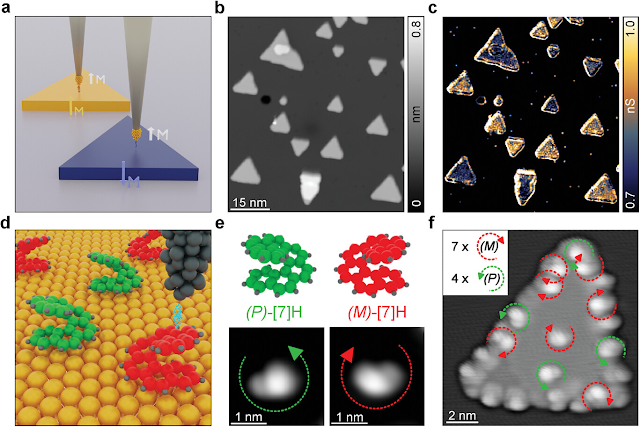
"From the beginning of molecular theory, the interplay of chirality and magnetism has intrigued scientists. There is still the question if enantiospecific adsorption of chiral molecules occurs on magnetic surfaces. Enantiomer discrimination was conjectured to arise from chirality-induced spin separation within the molecules and exchange interaction with the substrate's magnetization. Here, it is shown that single helical aromatic hydrocarbons undergo enantioselective adsorption on ferromagnetic cobalt surfaces. Spin and chirality sensitive scanning tunneling microscopy reveals that molecules of opposite handedness prefer adsorption onto cobalt islands with opposite out-of-plane magnetization. As mobility ceases in the final chemisorbed state, it is concluded that enantioselection must occur in a physisorbed transient precursor state. State-of-the-art spin-resolved ab initio simulations support this scenario by refuting enantio-dependent chemisorption energies. These findings demonstrate that van der Waals interaction should also include spin-fluctuations which are crucial for molecular magnetochiral processes."

Magnetic effects at the origin of life? It's the spin that makes the difference

Magnetic effects at the origin of life? It's the spin that makes the difference (EMPA) Biomolecules such as amino acids and sugars occur in two mirror-image forms – in all living organisms, however, only one is ever found. Why this is the case is still unclear. Researchers at Empa and Forschungszentrum Jülich in Germany have now found evidence that the interplay between electric and magnetic fields could be at the origin of this phenomenon.


Fig. 1 Principles of spin-polarized and enantio-resolved STM


Saturday, January 06, 2024

Ants as pharmacists, nurses and doctors: Ants of the same society treat other member ants infected wounds with antibiotics

Amazing stuff! Absolutely stunning!

"... They only eat termites and will go on dangerous hunting expeditions in which they frequently get injured as they hunt those termites. ...
A study in 2018 found that the Matabele ants carry their wounded partners home after an attack on termites and then care for them back in the nest, holding the hurt limb with their mandibles and front legs while licking the wound. It’s the first non-human animal that has been seen systematically nursing their wounded back to health. ...
They take these antibiotics from a gland located on the side of the thorax. Its secretion has over 110 components, half of which have a wound-healing effect.
It’s a highly effective therapy. The mortality rate of infected individuals is reduced by 90%, as the researchers discovered. They believe this has medical implications, as the main pathogen found in ants’ wounds, called Pseudomonas aeruginosa, is also a leading cause of infection in humans, with several strains that are antibiotic resistant. ..."

"... "Chemical analyses ... have shown that the hydrocarbon profile of the ant cuticle changes as a result of a wound infection," ... It is precisely this change that the ants are able to recognise and thus diagnose the infection status of injured nestmates. ..."

From the abstract:
"Infected wounds pose a major mortality risk in animals. Injuries are common in the ant Megaponera analis, which raids pugnacious prey. Here we show that M. analis can determine when wounds are infected and treat them accordingly. By applying a variety of antimicrobial compounds and proteins secreted from the metapleural gland to infected wounds, workers reduce the mortality of infected individuals by 90%. Chemical analyses showed that wound infection is associated with specific changes in the cuticular hydrocarbon profile, thereby likely allowing nestmates to diagnose the infection state of injured individuals and apply the appropriate antimicrobial treatment. This study demonstrates that M. analis ant societies use antimicrobial compounds produced in the metapleural glands to treat infected wounds and reduce nestmate mortality."

Ants as Pharmacists: These ants treat infected wounds with antibiotics


A Matabele ant tends to the wound of a fellow ant whose legs were bitten off in a fight with termites.

On the left a fresh injury, on the right the condition one hour after treatment. The wound surface appears to be sealed.


Sunday, August 13, 2023

Newly discovered bacterial communication system aids antimicrobial resistance

Amazing stuff! Wonders of life! Towards more powerful antibiotics!

"Researchers have discovered a new stress signaling system that enables bacteria cells to adapt and protect themselves against the immune system and certain antibiotics.
An enzyme, RlmN, was observed to directly sense chemical and environmental stresses, and rapidly signal for the production of other proteins that allow the bacteria cell to adapt and survive. This breakthrough discovery of RlmN as a stress sensor has revealed a new mechanism of antimicrobial resistance that can be targeted for drug development. ...
The work was carried out by researchers from the ... interdisciplinary research group at the Singapore-MIT Alliance for Research and Technology (SMART), ... in collaboration with MIT, the Singapore Center for Environmental Life Sciences Engineering, and Nanyang Technological University Singapore. ...
The discovery was made using a sophisticated mass spectrometry technology developed at SMART and MIT to simultaneously identify all 50 different ribonucleic acids (RNA) modifications in bacteria. This approach allowed scientists to observe changes in cell behavior or pattern mutations that cannot be detected when studied individually.  ..."

From the abstract:
"Bacteria possess elaborate systems to manage reactive oxygen and nitrogen species (ROS) arising from exposure to the mammalian immune system and environmental stresses. Here we report the discovery of an ROS-sensing RNA-modifying enzyme that regulates translation of stress-response proteins in the gut commensal and opportunistic pathogen Enterococcus faecalis. We analyze the tRNA epitranscriptome of E. faecalis in response to reactive oxygen species (ROS) or sublethal doses of ROS-inducing antibiotics and identify large decreases in N2-methyladenosine (m2A) in both 23 S ribosomal RNA and transfer RNA. This we determine to be due to ROS-mediated inactivation of the Fe-S cluster-containing methyltransferase, RlmN. Genetic knockout of RlmN gives rise to a proteome that mimics the oxidative stress response, with an increase in levels of superoxide dismutase and decrease in virulence proteins. While tRNA modifications were established to be dynamic for fine-tuning translation, here we report the discovery of a dynamically regulated, environmentally responsive rRNA modification. These studies lead to a model in which RlmN serves as a redox-sensitive molecular switch, directly relaying oxidative stress to modulating translation through the rRNA and the tRNA epitranscriptome, adding a different paradigm in which RNA modifications can directly regulate the proteome."

Newly discovered bacterial communication system aids antimicrobial resistance | MIT News | Massachusetts Institute of Technology SMART researchers find the enzyme RlmN, which directly senses chemical and environmental stresses, can be targeted in drug development.


Fig. 6: Working model of RlmN as a sensor for oxidative stress


Thursday, March 16, 2023

World’s Most Premature Twins Defy Doctors’ Zero Percent Chance Prognosis to Celebrate Their First Birthday

Amazing stuff!

"Premature twin babies born at 22 weeks, who were given a zero percent chance of survival, have overcome impossible odds and proved their doctors wrong. At the age of one, the toddlers are thriving and also hold the Guinness World Record title of “world’s most premature twins.” ..."

World’s Most Premature Twins Defy Doctors’ Zero Percent Chance Prognosis to Celebrate Their First Birthday


Saturday, August 20, 2022

99 year old Pennsylvania Grandmother Celebrates 100th Great-Grandchild

Amazing!

"Together [she and her husband], they had 11 children and then welcomed a whopping 56 grandchildren. ..."

Pennsylvania Grandmother Celebrates 100th Great-Grandchild Growing up as an only child, 99-year-old Peggy Koller always wished for a big family. Now, she is celebrating her 100th great-grandchild.


Tuesday, February 08, 2022

Life is full of surprises and coincidences

Playing on the famous theme from the movie Forrest Gump: Life is like a box of chocolates. You never know what you're gonna get! 😄

Embrace and discover life: It is full of surprises and coincidences

Breastfeeding in public: There was a woman sitting at a table in a public seating area of a shopping mall reading a large sized book, which appeared to be a textbook. When asked about what she was reading, she showed the cover of the book. It was a course or preparation book for a breastfeeding consultant. In the public seating area only a few yards away there was a young family with a woman breast feeding her baby in public without any cover. The two parties were strangers and most likely not related at all. The future breastfeeding consultant was smiling when this coincidence was pointed out to her.
Now you may wonder perhaps how many lactating or breastfeeding consultants are out there! 😄

Two young African adults meet for the first time: In the same mall, there is also a store run by an international French perfume and cosmetics company with a very French name. Next to it is a large store of one of the most iconic and most valuable (in terms of stock price) American consumer electronics, software, online services companies. There is a young African woman working in the first store. In the latter store, there is a young African man working. Both have been working in these stores side by side for several months. They did not know each other.  The young woman hails from Kinshasa, Democratic Republic of Congo and she speaks French. By pure chance, not long ago it was discovered that the young man also speaks some French. It was then immediately suggested to introduce him to the young African woman. Once these two young Africans were introduced to each other, the young man revealed he also was from Kinshasa, Democratic Republic of Congo. Did the young man just say that for whatever reason or was this another almost incredible coincidence? Hint: The DR of Congo the fourth most populous country in Africa

Tuesday, January 19, 2021

Dentistry Student Shares Touching Story of Being Raised by Father With Down Syndrome

A truly amazing story!

"... Sader Issa appeared in a touching video by the Syrian Society for Social Development, where he describes his dad, Jad, as a “father a husband and family leader.” He explains that while the situation may be hard to comprehend by others, being raised by someone with Down syndrome gave him “all the love and tenderness that anyone can offer.” The video, posted in March 2019, has since gone viral with nearly 200,000 views.

According to Issa, if he had a choice, he wouldn’t change a thing and credits his achievements to the love, care, and encouragement he received from his dad growing up. The young man pursued a career in dentistry and is now a third-year student. “Throughout my life, he has been the greatest support for me when I needed it,” he says. ...
In spite of living with Down syndrome, Jad worked at the local mill factory and supported his family for over 20 years. Proud of his son’s success, every time he meets new people, the man states, “My son is a doctor.” ..."

Dentistry Student Shares Touching Story of Being Raised by Father With Down Syndrome


Saturday, June 13, 2020

Balls of cells mimic an unseen stage of human embryo development

How many more years will it take to gestate a human fertilized egg outside of the womb? Perhaps 15-30 years?

"After about 14 days, the embryo elongates and forms layers, revealing a rough plan for the body. But this dramatic transformation, called gastrulation, has never been directly observed in human embryos: Growing them to this stage in a lab is technically difficult and ethically fraught. Now, researchers have made structures from human stem cells that mimic some features of embryos after gastrulation, an advance that could reveal how genetic mutations and chemical exposures can lead to miscarriages and birth defects."

"The structures, created from stem cells and called gastruloids, are the first to form a 3D assembly that lays out how the body will take shape. The gastruloids developed rudimentary components of a heart and nervous system, but lacked the components to form a brain and other cell types that would make them capable of becoming a viable fetus. ... Human embryos take a momentous leap in their third week, when the largely homogeneous ball of cells starts to differentiate and develop specific characteristics of the body parts they will become, a process known as gastrulation. During this process, the embryo elongates and lays down a body plan with a head and tail, often called the head-to-tail axis.
But scientists have never seen this process in action. That is partly because many countries have regulations that stop embryos from being grown in the laboratory for research beyond 14 days after conception. ... Moris says the most thrilling result was the formation of pockets of cells that symmetrically straddle the head-to-tail axis. Genetic analysis showed that the cells were those that would eventually go on to form muscles in the trunk, vertebrae, heart and other organs. ..."