Showing posts with label Drosophila melanogaster. Show all posts

Saturday, August 01, 2026

RNA editing for stem cell health and longer life

Good news! Behind the secrets of aging!

"Intestinal stem cell function declines with age, and dysregulation of these cells is associated with a shortened lifespan. Zhang et al. found that the RNA-editing enzyme adenosine deaminase acting on RNA (ADAR) restrained intestinal stem cell proliferation in fruit flies, and its abundance decreased with aging and after gut injury.
Loss of ADAR in these cells in young flies caused intestinal hyperproliferation and reduced lifespan, whereas ADAR overexpression in aged flies improved gut function and increased lifespan.
Reductions in colonic ADAR2 were associated with aging in humans and with intestinal regeneration in mice, suggesting that ADAR mediated regulation of intestinal stem cells may be conserved."

From the editor's summary and abstract (a very technical abstract):
"Editor’s summary
Intestinal stem cell (ISC) function declines with age, and ISC dysregulation is associated with shortened life span. 
Zhang et al. found that the RNA editing enzyme ADAR restrained ISC proliferation in fruit flies, and its abundance and activity decreased with aging and after gut injury.
ISC-specific loss of ADAR in young flies caused intestinal hyperproliferation and reduced life span, whereas ADAR overexpression in aged flies improved gut function and increased life span. 
ADAR inhibited proliferative MAPK signaling in ISCs because its RNA editing activity generated a translational repressor of MAPK pathway components. Reductions in colonic ADAR2 and a protein that stabilizes it were associated with aging in humans and with intestinal regeneration in mice, suggesting that ADAR-mediated regulation of ISCs may be conserved. ...

Abstract
Aging impairs intestinal stem cell (ISC) function, disrupting epithelial homeostasis and regenerative repair.
Loss of ISC quiescence promotes intestinal dysfunction and contributes to organismal aging.
Here, we report an epitranscriptomic mechanism through which a decrease in adenosine-to-inosine (A-to-I) RNA editing by the adenosine deaminase ADAR in ISCs during aging disrupts a conserved signaling axis that maintains ISC quiescence. 
In Drosophila melanogaster, ISC-specific loss of dADAR triggered hyperproliferation and tissue aging, whereas dADAR overexpression reduced age-related gut dysfunction and extended life span.
Intestinal injury induced a decrease in dADAR, which was necessary for tissue regeneration, and in the zinc finger protein dZn72D, which stabilized dADAR to support intestinal homeostasis during aging. dADAR edited transcripts encoding the RNA binding protein Pumilio (dPUM) to generate an isoform that inhibited translation of two components of the mitogen-activated protein kinase (MAPK), dEGFR and dERK, thereby maintaining ISC quiescence.
The abundance of ADAR2 and of the dZn72D ortholog ZFR decreased in human colonic crypts with aging and in mouse colon after injury, suggesting that attenuation of ADAR activity may play a conserved role in ISC aging and in facilitating colonic regeneration.
Our work identifies a conserved mechanism of epitranscriptomic regulation that safeguards tissues and the decay of ADAR-mediated RNA editing as a form of age-related epigenetic information loss that disrupts ISC homeostasis."

In Science Journals | Science


Fig. 1. A-to-I RNA editing in ISCs declines during aging.


Fig. 2. dADAR inhibits ISC proliferation in a cell-autonomous manner.


Fig. 4. dADAR loss drives gut aging and reduces life span in Drosophila.


Fig. 6. dADAR maintains ISC quiescence by inhibiting the MAPK signaling pathway.


Saturday, October 18, 2025

Why and how does personality emerge? Studying the evolution of individuality using thousands of fruit flies

Amazing stuff! Even fruit flies have a personality! They live only about 40-50 days.

"... My labmates and I repeated that process again and again, ultimately measuring the behavior of 900 individual flies daily. ...

I had been excited to work with MAPLE, my lab’s robot, to automate the first and last steps of the process. MAPLE would grab individual flies, safely move them into their own tiny mazes, and back out after I’d measured their behaviors. ...

All animals – from the smallest worm to the biggest whale – have personalities: individual behavioral preferences that remain more or less stable throughout their lifetime. In Drosophila melanogaster, the fruit flies I worked with, individuality is evident in simple binary behaviors. Individual flies show a preference for turning left or right, choosing a hot or cool environment, preferring brightly lit areas or the shade, and many other idiosyncrasies.

Both nature and nurture influence animal personality. The environment during development can play a crucial role in some instances. In others, genes inherited from parents can drive preferences. ..."

Why and how does personality emerge? Studying the evolution of individuality using thousands of fruit flies


Still looking for a Halloween costume? What a personality! 😊


Monday, August 18, 2025

Scientists transfer obscure courtship behavior between species via mutation of a single gene

Amazing stuff!

"In a breakthrough study, scientists have transferred a courtship behavior from one species to another, triggering the recipient to perform this completely foreign act as if it was its own. While genes have been swapped between species to influence traits, a totally unknown behavior has never been genetically swapped into a different animal before. ..."

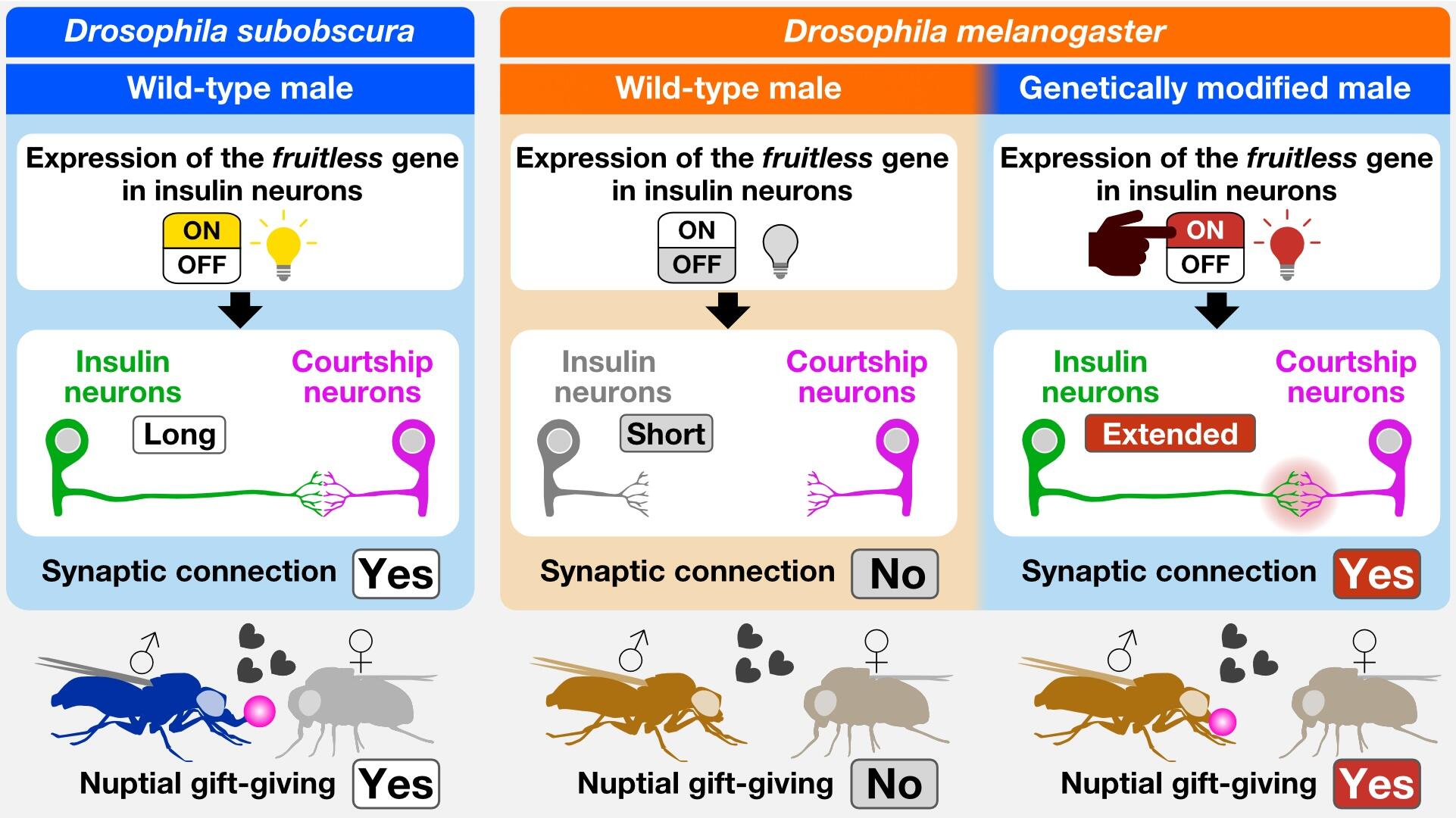
"Researchers in Japan have genetically transferred a unique courtship behavior from one fruit fly species to another. By turning on a single gene in insulin-producing neurons, the team successfully made a species of fruit fly (Drosophila melanogaster) perform a gift-giving ritual it had never done before. The study ...  represents the first example of manipulating a single gene to create new neural connections and transfer behavior between species.  ..."

From the editor's summary and abstract:
"Editor’s summary
In the fruit fly Drosophila subobscura, courtship behavior includes nuptial gift giving, in which the male feeds the female a regurgitated food gift. The same behavior is not observed in related species, including the common lab animal D. melanogaster.
Tanaka et al. studied the genetics of nuptial gift giving in male animals and showed that expression of the gene FruitlessM (FruM) in insulin-like peptide-producing cells (IPCs) was both necessary and sufficient for triggering this behavior in D. subobscura.
Overexpression of FruM in D. melanogaster IPCs induced neurite outgrowth in these cells and increased regurgitation behavior. These results unveil the genetic and neuronal basis of an evolutionary important species-specific behavior. ...

Abstract
In accepting a courting male, Drosophila subobscura females require nuptial gift giving in which a male gives regurgitated crop contents to her mouth to mouth. No similar behavior is found in D. melanogaster.
By clonal activation of neurons expressing the male-determinant FruM, we identified insulin-like peptide–producing cells (IPCs) and their putative postsynaptic targets, proboscis-innervating motoneurons, as those critical for gift giving.
We demonstrate that loss of FruM from D. subobscura IPCs abrogates neurite extension and gift giving, whereas FruM overexpression in their D. melanogaster counterparts induces overgrowth of neurites that harbor functional synapses, culminating in increased regurgitation.
We suggest that the acquisition of FruM expression by IPCs was a key event occurring in an ancestral D. subobscura that conferred a latent capability to perform nuptial gift giving."

Scientists transfer courtship behavior between species


Scientists have successfully transferred gift-giving courtship behavior from Drosophila subobscura to D. melanogaster males. They genetically engineered insulin-producing neurons in D. melanogaster to produce FruM proteins, causing these cells to grow long neural projections and connect to the courtship center in the brain.


Wednesday, September 11, 2024

Scientists built mini treadmills for insects – not to keep them fit but to study their walking

Amazing stuff!

Don't laugh! Too bad, humans do not have a middle leg! 😊

"... The researchers were able to track fly walking over long periods of time. Split-belt treadmills were used to investigate how the flies reacted to belts with different speeds on either side of the body. ...

Split-belt treadmills had little effect on the coordination between legs. But the step distances of their middle legs changed a lot. ..."

From the highlights and abstract:
"Highlights
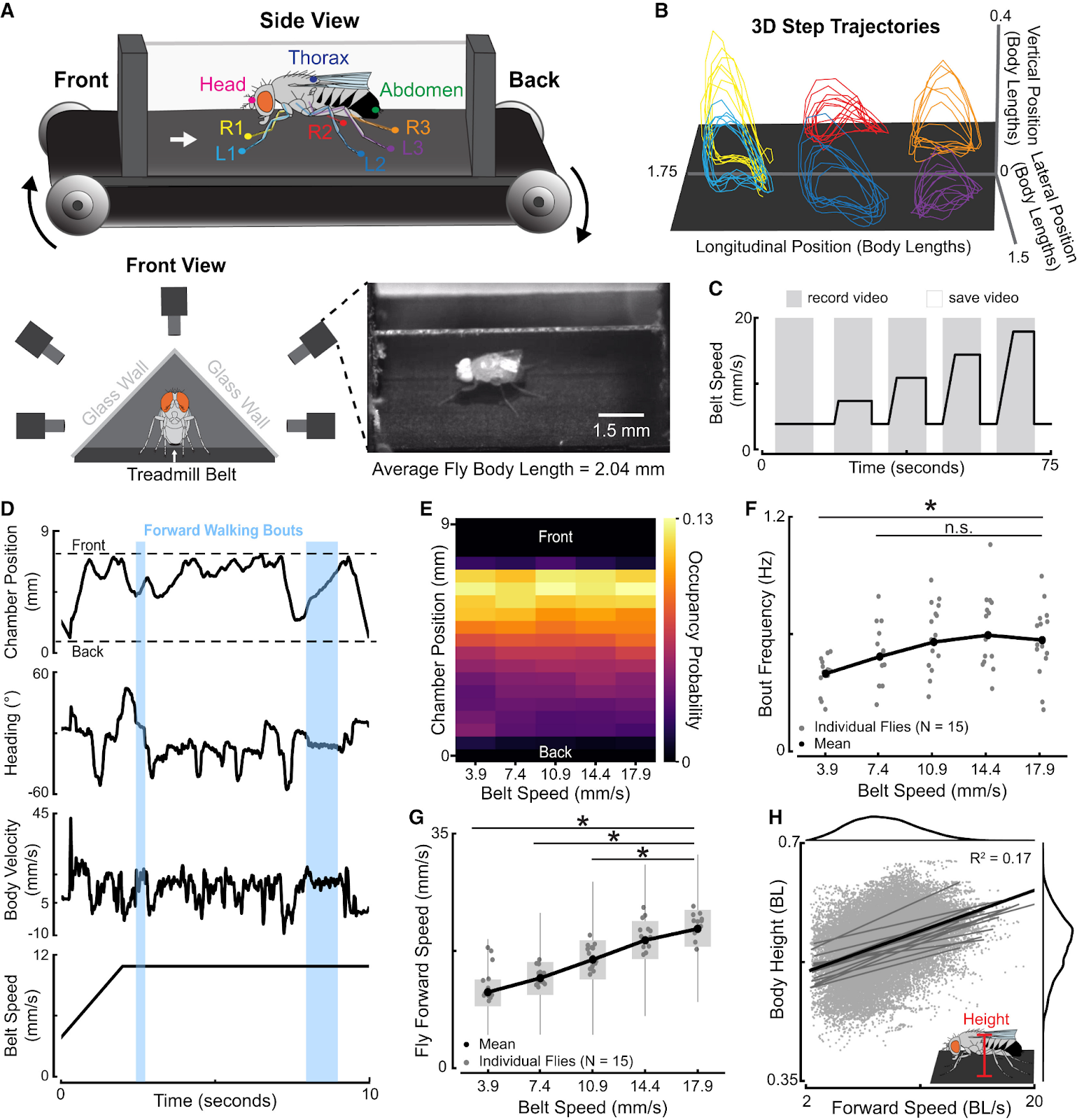
•A new actuated treadmill system captures 3D kinematics of flies compelled to walk
• Flies walking on the treadmill have similar kinematics to freely walking flies
• Proprioceptive feedback is important for leg motor control at all walking speeds
• Flies on a split-belt treadmill use their middle legs to counteract perturbations

Summary
To navigate complex environments, walking animals must detect and overcome unexpected perturbations. One technical challenge when investigating adaptive locomotion is measuring behavioral responses to precise perturbations during naturalistic walking; another is that manipulating neural activity in sensorimotor circuits often reduces spontaneous locomotion. To overcome these obstacles, we introduce miniature treadmill systems for coercing locomotion and tracking 3D kinematics of walking Drosophila. By systematically comparing walking in three experimental setups, we show that flies compelled to walk on the linear treadmill have similar stepping kinematics to freely walking flies, while kinematics of tethered walking flies are subtly different. Genetically silencing mechanosensory neurons altered step kinematics of flies walking on the linear treadmill across all speeds. We also discovered that flies can maintain a forward heading on a split-belt treadmill by specifically adapting the step distance of their middle legs. These findings suggest that proprioceptive feedback contributes to leg motor control irrespective of walking speed and that the fly’s middle legs play a specialized role in stabilizing locomotion."

Scientists built mini treadmills for insects – not to keep them fit but to study their walking "Fruit flies on treadmills are giving scientists insights into how insects walk in ways that previous, more invasive techniques could not"


Figure 1. The linear treadmill controls locomotor speed and enables tracking of 3D kinematics in walking Drosophila


Friday, March 10, 2023

Scientists complete first map of an larval insect brain with just over 3,000 neurons with 93 neuron types

Amazing stuff! Very exciting! However, do insects and humans think alike?

"Researchers have completed the most advanced brain map to date, that of an insect—a landmark achievement in neuroscience that brings scientists closer to true understanding of the mechanism of thought.
The international team led by Johns Hopkins University and the University of Cambridge produced a breathtakingly detailed diagram tracing every neural connection in the brain of a larval fruit fly, an archetypal scientific model with brains comparable to humans. ..."

From the abstract:
"INTRODUCTION
A brainwide, synaptic-resolution connectivity map—a connectome—is essential for understanding how the brain generates behavior. However because of technological constraints imaging entire brains with electron microscopy (EM) and reconstructing circuits from such datasets has been challenging. To date, complete connectomes have been mapped for only three organisms, each with several hundred brain neurons: the nematode C. elegans, the larva of the sea squirt Ciona intestinalis, and of the marine annelid Platynereis dumerilii. Synapse-resolution circuit diagrams of larger brains, such as insects, fish, and mammals, have been approached by considering select subregions in isolation. However, neural computations span spatially dispersed but interconnected brain regions, and understanding any one computation requires the complete brain connectome with all its inputs and outputs.
RATIONALE
We therefore generated a connectome of an entire brain of a small insect, the larva of the fruit fly, Drosophila melanogaster. This animal displays a rich behavioral repertoire, including learning, value computation, and action selection, and shares homologous brain structures with adult Drosophila and larger insects. Powerful genetic tools are available for selective manipulation or recording of individual neuron types. In this tractable model system, hypotheses about the functional roles of specific neurons and circuit motifs revealed by the connectome can therefore be readily tested.
RESULTS
The complete synaptic-resolution connectome of the Drosophila larval brain comprises 3016 neurons and 548,000 synapses. We performed a detailed analysis of the brain circuit architecture, including connection and neuron types, network hubs, and circuit motifs. Most of the brain’s in-out hubs (73%) were postsynaptic to the learning center or presynaptic to the dopaminergic neurons that drive learning. We used graph spectral embedding to hierarchically cluster neurons based on synaptic connectivity into 93 neuron types, which were internally consistent based on other features, such as morphology and function. We developed an algorithm to track brainwide signal propagation across polysynaptic pathways and analyzed feedforward (from sensory to output) and feedback pathways, multisensory integration, and cross-hemisphere interactions. We found extensive multisensory integration throughout the brain and multiple interconnected pathways of varying depths from sensory neurons to output neurons forming a distributed processing network. The brain had a highly recurrent architecture, with 41% of neurons receiving long-range recurrent input. However, recurrence was not evenly distributed and was especially high in areas implicated in learning and action selection. Dopaminergic neurons that drive learning are amongst the most recurrent neurons in the brain. Many contralateral neurons, which projected across brain hemispheres, were in-out hubs and synapsed onto each other, facilitating extensive interhemispheric communication. We also analyzed interactions between the brain and nerve cord. We found that descending neurons targeted a small fraction of premotor elements that could play important roles in switching between locomotor states. A subset of descending neurons targeted low-order post-sensory interneurons likely modulating sensory processing.
CONCLUSION
The complete brain connectome of the Drosophila larva will be a lasting reference study, providing a basis for a multitude of theoretical and experimental studies of brain function. The approach and computational tools generated in this study will facilitate the analysis of future connectomes. Although the details of brain organization differ across the animal kingdom, many circuit architectures are conserved. As more brain connectomes of other organisms are mapped in the future, comparisons between them will reveal both common and therefore potentially optimal circuit architectures, as well as the idiosyncratic ones that underlie behavioral differences between organisms. Some of the architectural features observed in the Drosophila larval brain, including multilayer shortcuts and prominent nested recurrent loops, are found in state-of-the-art artificial neural networks, where they can compensate for a lack of network depth and support arbitrary, task-dependent computations. Such features could therefore increase the brain’s computational capacity, overcoming physiological constraints on the number of neurons. Future analysis of similarities and differences between brains and artificial neural networks may help in understanding brain computational principles and perhaps inspire new machine learning architectures."

Scientists complete first map of an insect brain | Hub In the quest to understand how we think, 'everything has been working up to this,' says biomedical engineer Joshua T. Vogelstein, part of the international team led by Johns Hopkins University and the University of Cambridge


The connectome of the Drosophila larval brain.


Saturday, August 06, 2022

Drosophila embryo analyzed cell by cell and minute-by-minute captured in a single-cell atlas

Amazing stuff!

The study of the most famous research insect of the world (besides the bee, ant, and the mosquito) keeps on giving! We should actually erect a large statue for this insect! 😄

"Animal development can progress quite rapidly, with cellular lineages proliferating and differentiation status changing minute to minute. Calderon et al. have now visualized development in the fruit fly Drosophila in greater detail than ever before. Taking advantage of the ability to produce collections of Drosophila embryos that differ in developmental stage by only seconds or minutes, the authors have analyzed, on a single-cell basis, how chromatin accessibility and gene expression shift during Drosophila embryogenesis. This single-cell atlas of Drosophila embryogenesis reveals cell lineages and their developmental relationships and links enhancer usage and gene expression."

From the abstract:
"... We profiled chromatin accessibility in almost 1 million nuclei and gene expression in half a million nuclei from eleven overlapping windows spanning the entirety of embryogenesis (0 to 20 hours). To exploit the developmental asynchronicity of embryos from each collection window, we applied deep neural network–based predictive modeling to more-precisely predict the developmental age of each nucleus within the dataset, resulting in continuous, multimodal views of molecular and cellular transitions in absolute time. With these data, the dynamics of enhancer usage and gene expression can be explored within and across lineages at the scale of minutes, including for precise transitions like zygotic genome activation.
CONCLUSION
This Drosophila embryonic atlas broadly informs the orchestration of cellular states during the most dynamic stages in the life cycle of metazoan organisms. The inclusion of predicted nuclear ages will facilitate the exploration of the precise time points at which genes become active in distinct tissues as well as how chromatin is remodeled across time."

Drosophila embryo analyzed cell by cell


Wednesday, November 27, 2019

Sex Promotes Lasting Memories in Female Flies

Amazing stuff! Not exactly what you may think! However, analogous research on mammals, primates, and humans is still outstanding. So sex is perhaps after all much more than just about procreation and bonding.  

Sex Promotes Lasting Memories in Female Flies | The Scientist Magazine®: A protein present in the ejaculate of male fruit flies activates long-term memory formation in the brains of their female partners.

Friday, February 22, 2013

The Unknown Common Fruit Fly

One Of The Most Studied Organisms In Science

The common fruit fly is one of the most scientifically studied model organisms in the world since the early 20th century, a.k.a. Drosophila melanogaster. It still surprises us.

We Still Know So Little About The Common Fruit Fly

When I read this scientific news article titled “Fruit Flies Force Their Young to Drink Alcohol for Their Own Good” today (2/22/2013), I was stunned to read how much we still do not know about this so intensely studied object of science.

The article informs us that:
1.       “Adult fruit flies detect the [parasitic] wasps [“who are major killers of fruit flies”] by sight, and appear to have much better vision than previously realized Our data indicate that the flies can visually distinguish the relatively small morphological differences between male and female wasps, and between different species of wasps."”
2.       “The fly strains used in the experiments have been bred in the lab for decades. "The flies that we work with have not seen wasps in their lives before, and neither have their ancestors going back hundreds of generations," … "And yet, the flies still recognize these wasps as a danger when they are put in a cage with them."”
3.       “Further experiments showed that the flies are extremely discerning about differences in the wasps. They preferred to lay their eggs in alcohol when female wasps were present, but not if only male wasps were in the cage.”
4.       “Further experimentation showed that the fruit flies can distinguish different species of wasps, and will only choose the alcohol food in response to wasp species that infect larvae, not fly pupae.”

Wow! How do these until now considered to be stupid flies do all that?

Pretense Of Knowledge

Since Socrates we have to be keenly aware of the false pretenses by too many scientists. Global Warming alarmism by scientists who claim they can predict average global temperatures, sea levels etc. over a period of one hundred years from now should be laughed out of their tenured jobs financed by tax payers’ money.