Showing posts with label magnetism. Show all posts

Saturday, September 12, 2026

Meteorite dust holds records of magnetism that may have helped form the sun

Amazing stuff!

"Around 4.6 billion years ago, the solar system was little more than a giant ball of gas and dust. Over the next few million years, this “solar nebula” underwent a huge transformation, flattening into a disk of matter that then condensed to form the central sun and orbiting planets. 

Scientists have assumed that the early solar system was shaped mainly through gravity. But a new study finds that magnetism also likely played a role. 

... scientists have discovered records of ancient magnetism in the oldest samples of meteorites known today. The team analyzed microscopic grains embedded in a meteorite that was discovered in Antarctica in 2008. These grains, called calcium-aluminum-rich inclusions, or CAIs, originally formed during the solar system’s first 200,000 years, making the samples the oldest known solar system material.

The findings suggest that a magnetic field existed very early on, during the time of the solar nebula. The researchers estimate that this nebular magnetic field was stronger than Earth’s magnetic field today, and likely played a significant role in pulling together primordial matter to form the early sun. ..."

From the significance and abstract:
"Significance
A key step in the formation of planetary systems is the collapse of a cloud of gas and dust into a protoplanetary disk. It has been unclear what forces transformed the disk into the final configuration of a central massive star surrounded by planets. In particular, it has been proposed that in the earliest stages of disk evolution gravity and/or magnetism played a central role.
Here we report studies of the remanent magnetization in calcium-aluminum-rich inclusions, the oldest known solar system solids. We find that they record ancient magnetic fields with intensities stronger than that of the Earth today. This supports the hypothesis that magnetism played a key role in driving mass transport in the early protoplanetary disk.

Abstract
The initial stage of planet formation is expected to take place in a nascent protoplanetary disk (PPD) accreting onto the protostar embedded in an infalling envelope.
This stage is likely accompanied by the formation of high-condensation temperature solids resembling calcium-aluminum-rich inclusions (CAIs), the oldest known solar system solids. However, it is unknown whether magnetism and/or gravity dominantly drove accretion in the youngest evolutionary stages of PPDs and the solar nebula.
Here we report paleomagnetic measurements of CAIs indicating that they record a nebular magnetic field of ∼150 to 600 μT.
This intensity is consistent with magnetic fields playing a key role driving disk accretion while also heating the very inner disk to 103 K at the earliest stages of solar system formation."

Meteorite dust holds records of magnetism that may have helped form the sun | MIT News | Massachusetts Institute of Technology "The discovery likely represents the earliest known evidence of a magnetic field in the infant solar system"


Fig. 3 Summary of high-resolution imaging of CAI 11 indicating the presence of primary magnetic phases.


Friday, August 07, 2026

A Magnetic Clue to Life’s Origins Chemistry

Amazing stuff!

"... Their study, recently published in Chem, offers a possible missing link in a theory proposing that life first emerged on magnetic surfaces, such as the beds of shallow lakes rich in magnetic minerals. ...

an experiment ... used right- and left-handed versions of methionine – an amino acid that typically initiates protein synthesis – and passed a solution containing this amino acid through a paper filter embedded with micron-sized magnetic particles.

To track the molecules, the researchers incorporated two carbon isotopes – atoms of the same element with different weights – into the amino acid.
In some experiments, right-handed molecules contained the more common, lighter carbon-12 isotope and left-handed ones the heavier carbon-13;
in others, the assignment was reversed. The direction of magnetization was also switched: In different iterations of the experiment, the magnets first pointed toward the solution with one of their poles, north or south, then with the other. After filtering the solution, the scientists used mass spectrometry to measure the ratio of isotopes and the balance between the two chiral forms.

The result was unexpected. The magnetic filter appeared to separate methionine not only by chirality but also by isotope composition. Molecules containing the heavier carbon isotope – regardless of their handedness – showed a stronger attraction to particles magnetized in one direction over the other. ..."

From the highlights and abstract:
"The bigger picture
Isotopic fractionation in biomolecules provides key insight into chemical and biochemical formation pathways, yet the mechanisms underlying isotope selectivity in chiral molecular systems remain poorly understood.
This work demonstrates a direct experimental connection between spin-dependent interactions and isotopic effects in a chiral amino acid, showing that molecules differing only in their carbon isotope composition interact differently with oppositely magnetized surfaces. These findings reveal a previously unexplored contribution of electronic spin polarization to isotopic behavior in molecular systems.
More broadly, the results introduce spin selectivity as a new physical dimension in isotope chemistry.
In the longer term, such spin- and chirality-dependent interactions may enable new approaches for isotope discrimination or separation in chiral chemical environments, with potential relevance to analytical chemistry and materials design.
By linking magnetic interactions, molecular chirality, and isotope effects, this study establishes a framework for investigating how subtle spin-mediated processes can influence isotopic outcomes in complex molecular systems.

Highlights
• Spin-polarized magnetic filters induce carbon isotope fractionation in L-methionine
• Volume-resolved elution reveals metastable spin-dependent interactions
• Chirality couples electronic spin selectivity to isotope chemistry
• Spin-dependent effects may shape isotopic signatures in early biomolecules

Summary
Distinct isotopic fractionation in biomolecules, compared with atmospheric values, reflects their biosynthetic origin.
Monitoring these fractionation changes offers a valuable approach for probing early metabolic networks.
A key question in the study of life’s origins is the role of electronic spin and magnetic surfaces in symmetry breaking and the emergence of homochirality.
Here, we used magnetic filters to show that the dynamical interaction with the magnetic surfaces changes the isotope fractions of 13C L-methionine compared with 12C L-methionine.
Specifically, mass spectrometry analysis reveals that the isotopic fractionation of both natural and ¹³C-enriched L-methionine is influenced by electron spin-dependent interactions."

A Magnetic Clue to Life’s Origins - Chemistry | Weizmann Wonder Wander - News, Features and Discoveries "Study suggests that magnetic surfaces may influence not only the handedness of biological molecules but also their isotope composition – thus connecting two fundamental fingerprints of life"

Spin-dependent isotopic fractionation of L-methionine (no public access, appeared in March 2026)


Graphical abstract


Monday, April 13, 2026

A Macroscopic Magnet Precesses while in gyroscopic motion

Amazing stuff! Among others, Albert Einstein worked on this subject (see references).

"In 1861, physicist James Clerk Maxwell proposed that a magnet behaves to some extent like a spinning gyroscope, but his experiments never managed to demonstrate the effect. Since then, researchers have observed various manifestations of so-called gyromagnetism, mostly in specialized magnetic materials or with spinning magnets,
but now a research team has detected signatures of gyroscopic motion corresponding to Maxwell’s original ideas. The team used a microscopic magnetic sphere in a technique that, with improvements, could be employed for ultrasensitive magnetic-field detection, which could be useful for research on biological magnetism.

If you try to tilt a gyroscope spinning around a vertical axis, it will respond by tilting at 90° from the push direction, an effect that leads to precession in response to gravity—such as the slow loop executed by the axis of a spinning top.

An electron in a magnetic field behaves like a gyroscope in a gravitational field because the electron has a magnetic moment, which is associated with intrinsic angular momentum, or spin.

So you might expect that a material whose microscopic spins align—such as an ordinary ferromagnet—would have a macroscopic angular momentum and behave like a gyroscope. ...

Armed with much smaller magnets—spheres 40–60 µm in diameter ... They levitated a magnet by placing it inside a 2.5-mm-diameter hole bored into a piece of lead chilled below its superconducting transition temperature. Superconductors expel magnetic fields, so they can form stable magnetic traps. In this experiment, at equilibrium, the magnet’s magnetic moment aligns with a small, nearly horizontal field present in the trap. Following an excitation by the field, the magnet oscillates around its aligned equilibrium orientation for some 20 seconds.

The magnet’s motion can be excited into either of two perpendicular oscillations, horizontal and vertical, with distinct frequencies. But the magnet’s intrinsic angular momentum should generate precession that turns the two oscillations’ otherwise linear trajectories into narrow ellipses.

To detect these subtle motions, ... placed two extremely sensitive magnetometers above the levitated magnet, each sensitive to one of the two oscillation modes. By analyzing the two signals, the team determined the tiny amount of intrinsic angular momentum associated with the sphere’s magnetic moment. They also determined the sphere’s g factor, a number proportional to the ratio of a particle’s magnetic moment to its intrinsic angular momentum. The values determined for several spheres were within about 10% of the team’s estimates based on a simple theory accounting for the magnets’ sizes and composition. ...

that previous work has found similar effects in the oscillation of optically levitated nanoparticles driven either by an external force or by thermal noise. But demonstrating gyromagnetism that arises from the total internal spin of a particle “has eluded researchers for a very long time,” ..."

From the abstract:
"A nonspinning permanent ferromagnet is predicted to behave as a gyroscope at sufficiently low frequencies, which can be seen as a manifestation of gyromagnetism.
This yet unexplored regime, conjectured for the first time by Maxwell [A Treatise on Electricity and Magnetism (... 1873).], has recently been proposed for ultrasensitive magnetometry and for atomic like quantum stabilization of a levitated nanomagnet in a static field.
Here, we observe signatures of gyroscopic effects in the rotational dynamics of a nonspinning permanent ferromagnet levitated in a superconducting trap. Specifically, we detect spin-rotation coupling between different librational modes, leading to elliptical trajectories, in good agreement with theoretical predictions. From our measurements, we can infer both the intrinsic angular momentum of the levitated magnet and its gyromagnetic 𝑔"

Physics - A Macroscopic Magnet Precesses "An isolated magnet’s intrinsic angular momentum induces gyroscopic motion, an observation that could lead to ultrasensitive magnetometers."

Observation of Gyroscopic Coupling in a Nonspinning Levitated Ferromagnet (open access)


Spin around. The magnetic moment (orange arrow) of a levitated magnetic microsphere (black) executes elliptical motion (green and blue loops) in the presence of a magnetic field (not shown). In the absence of the gyromagnetic effects that arise from the magnet’s intrinsic angular momentum, the motions would be linear.


Thursday, January 29, 2026

Physicists uncover hidden magnetic order in the mysterious pseudogap phase

Amazing stuff!

"Physicists have uncovered a link between magnetism and a mysterious phase of matter called the pseudogap, which appears in certain quantum materials just above the temperature at which they become superconducting. The findings could help researchers design new materials with sought-after properties such as high-temperature superconductivity, in which electric current flows without resistance. 

Using a quantum simulator chilled to just above absolute zero, the researchers discovered a universal pattern in how electrons — which can have spin up or down — influence their neighbors’ spins as the system is cooled. The findings represent a significant step toward understanding unconventional superconductivity ...

In many high-temperature superconductors, the transition to the superconducting state does not emerge out of a conventional metallic state. Instead, the material first enters a curious intermediate regime known as the pseudogap, in which electrons start behaving in unusual ways, and fewer electronic states are available for electrons to flow through the material. ...

In materials containing an unaltered number of electrons, the electrons arrange themselves in an orderly, alternating magnetic pattern known as antiferromagnetism. In this pattern, neighboring electron spins point in opposite directions — like dancers following a precise left-right rhythm.

But when electrons are removed through a process known as doping, this magnetic order becomes strongly disrupted. For a long time, researchers assumed that doping destroyed long-range magnetic order entirely. The new study in PNAS, however, shows that at extremely low temperatures, a subtle form of organization remains, hidden beneath the apparent disorder. ..."

From the significance and abstract:
"Significance
Understanding strongly correlated fermions constitutes a major challenge of modern physics. Here, we take a significant step in this direction, by the finding of a universal scaling of spin and charge correlations upon entering the pseudogap phase in the paradigmatic Hubbard model, using our ultracold atom quantum simulator. This leads to a quantitative description of how doping suppresses the spin stiffness, concurrent with the emergence of dominant higher-order correlations that we observe in the system. Our characterization of the magnetic properties of the pseudogap in the paradigmatic Hubbard model paves the way for future studies of further collective phases of matter that the pseudogap is believed to give way to at even lower temperatures.

Abstract
In strongly correlated materials, interacting electrons are entangled and form collective quantum states, resulting in rich low-temperature phase diagrams. Notable examples include cuprate superconductors, in which superconductivity emerges at low doping out of an unusual “pseudogap” metallic state above the critical temperature.
The Fermi–Hubbard model, describing a wide range of phenomena associated with strong electron correlations, still offers major computational challenges despite its simple formulation. In this context, ultracold atoms quantum simulators have provided invaluable insights into the microscopic nature of correlated quantum states.
Here, we use a quantum gas microscope Fermi–Hubbard simulator to explore a wide range of dopings and temperatures in a regime where a pseudogap is known to develop. By measuring multipoint correlation functions up to fifth order, we uncover a universal scaling behavior in magnetic and higher-order spin–charge correlations characterized by a doping-dependent temperature scale. Accurate comparisons with determinant Quantum Monte Carlo and Minimally Entangled Typical Thermal States simulations confirm that this temperature scale is comparable to the pseudogap temperature.
Our quantitative findings reveal a qualitative behavior of magnetic properties and spin–charge correlations in an emergent pseudogap and pave the way toward the exploration of charge pairing and collective phenomena expected at lower temperatures."

Physicists uncover hidden magnetic order in the mysterious pseudogap phase

Hidden Order in Quantum Confusion: The Pseudogap (original news release) "Quantum simulator using ultracold atoms reveals how subtle magnetic patterns shape one of the most puzzling states of matter."


Fig. 4 Emergence of extended polarons in the pseudogap. (A) Example of polaron correlations 


Monday, January 26, 2026

Shining laser light on a two-dimensional material produces subtle changes in its magnetic properties

Amazing stuff!

"Researchers in Switzerland have found an unexpected new use for an optical technique commonly used in silicon chip manufacturing. By shining a focused laser beam onto a sample of material, a team at the Paul Scherrer Institute (PSI) and ETH Zürich showed that it was possible to change the material’s magnetic properties on a scale of nanometres – essentially “writing” these magnetic properties into the sample in the same way as photolithography etches patterns onto wafers. The discovery could have applications for novel forms of computer memory as well as fundamental research. ..."

From the abstract:
"Across the fields of magnetism, microelectronics, optics, and others, engineered local variations in material properties can yield groundbreaking functionalities that play a crucial role in enabling future technologies.
One-dimensional lateral gradients in material properties give rise to a plethora of new effects in thin-film magnetic systems. However, extending such gradient-induced behaviors to two dimensions has been challenging to realize experimentally.
Here, we demonstrate the creation of two-dimensional complex patterns with continuous variations in magnetic anisotropy, interlayer exchange coupling, and ferrimagnetic compensation at the mesoscopic scale in numerous application-relevant magnetic materials. We exploit our engineered gradients in material properties to demonstrate novel magnetic functionalities, including the creation of a spin wave band pass filter and an architecture for passively resetting the position of a magnetic domain wall.
Our results highlight the exciting new physics and device applications enabled by two-dimensional gradients in thin film properties."

Shining laser light on a material produces subtle changes in its magnetic properties – Physics World

Laser draws made-to-order magnetic landscapes "Researchers at the Paul Scherrer Institute PSI, in collaboration with the National Institute of Standards and Technology (NIST) in Boulder, Colorado, have for the first time succeeded in using existing laser technology to continuously vary the magnetic properties of two-dimensional materials. This simple and fast method should make a large number of applications possible, including techniques for data storage and processing."

New Article on Direct-write Laser Patterning of Magnetic Landscapes (original news release)

Two-dimensional gradients in magnetic properties created with direct-write laser annealing (open access) "Patterning magnetic landscapes has recently emerged as a powerful avenue to achieve new functionalities in existing materials. In a recent publication from the Laboratory for Mesoscopic Systems, two-dimensional complex patterns with continuous variations in magnetic anisotropy, interlayer exchange coupling, and ferrimagnetic compensation are created at the mesoscopic scale in numerous application-relevant magnetic materials."


Fig. 1: Heat-activated physical and chemical changes provided by DWLA and their impact on the magnetic properties. (direct-write laser annealing (DWLA))


Thursday, November 27, 2025

Diamond defects, now in pairs, reveal hidden fluctuations in the quantum world

Amazing stuff! This could be huge! 

"Now ... researchers have developed a diamond-based quantum sensor that reveals rich new information about magnetic phenomena at this minute scale. The technique uncovers fluctuations that are beyond the reach of existing instruments and provides key insight into materials such as graphene and superconductors. Superconductors have enabled today’s most advanced medical imaging tools and form the basis of hoped-for technologies like lossless power lines and levitating trains. ...

the team reported roughly 40-times greater sensitivity than previous techniques. ...

That enables unprecedented measurement and reveals details about magnetic fluctuations that hide in the statistical data of more conventional approaches. ...

Her team’s new technique is based on engineered defects near the surface of a lab-grown diamond. These diamonds, about the size of a large flake of sea salt ... one missing atom in a lattice of billions. But because those defects interact strongly with magnetic fields, and because they can be carefully engineered, they make excellent magnetic sensors.

Typically, these sensors are treated as individual points in space. In this latest advance, de Leon and her team built a system that implants two of these defects extremely close together, allowing the defects to interact in quantum-mechanical ways  ..."

From the abstract:
"Nitrogen vacancy (NV) centres in diamond are widely deployed as local magnetic sensors, using single-qubit control to measure both time-averaged fields and noise with nanoscale spatial resolution1.
Moving beyond single qubits to multi-qubit control enables new sensing modalities such as measuring nonlocal spatiotemporal correlators or using entangled states to enhance measurement sensitivity.
Here we describe protocols for using optically unresolved NV centre pairs and nuclear spins as multi-qubit sensors for measuring correlated noise at nanometre length scales.
For noninteracting NV centres, we implement a phase-cycling protocol that disambiguates magnetic correlations from variance fluctuations, leveraging the presence of a third qubit, a 13C nucleus, to effect coherent single-NV spin flips and enable phase cycling even for co-aligned NV centres that are spectrally unresolved. For length scales around 10 nm, we create maximally entangled Bell states through dipole–dipole coupling between two NV centres and use these entangled states to directly read out the magnetic field correlation, rather than reconstructing it from independent measurements of unentangled NV centres.
Importantly, this changes the scaling of sensitivity with readout noise from quadratic to linear.
For conventional off-resonant readout of the NV centre spin state (for which the readout noise is roughly 30 times the quantum projection limit), this results in more than an order of magnitude improvement in sensitivity. Finally, we demonstrate methods for detecting high spatial- and temporal-resolution correlators with pairs of strongly interacting NV centres."

Diamond defects, now in pairs, reveal hidden fluctuations in the quantum world - Princeton Engineering "In spaces smaller than a wavelength of light, electric currents jump from point to point and magnetic fields corkscrew through atomic lattices in ways that defy intuition. Scientists have only ever dreamed of observing these marvels directly."


Multi-qubit nanoscale sensing with entanglement as a resource (preprint, open access)

Credits: Quantensensor zeigt Magnetfelder, die bisher niemand sehen konnte "Neue Quantensensor-Technologie nutzt verschränkte Diamant-Defekte, um unsichtbare magnetische Phänomene in Supraleitern und Graphen zu messen."


Nathalie de Leon, a leader in diamond-based quantum sensing technologies, led the development of a technique that uncovers previously invisible magnetic fluctuations that are key to understanding quantum materials like graphene and superconductors.


Tuesday, October 14, 2025

Antiferromagnets could be better than ferromagnets for some ultrafast, high-density memories

Good news!

"While antiferromagnets show much promise for spintronics applications, they have proved more difficult to control compared to ferromagnets. Researchers in Japan have now succeeded in switching an antiferromagnetic manganese–tin nanodot using electric current pulses as short as 0.1 ns. Their work shows that these materials can be used to make efficient high-speed, high-density, memories that operate at gigahertz frequencies, so outperforming ferromagnets in this range. ..."

"Advances in spintronics have led to the practical use of magnetoresistive random-access memory (MRAM), a non-volatile memory technology that supports energy-efficient semiconductor integrated circuits. Recently, antiferromagnets─magnetic materials with no net magnetization─have attracted growing attention as promising complements to conventional ferromagnets. While their properties have been extensively studied, clear demonstrations of their technological advantages have remained elusive.

Now, researchers ... have provided the first compelling evidence of the unique benefits of antiferromagnets. Their study shows that antiferromagnets enable high-speed, high-efficiency memory operations in the gigahertz range, outperforming their ferromagnetic counterparts. ..."

From the editor's summary and abstract:
"Editor’s summary
Antiferromagnetic spintronics hold the promise of high speed and high efficiency unachievable with ferromagnets. However, reaching these goals in experiments has proven tricky. Takeuchi et al. realized all-electrical driving of an antiferromagnetic Mn3Sn (manganese-tin) nanodot. The researchers used electric-current pulses as short as 0.1 nanoseconds at current densities insensitive to pulse width. ...

Abstract
Electric current driving of antiferromagnetic states at radio or higher frequencies remains challenging to achieve. In this study, we report all-electrical, gigahertz-range coherent driving of chiral antiferromagnet manganese-tin (Mn3Sn) nanodot samples. High coherence in multiple trials and threshold current insensitive to pulse width, in contrast to results observed with ferromagnets, were achieved in subnanosecond range, allowing 1000/1000 switching by 0.1-nanosecond pulses at zero field. These features are attributed to the inertial nature of antiferromagnetic excitations. Our study highlights the potential of antiferromagnetic spintronics to combine high speed and high efficiency in magnetic device operations."

Antiferromagnets could be better than ferromagnets for some ultrafast, high-density memories – Physics World


(a) Schematic illustration of memory device consisting of chiral antiferromagnet Mn3Sn / nonmagnetic metal heterostructure (b) A scanning electron microscope image of the fabricated device with Mn3Sn nanodot and nonmagnetic metal channel. ©Yutaro Takeuchi et al.


Saturday, August 30, 2025

Electron 'spin' loss in spintronics key to ultra-low power computing

Good news!

"Scientists have found a way to improve the efficiency of spintronic devices which are a key foundation of next-generation computing such as ultra-low-power memory and neuromorphic chips.

The newly-discovered physical phenomenon allows magnetic materials to spontaneously change the direction of their internal magnetisation by harnessing the loss of electron ‘spin’ as a natural source of energy. ...

In the new method, current flows directly into the magnetic material instead. This causes spin to escape in one direction only, which acts on the magnetic material causing it to switch its magnetic orientation. ..."

"... A team of researchers has identified a new physical phenomenon that allows magnetic materials to spontaneously switch their internal magnetization direction without external stimuli. Magnetic materials are key to the next generation of information processing devices that store information or perform computations by changing the direction of their internal magnetization. For example, if the magnetization direction is upward, it is recognized as '1', and if it is downward, it is recognized as '0', and data can be stored or computed. ..."

From the abstract:
"Efficient control of magnetization in ferromagnets is crucial for high-performance spintronic devices. Magnons offer a promising route to achieve this objective with reduced Joule heating and minimized power consumption. While most research focuses on optimizing magnon transport with minimal dissipation, we present an unconventional approach that exploits magnon dissipation for magnetization control, rather than mitigating it.
By combining a single ferromagnetic metal with an antiferromagnetic insulator that breaks symmetry in spin transport across the layers while preserving the symmetry in charge transport, we realize considerable spin-orbit torques comparable to those found in non-magnetic metals, enough for magnetization switching.
Our systematic experiments and comprehensive analysis confirm that our findings are a result of magnonic spin dissipation, rather than external spin sources. These results provide insights into the experimentally challenging field of intrinsic spin currents in ferromagnets, and open up possibilities for developing energy-efficient devices based on magnon dissipation."

Electron 'spin' loss key to ultra-low power computing

"Turning spin loss into energy", developing a key technology for ultra-low power next-generation information devices "Natural loss of 'spin' harnessed as a source of energy, a new principle developed"


Fig. 1: SAM transfer in HM/FM/Insulator and AFI/FM metal/Insulator. (Left, a conventional spintronic device structure. Right, the new method proposed in the study.)


Saturday, July 26, 2025

Lasers pick up weak magnetism in non-magnetic metals like gold, copper, and aluminum

Amazing stuff!

"Scientists have cracked a century-old physics mystery by detecting magnetic signals in non-magnetic metals using only light and a revamped laser technique. Previously undetectable, these faint magnetic “whispers” are now measurable, revealing hidden patterns of electron behavior. The breakthrough could revolutionize how we explore magnetism in everyday materials—without bulky instruments or wires—and may open new doors for quantum computing, memory storage, and advanced electronics. ...

For over a century, scientists have known that electric currents bend in a magnetic field—a phenomenon known as the Hall effect. In magnetic materials like iron, this effect is strong and well understood. But in ordinary, non-magnetic metals like copper or gold, the effect is much weaker.

In theory, a related phenomenon—the optical Hall effect—should help scientists visualize how electrons behave when light and magnetic fields interact. But at visible wavelengths, this effect has remained far too subtle to detect.  ...

To solve this, the researchers upgraded a method called the magneto-optical Kerr effect (MOKE), which uses a laser to measure how magnetism alters light’s reflection. ...

By combining a 440-nanometer blue laser with large-amplitude modulation of the external magnetic field, they dramatically boosted the technique’s sensitivity. The result: they were able to pick up magnetic “echoes” in non-magnetic metals like copper, gold, aluminum, tantalum, and platinum—a feat previously considered near-impossible. ...

The technique offers a non-invasive, highly sensitive tool for exploring magnetism in metals—without the need for massive magnets or cryogenic conditions. Its simplicity and precision could help engineers build faster processors, more energy-efficient systems, and sensors with unprecedented accuracy. ..."

From the abstract:
"It is well known that the anomalous Hall effect displayed in ferromagnets is much stronger than the ordinary Hall effect. Therefore, the optical Hall effect is significantly weaker than the magneto-optical Kerr effect (MOKE) such that it is barely detectable at visible wavelengths.
We present a sensitive MOKE technique which is based on large-amplitude modulation of the externally applied magnetic field that is suitable for non-magnetic metals. Using a 440 nm laser, we measure Cu, Au, Al, Ta, and Pt and find partial agreement with the Lorentz-Drude theory implying contributions of the plasma dynamics and interband transitions beyond the approximations of the model.
Interestingly, we find that the noise scales with the spin-orbit coupling of the metals. This is manifested by a remarkable correlation between the noise amplitude and the Gilbert damping enhancement associated with these metals. These results suggest that the electromagnetic noise arises from optical interactions with spins that is mediated by the spin-orbit interaction and highlight a possible avenue for measuring the spin-orbit coupling using optical techniques."

Lasers just unlocked a hidden side of gold, copper, and aluminum | ScienceDaily


Fig. 1: Schematic illustration of the OHE and the experimental setup.


Saturday, July 12, 2025

Powerful magnets could unlock detection of high-frequency gravitational waves

Amazing stuff!

"New research ... suggests that superconducting magnets used in dark matter detection experiments could function as highly precise gravitational wave detectors, thereby establishing an entirely new frequency band for observing these cosmic ripples.

This concept expands on the initial Weber bar architecture from the 1960s, in which Joseph Weber proposed detecting gravitational waves using massive metal cylinders that would respond through mechanical resonance. ...

This study extends this concept, demonstrating that DC magnets can function as magnetic Weber bars, potentially detecting gravitational waves in the previously challenging kilohertz to megahertz frequency range. ..."

From the abstract:
"When a gravitational wave (GW) passes through a dc magnetic field, it couples to the conducting wires carrying the currents which generate the magnetic field, causing them to oscillate at the GW frequency.
The oscillating currents then generate an ac component through which the GW can be detected—thus forming a resonant mass detector or a magnetic Weber bar.
We quantify this claim and demonstrate that magnets can have exceptional sensitivity to GWs over a frequency range demarcated by the mechanical and electromagnetic resonant frequencies of the system; indeed,
we outline why a magnetic readout strategy can be considered an optimal Weber bar design. The concept is applicable to a broad class of magnets, but can be particularly well exploited by the powerful magnets being deployed in search of axion dark matter, for example, by DMRadio and ADMX-EFR.
Explicitly, we demonstrate that the MRI magnet that is being deployed for ADMX-EFR can achieve a broadband GW strain sensitivity of  ∼10−20/√Hz from a few kHz to about 10 MHz, with a peak sensitivity down to  ∼10−22/√Hz at a kHz exploiting a mechanical resonance."

Powerful magnets could unlock detection of high-frequency gravitational waves

Saturday, June 07, 2025

Physicists observe a new form of a very special magnetism for the first time, but only at extremely cold temperatures

Amazing stuff! And it splits the spin! Where are the spin doctors now? 😊

"... The new magnetic state is a mash-up of two main forms of magnetism: the ferromagnetism of everyday fridge magnets and compass needles, and antiferromagnetism, in which materials have magnetic properties at the microscale yet are not macroscopically magnetized.

Now, .. team has demonstrated a new form of magnetism, termed “p-wave magnetism.” ...

The team discovered the new p-wave magnetism in nickel iodide (NiI2), a two-dimensional crystalline material that they synthesized in the lab. Like a ferromagnet, the electrons exhibit a preferred spin orientation, and, like an antiferromagnet, equal populations of opposite spins result in a net cancellation. However, the spins on the nickel atoms exhibit a unique pattern, forming spiral-like configurations within the material that are mirror-images of each other, much like the left hand is the right hand’s mirror image.

What’s more, the researchers found this spiral spin configuration enabled them to carry out “spin switching”: Depending on the direction of spiraling spins in the material, they could apply a small electric field in a related direction to easily flip a left-handed spiral of spins into a right-handed spiral of spins, and vice-versa.

The ability to switch electron spins is at the heart of “spintronics,” which is a proposed alternative to conventional electronics.  ...

The team observed p-wave magnetism in nickel iodide flakes, only at ultracold temperatures of about 60 kelvins. "

From the abstract:
"Magnetic states with zero magnetization but non-relativistic spin splitting are outstanding candidates for the next generation of spintronic devices. Their electronvolt (eV)-scale spin splitting, ultrafast spin dynamics and nearly vanishing stray fields make them particularly promising for several applications.
A variety of such magnetic states with non-trivial spin textures have been identified recently, including even-parity d-wave, g-wave or i-wave altermagnets and odd-parity p-wave magnets.
Achieving voltage-based control of the non-uniform spin polarization of these magnetic states is of great interest for realizing energy-efficient and compact devices for information storage and processing. Spin-spiral type II multiferroics are optimal candidates for such voltage-based control, as they exhibit an inversion-symmetry-breaking magnetic order that directly induces ferroelectric polarization, allowing for symmetry-protected cross-control between spin chirality and polar order. 
Here we combine photocurrent measurements, first-principles calculations and group-theory analysis to provide direct evidence that the spin polarization of the spin-spiral type II multiferroic NiI2 exhibits odd-parity character connected to the spiral chirality. The symmetry-protected coupling between chirality and polar order enables electrical control of a primarily non-relativistic spin polarization.
Our findings represent an observation of p-wave magnetism in a spin-spiral type II multiferroic, which may lead to the development of voltage-based switching of non-relativistic spin polarization in compensated magnets."

Physicists observe a new form of magnetism for the first time | MIT News | Massachusetts Institute of Technology "The magnetic state offers a new route to “spintronic” memory devices that would be faster and more efficient than their electronic counterparts."


Friday, May 23, 2025

Physicists discover a new type of superconductor that’s also a magnet

Amazing stuff! It's the magic graphene again!

"Magnets and superconductors go together like oil and water — or so scientists have thought. ...

In a paper ... the physicists report that they have discovered a “chiral superconductor” — a material that conducts electricity without resistance, and also, paradoxically, is intrinsically magnetic. ... this exotic superconductivity in ... graphite, the primary material in pencil lead. ...

when four or five sheets of graphene are stacked in this “rhombohedral” configuration, the resulting structure can exhibit exceptional electronic properties that are not seen in graphite as a whole. ..."

From the abstract:
"Chiral superconductors are unconventional superconducting states that break time reversal symmetry spontaneously and typically feature Cooper pairing at non-zero angular momentum. Such states may host Majorana fermions and provide an important platform for topological physics research and fault-tolerant quantum computing. Despite intensive search and prolonged studies of several candidate systems, chiral superconductivity has remained elusive so far.
Here we report the discovery of robust unconventional superconductivity in rhombohedral tetra- and penta-layer graphene without moiré superlattice effects. We observed two superconducting states in the gate-induced flat conduction bands with Tc up to 300 mK and charge density ne down to 2.4*1011 cm-2 in five devices.
Spontaneous time-reversal-symmetry-breaking due to electron’s orbital motion is found, and several observations indicate the chiral nature of these superconducting states, including:
1. In the superconducting state, Rxx shows magnetic hysteresis in varying out-of-plane magnetic field B⊥—absent from all other superconductors;
2. the superconducting states are robust against in-plane magnetic field and are developed within a spin- and valley-polarized quarter-metal phase;
3. the normal states show anomalous Hall signals at zero magnetic field and magnetic hysteresis.
We also observed a critical B⊥ of 1.4 Tesla, higher than any graphene superconductivity and indicates a strong-coupling superconductivity close to the BCS-BEC crossover. Our observations establish a pure carbon material for the study of topological superconductivity, with the promise to explore Majorana modes and topological quantum computing."

MIT physicists discover a new type of superconductor that’s also a magnet | MIT News | Massachusetts Institute of Technology "The “one-of-a-kind” phenomenon was observed in ordinary graphite."


Tuesday, May 06, 2025

Trithorium superatom confounds with its unexpected and ‘mind-blowing’ diamagnetism

Amazing stuff! The Trithorium was apparently already discovered as early as 2021.

"Superatoms are unusual structures first discovered 40 years ago, where clusters of atoms exhibit the properties of elemental atoms due to quantum confinement effects. This can result in radically different behaviour than would otherwise be expected; for example, a cluster of Al13 acts in a similar manner to elemental chlorine. This unique shifting of how the clusters react has meant superatoms can be used as nanoscale building blocks, with chemists able to fine-tune the properties of structures as required. ...

Actinides are difficult to work with. They are radioactive and compounds are often thermally unstable, with powdered samples decomposing in days and solutions rapidly decomposing at over 35°C.
Previously, the group created a σ-aromatic thorium, the first aromatic ring made solely from actinides and the first time an actinide–actinide bond had been created. This earlier work overturned previous predictions, which suggested that actinide–actinide bonds would be weak, rather than the strong bonds typically seen in delocalised aromatic structures.

This new paper pushes the boundaries of actinide chemistry even further. The superatom structure is based around a trithorium nanocluster – three thorium atoms forming an aromatic ring – supported by a scaffold of chlorine, with each thorium atom also supporting a wing-like aromatic ring. ...

molecule also comes with a ‘mind-blowing’ twist, Liddle says. ‘Although [the electron structure is] unambiguously paramagnetic, [the molecule’s] magnetism is diamagnetic.’ ...

Although diamagnetic molecules are common (the best example is water), the result indicates that the actinide bonds are causing ‘exalted’ diamagnetism – greater than expected diamagnetism due to an aromatic ring. ..."

From the abstract:
"Quantum-confined nanoclusters can be described by the jellium model, which emphasizes closed-shell electron configurations, but an open-shell variation with jellium aromaticity has been proposed.
Such clusters are termed superatoms because they behave like an atom, and they exhibit unusual properties. Superatoms feature metal–metal bonding; hence, since their discovery 40 years ago, superatoms have exclusively involved main group or transition metals, with actinides only considered computationally as dopants owing to actinide–actinide bonding being exceedingly rare.
Here we report trithorium nanoclusters exhibiting three-centre-one-electron actinide–actinide bonding. Experimental and computational analysis demonstrates Robin–Day Class III 6d-orbital valence delocalization in these clusters. These S = 1/2 clusters are paramagnetic, but in external applied magnetic fields they exhibit exalted diamagnetism, evidencing actinide open-shell jellium aromaticity superatom character.
Exalted diamagnetism is not normally associated with a single unpaired electron, but with a 1S1 magic number, the valence delocalization enables exalted diamagnetism, which is aromaticity, via superatom ring currents."

Trithorium superatom confounds with its unexpected and ‘mind-blowing’ diamagnetism | Research | Chemistry World "The first superatoms made using actinides have been created, continuing to upend our understanding of how f-block elements form bonds and adding a new dimension to one of the strangest chemical phenomena."


Fig. 1: Synthesis of 3 and 4M (M = K, Rb and Cs).
In previous work (ref. 21), treatment of 1 with 2 afforded 3, which contains a three-centre-two-electron trithorium bonding interaction. In this work, treatment of 1 and 2.2.2-cryptand with MC8 reducing agents affords complexes 4M (M = K, Rb, Cs). The fate of the excess M and 2.2.2-cryptand component was not determined.


Sunday, April 20, 2025

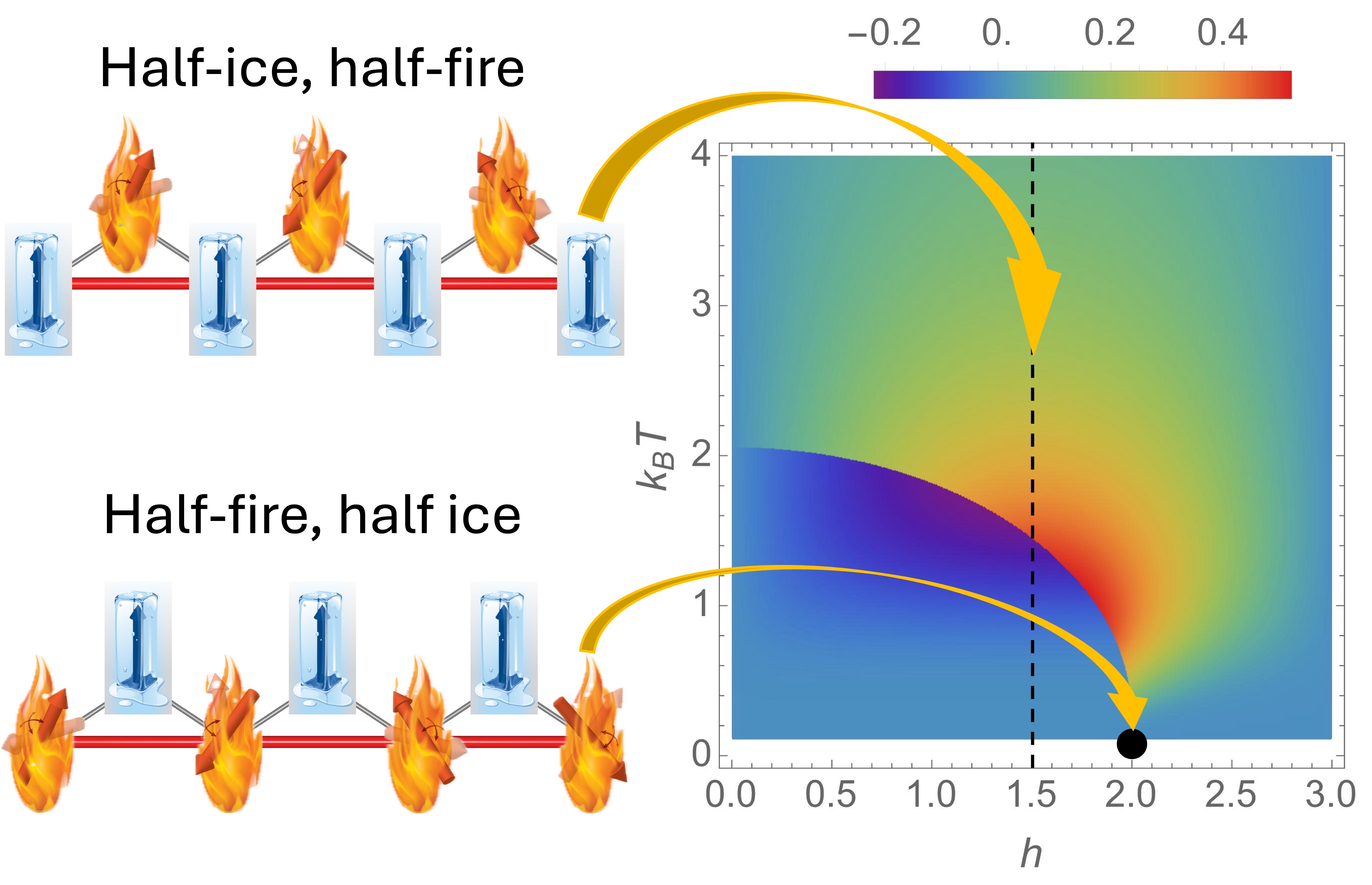
'Half ice, half fire': Physicists discover new phase of matter in a magnetic material. A twin state of “half fire, half ice”.

Amazing stuff!

"Two scientists ... have discovered a new phase of matter while studying a model system of a magnetic material.

The phase is a never-before-seen pattern of electron spins — the tiny “up” or “down” magnetic moments carried by every electron. It consists of a combination of highly ordered spins and highly disordered spins. The highly ordered spins are referred to as “cold,” while the highly disordered spins are “hot,” which led the researchers to dub the new phase “half ice, half fire.” They discovered the phase while studying a one-dimensional model of a type of magnetic material called a ferrimagnet. ...

The “half-ice, half-fire” phase is the twin state of the “half-fire, half-ice” phase discovered ... 2015 ... They describe the discovery in a paper published in early 2024. ...

studying Sr3CuIrO6, a magnetic compound of strontium, copper, iridium, and oxygen ..."


From the abstract:
"The notion of “half fire, half ice” was recently introduced to describe an exotic macroscopic ground-state degeneracy emerging in a ferrimagnet under the critical magnetic field, in which the “hot” spins are fully disordered on the sublattice with smaller magnetic moments and the “cold” spins are fully ordered on the sublattice with larger magnetic moments.
Here, we further point out that this state has a twin named “half ice, half fire” in which the hot and cold spins switch positions. The new state is an excited state—thus hidden in the ground-state phase diagram—and is robust with respect to the interactions that destroy the half-fire, half-ice state.
We demonstrate with exact results how this hidden state can drive phase switching at desirable finite temperature, even for the one-dimensional Ising model where phase transition at finite temperature is forbidden. We suggest that our findings may open a new door to the understanding and controlling of phase competition and transition in unconventional frustrated systems."

'Half ice, half fire': Physicists discover new phase of matter in a magnetic material

Brookhaven Physicists Discover New Phase of Matter in a Magnetic Material (original news release) "The "half-ice, half-fire" phase, a twin to the recently discovered "half-fire, half-ice" state, opens a new route of potential physics discovery"


This image shows a graphical interpretation of the "half-ice, half-fire" and "half-fire, half-ice" states (left). The plot (right) shows the magnetic entropy change in the magnetic field (h) versus temperature (T) plane. The black dot at zero temperature indicates where the half-fire, half-ice state appears. The dashed line indicates where the half-ice, half-fire state hides.


Thursday, March 06, 2025

New Fundamental Magnetic Law Uncovered

Amazing stuff!

"... However, a profound difference between the quantized lattice electric excitations—such as phonons—and spin excitations—such as paramagnetic and antiferromagnetic spin resonances and magnons—has now been unveiled in terms of their corresponding contributions to the static electric susceptibility and magnetic permeability. Viktor Rindert of Lund University in Sweden and his collaborators have derived and verified a formula that relates a material’s magnetic permeability to the frequencies of magnetic spin resonances. Whereas a well-established formula for the dielectric function—the electric equivalent of magnetic permeability—features a quadratic dependence on phonon frequencies, the new magnetic formula features a linear dependence on magnetic frequencies. Just as significant as the formula itself is the way in which it was validated, using a new optical technique that is set to be broadly useful for characterizing spintronic materials. ..."

From the abstract:
"We describe a magnetic relation in analogy to the well-known dielectric Lyddane-Sachs-Teller relation ... This magnetic relation follows directly from the model equations for nuclear induction due to fast oscillating electromagnetic fields ... and relates the static permeability with the product over all ratios of antiresonance and resonance frequencies associated with all magnetic excitations within a given specimen. The magnetic relation differs significantly from its dielectric analog where the static properties are related to ratios of the squares of resonance frequencies. We demonstrate the validity of the magnetic Lyddane-Sachs-Teller relation using optical magnetization data from terahertz electron magnetic resonance spectroscopic ellipsometry measurements in the presence of an external magnetic field on an iron-doped semiconductor crystal of gallium nitride."

Physics - New Fundamental Magnetic Law Uncovered "A new formula that connects a material’s magnetic permeability to spin dynamics has been derived and tested 84 years after the debut of its electric counterpart."

Magnetic Lyddane-Sachs-Teller Relation (open access)


Figure 1: Left: The original Lyddane-Sachs-Teller (LST) relation specifies the dielectric function in terms of the frequencies of lattice vibrations. Right: The new formula for magnetic LST specifies the magnetic permeability in terms of the precession frequencies of magnetic dipoles.


Friday, January 31, 2025

Physicists discover — and explain — unexpected magnetism in an atomically thin material tri-layer graphene

Amazing stuff! Superimposed, hierarchical moire lattices.

"MIT physicists have created a new ultrathin, two-dimensional material with unusual magnetic properties that initially surprised the researchers before they went on to solve the complicated puzzle behind those properties’ emergence. As a result, the work introduces a new platform for studying how materials behave at the most fundamental level — the world of quantum physics. ...

worked with three layers of graphene. Each layer was twisted on top of the next at the same angle, creating a helical structure akin to the DNA helix or a hand of three cards that are fanned apart.

“Helicity is a fundamental concept in science, from basic physics to chemistry and molecular biology. With 2D materials, one can create special helical structures, with novel properties which we are just beginning to understand. This work represents a new twist in the field of twistronics ..." ...

Twistronics can lead to new properties in ultrathin materials because arranging sheets of 2D materials in this way results in a unique pattern called a moiré lattice. And a moiré pattern, in turn, has an impact on the behavior of electrons. ...

In the current work, the helical structure created by the three graphene layers forms two moiré lattices. One is created by the first two overlapping sheets; the other is formed between the second and third sheets.

The two moiré patterns together form a third moiré, a supermoiré, or “moiré of a moiré,” ... “It’s like a moiré hierarchy.” While the first two moiré patterns are only nanometers, or billionths of a meter, in scale, the supermoiré appears at a scale of hundreds of nanometers superimposed over the other two. ..."

From the abstract:
"The intrinsic anomalous Hall effect (AHE) is driven by non-zero Berry curvature and spontaneous time-reversal symmetry breaking. This effect can be realized in two-dimensional moiré systems hosting flat electronic bands but is not usually seen in inversion-symmetric materials.
Here, we show that this physics is manifested in helical trilayer graphene—three graphene layers, each twisted in sequence by the same angle—although the system retains global in-plane inversion symmetry.
We uncover a phase diagram of correlated and magnetic states at a magic twist angle of 1.8∘, which is explained by a lattice relaxation that leads to the formation of large periodic domains where in-plane inversion symmetry is broken on the moiré scale.
Each domain harbours flat topological bands with opposite Chern numbers in the two valleys. We find correlated states at multiple integer and fractional electron fillings per moiré unit cell and an AHE at a subset of them. The AHE disappears above a critical electric displacement field at one electron per unit cell, indicating a topological phase transition. We establish helical trilayer graphene as a platform that presents an opportunity to engineer topology due to its emergent moiré-scale symmetries."

Physicists discover — and explain — unexpected magnetism in an atomically thin material | MIT News | Massachusetts Institute of Technology "The work introduces a new platform for studying quantum materials."

Monday, January 06, 2025

Physicists magnetize a material with light

Amazing stuff!

"... Using carefully tuned terahertz light, the ... team was able to controllably switch an antiferromagnet to a new magnetic state. Antiferromagnets could be incorporated into future memory chips that store and process more data while using less energy and taking up a fraction of the space of existing devices, owing to the stability of magnetic domains. ...

researchers report using a terahertz laser — a light source that oscillates more than a trillion times per second — to directly stimulate atoms in an antiferromagnetic material. The laser’s oscillations are tuned to the natural vibrations among the material’s atoms, in a way that shifts the balance of atomic spins toward a new magnetic state. ..."

From the abstract:
"Controlling the functional properties of quantum materials with light has emerged as a frontier of condensed-matter physics, leading to the discovery of various light-induced phases of matter, such as superconductivity, ferroelectricity, magnetism and charge density waves. However, in most cases, the photoinduced phases return to equilibrium on ultrafast timescales after the light is turned off, limiting their practical applications.
Here we use intense terahertz pulses to induce a metastable magnetization with a remarkably long lifetime of more than 2.5 milliseconds in the van der Waals antiferromagnet FePS3. The metastable state becomes increasingly robust as the temperature approaches the antiferromagnetic transition point, suggesting that critical order parameter fluctuations play an important part in facilitating the extended lifetime.
By combining first-principles calculations with classical Monte Carlo and spin dynamics simulations, we find that the displacement of a specific phonon mode modulates the exchange couplings in a manner that favours a ground state with finite magnetization near the Néel temperature. This analysis also clarifies how the critical fluctuations of the dominant antiferromagnetic order can amplify both the magnitude and the lifetime of the new magnetic state. Our discovery demonstrates the efficient manipulation of the magnetic ground state in layered magnets through non-thermal pathways using terahertz light and establishes regions near critical points with enhanced order parameter fluctuations as promising areas to search for metastable hidden quantum states."

Physicists magnetize a material with light | MIT News | Massachusetts Institute of Technology "The technique provides researchers with a powerful tool for controlling magnetism, and could help in designing faster, smaller, more energy-efficient memory chips."


THz field-induced non-equilibrium state with a net magnetization a,d,g, THz field-induced long-lived polarization rotation


Saturday, November 09, 2024

Magnet-cooled crystals could help liquefy hydrogen fuel based on the giant magnetocaloric effect

Good news! A "giant" effect? 😊

Still, the million dollar question is how safe will be the handling of hydrogen overall? Remember, e.g. the Hindenburg disaster of 1937!

"Researchers have made a material capable of cooling substances down to -253°C – enough to liquefy hydrogen – using magnets.

They say their research ... could provide a cheaper and more sustainable way to supercool hydrogen fuel for storage and transport.

The researchers tapped into the “magnetocaloric effect”: applying magnetic fields to certain substances can change their temperature. ...

The pink crystals could cool to 20 Kelvin, or -253°C. Just 20°C above absolute zero, this is cool enough to prompt the condensation of hydrogen, rendering it a liquid. ..."

"... Blake used magnetocaloric cooling to reach 20°K, cold enough to liquify hydrogen. This has been done before, but only with materials containing rare-earth metals. ..."

From the abstract:
"Magnetic refrigeration, which utilizes the magnetocaloric effect, can provide a viable alternative to the ubiquitous vapor compression or Joule-Thompson expansion methods of refrigeration. For applications such as hydrogen gas liquefaction, the development of magnetocaloric materials that perform well in moderate magnetic fields without using rare-earth elements is highly desirable. Here we present a thorough investigation of the structural and magnetocaloric properties of a novel layered organic-inorganic hybrid coordination polymer Co4(OH)6(SO4)2[enH2] (enH2 = ethylenediammonium). Heat capacity, magnetometry and direct adiabatic temperature change measurements using pulsed magnetic fields reveal a field-dependent ferromagnetic second-order phase transition at 10 K << 15 K. Near the hydrogen liquefaction temperature and in a magnetic field change of 1 T, a large maximum value of the magnetic entropy change,  = − 6.31 J kg−1 K−1, and an adiabatic temperature change, 
 = 1.98 K, are observed. These values are exceptional for rare-earth-free materials and competitive with many rare-earth-containing alloys that have been proposed for magnetic cooling around the hydrogen liquefaction range."

Magnet-cooled crystals could help liquefy hydrogen fuel