Showing posts with label standards. Show all posts

Monday, August 31, 2026

Anthropic is developing software hardware standard that makes it much easier for AI agents to operate laboratory and manufacturing equipment

Good news!

"... The system, called the Model Hardware Standard, allows AI models to control and coordinate devices from different manufacturers through a standardized interface.
Anthropic claims the system can reduce the time it takes a typical lab or factory to integrate its equipment with AI from weeks to just a few hours, making it much easier to set up autonomous experiments. A select group of research labs and manufacturers are currently testing the system, but it is ultimately intended to be open source. ..."

"We’re opening a research preview of the Model Hardware Standard (MHS), a shared specification for AI agents to safely operate physical devices, to a first group of scientific research labs and advanced manufacturers. MHS enables AI agents to operate multiple lab and manufacturing instruments, such as microscopes, liquid handlers, and robotic arms, in parallel, and perform intricate tasks ranging from routine drug discovery experiments to laser calibration on a quantum computer. ...

Getting multiple devices in a lab or on a factory floor to communicate with one another can be challenging, even setting aside the added difficulty of integrating AI into the setup.
Each device tends to have its own programming interface, and so far there has been no standardized way to integrate them. And once the devices are connected, there is no common way for them to share data with an AI agent, nor to let the agent operate them safely.

MHS addresses these challenges by introducing a standardized driver: software that translates between a computer’s operating system and a hardware device. The MHS driver uses a simple set of primitives—commands like “read” (for example, “get temperature”) or “write” (for example, “set temperature”)—that any hardware device can understand and act on.
And it makes each device discoverable in a standard format, so that devices and agents can find each other and communicate across networks without needing a bespoke “translator” program in between.

The MHS driver also helps an AI agent understand how to use a device it has never seen before, giving it information about machine characteristics that may not be discernable from code alone (for example, the weight of a robot arm, which is important for knowing how to manipulate it safely). ..."

Doomslayer: Progress Roundup - by Malcolm Cochran


Sunday, August 02, 2026

Israel prepares standardization regulation for robotaxis in 2027 based on UNECE approved international regulation WP.29

Bad news! What is the rush about?

Was this smart to follow the United Nations Economic Commission for Europe (UNECE)? I doubt it. This UNECE seems to be preoccupied with issues like the climate change hoax, sustainability and the like.

"At the end of June 2026, the UNECE approved the world's first global regulatory framework for fully autonomous driving systems (ADS)" (Google Search)

"In the second half of 2027, regulations will come into effect in Israel to allow driving in vehicles with advanced autonomous assistance systems, sources in the Ministry of Transport believe. Local regulations on the subject have been in the process of being formulated in government ministries for over five years, but their implementation has been delayed, due to the lack of organized international standards and legal problems.

However, at the end of June, the UN's central standardization body (UNECE) approved an international regulation that regulates the standardization of autonomous vehicles allowed to travel on public roads. According to the sources, it constitutes a "breakthrough that will accelerate the process."

This is the first comprehensive international regulation of its kind that regulates fully autonomous systems for autonomy level 4 and above - vehicles that can drive in a controlled environment with minimal driver intervention. ...

The automotive industry estimates that in the first phase, adoption will focus on commercial fleets that travel on limited and demarcated routes, such as "robot taxis" (robotaxis), autonomous unloading cranes at ports and designated buses. ..."

"Main takeaways 
  • World’s first driverless-vehicle regulation — UNECE’s WP.29 has approved the first global framework that legally enables fully autonomous driving systems (ADS).  
  • Harmonized global safety rules — The regulation mandates Safety Management Systems, credible testing, safety‑case validation, and continuous in‑service monitoring. 
  • Backed by major auto markets — the US, China, EU, Japan, Canada, and the UK support the framework, accelerating worldwide deployment. 
  • Accompanied by updates to existing UN vehicle regulations framework to make it fit for autonomous driving era
..."

Israel prepares regulation for robotaxis in 2027 - Globes "International regulation approved by the UNECE at the end of June is likely to come into effect in Israel in the second half of 2027."

Tuesday, January 06, 2026

Shanghai AI Lab releases open protocol to connect scientific research agents

Good news! The dawn of automated scientific research thanks to ML & AI!

"The Shanghai Artificial Intelligence Laboratory released the Science Context Protocol, an open-source standard designed to connect AI agents, researchers, and lab equipment across institutional boundaries. SCP builds on Anthropic’s Model Context Protocol by adding structured experiment metadata, centralized hub architecture for coordinating multiple agents, intelligent workflow orchestration, and standardized drivers for lab devices.
The protocol already supports over 1,600 scientific tools spanning biology, physics, chemistry, and materials science, and enables automated workflows from experimental design through execution and validation. Researchers can deploy their own SCP infrastructure or use the lab’s hosted Intern-Discovery platform to register and share resources."

From the abstract:
"We introduce SCP: the Science Context Protocol, an open-source standard designed to accelerate discovery by enabling a global network of autonomous scientific agents.
SCP is built on two foundational pillars:
(1) Unified Resource Integration: At its core, SCP provides a universal specification for describing and invoking scientific resources, spanning software tools, models, datasets, and physical instruments. This protocol-level standardization enables AI agents and applications to discover, call, and compose capabilities seamlessly across disparate platforms and institutional boundaries.
(2) Orchestrated Experiment Lifecycle Management: SCP complements the protocol with a secure service architecture, which comprises a centralized SCP Hub and federated SCP Servers.
This architecture manages the complete experiment lifecycle (registration, planning, execution, monitoring, and archival), enforces fine-grained authentication and authorization, and orchestrates traceable, end-to-end workflows that bridge computational and physical laboratories.
Based on SCP, we have constructed a scientific discovery platform that offers researchers and agents a large-scale ecosystem of more than 1,600 tool resources. Across diverse use cases, SCP facilitates secure, large-scale collaboration between heterogeneous AI systems and human researchers while significantly reducing integration overhead and enhancing reproducibility.
By standardizing scientific context and tool orchestration at the protocol level, SCP establishes essential infrastructure for scalable, multi-institution, agent-driven science."

Data Points: Meta buys Manus for its agentic tech


Tuesday, December 23, 2025

New Google project builds app UIs using structured, declarative data

Good news! Amazing stuff! Declare the app user interface and AI agents will build it for you!

"Google released A2UI, an open-source project that lets AI agents generate user interfaces that render securely across different platforms and frameworks. The system uses a declarative JSON format that allows agents to compose interfaces from pre-approved component catalogs, avoiding the security risks of executing AI-generated code while giving host applications full control over styling and branding.
A2UI works with various UI frameworks including Lit, Angular, and Flutter, and integrates with Google's Agent-to-Agent protocol to enable remote agents to send interface descriptions as messages rather than executable code.
The project includes renderers, component libraries, and sample implementations like a restaurant booking agent that can generate date pickers and time selectors instead of relying on text-only chat interactions. Google built A2UI in partnership with teams including AG UI, CopilotKit, Opal, Gemini Enterprise, and Flutter, with the code now available on GitHub for community collaboration.
"

"... We are entering the era of the multi-agent mesh. Agents from Google are talking to agents from Cisco, IBM, SAP, and Salesforce to solve complex tasks. This is why we collectively created the Agent-to-Agent (A2A) Protocol and donated it to the Linux Foundation: to enable agents to collaborate even when they don’t share memory, tools, or context.

However, this decentralization creates a user interface problem.

If your agent lives inside your application, it can directly manipulate the view layer (e.g. DOM).

But in a multi-agent world, the agent doing the work is often remote—running in the background, on a different server, or owned by a different organization. It cannot touch your UI directly; it must send messages.

Historically, rendering UI from a remote, untrusted source meant sending HTML or JavaScript and sandboxing it inside iframes. This approach is heavy, can be visually disjointed (it rarely matches your app's native styling), and introduces complexity around security boundaries. ...

Core philosophy: Secure, updateable, and decoupled

We designed A2UI around a few key principles:

  • Security first: Running arbitrary code generated by an LLM may present a significant security risk. A2UI is a declarative data format, not executable code. Your client application maintains a "catalog" of trusted, pre-approved UI components (e.g., Card, Button, TextField), and the agent can only request to render components from that catalog. This helps you to reduce the risk of UI injection and other vulnerabilities.
  • LLM-friendly and incrementally updateable: The UI is represented as a flat list of components with ID references which is easy for LLMs to generate incrementally, allowing for progressive rendering and a responsive user experience. An agent can efficiently make incremental changes to the UI based on new user requests as the conversation progresses.
  • Framework-agnostic and portable: A2UI separates the UI structure from the UI implementation. The agent sends a description of the component tree and its associated data model. Your client application is responsible for mapping these abstract descriptions to its native widgets—be it web components, Flutter widgets, React components, SwiftUI views or something else entirely. The same A2UI JSON payload from an agent can be rendered on multiple different clients built on top of different frameworks. ..."

Introducing A2UI: An open project for agent-driven interfaces

Data Points newsletter


Supported integrations


Friday, September 19, 2025

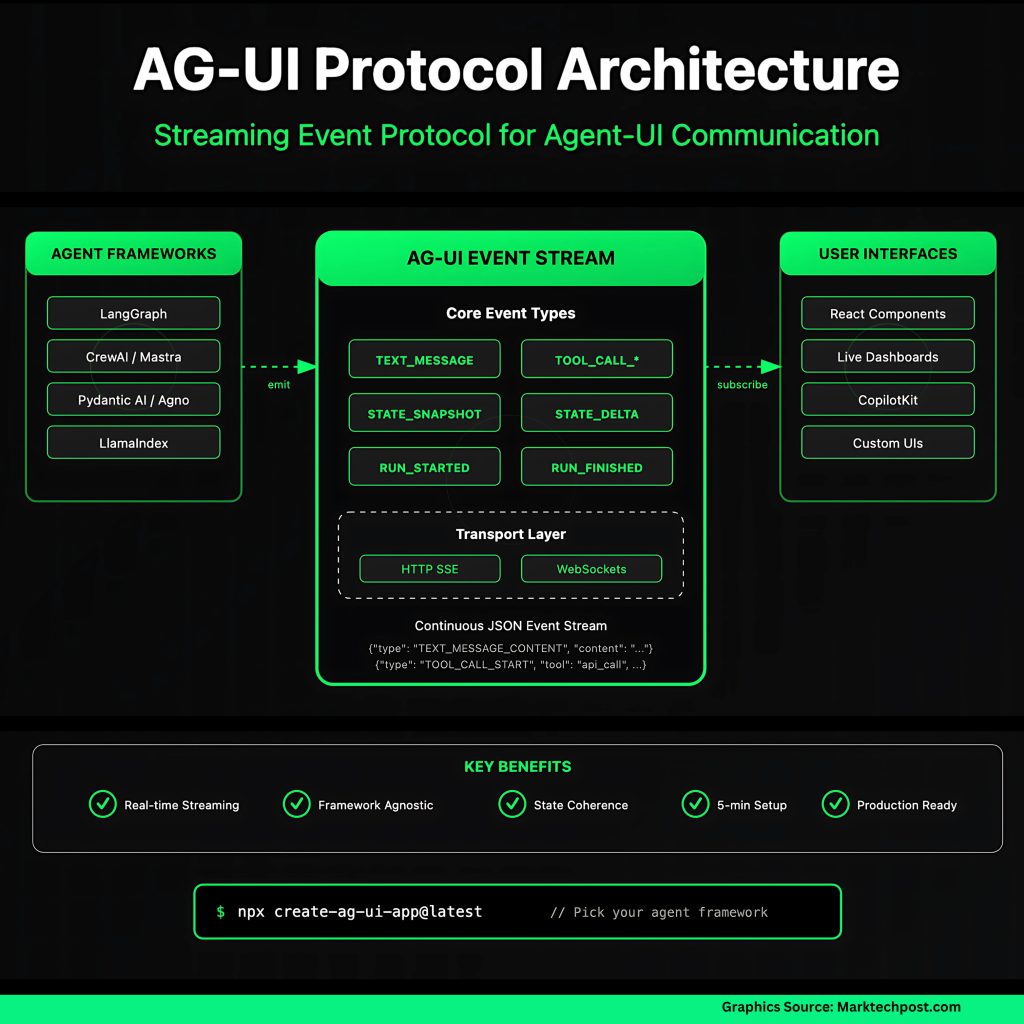
Bringing AI Agents Into Any UI: The AG-UI Protocol for Real-Time, Structured Agent–Frontend Streams

Good news! More standardisation is coming to ML & AI!

"AI agents are no longer just chatbots that spit out answers. They’re evolving into complex systems that can reason step by step, call APIs, update dashboards, and collaborate with humans in real time. But this raises a key question: how should agents talk to user interfaces? ..."

Bringing AI Agents Into Any UI: The AG-UI Protocol for Real-Time, Structured Agent–Frontend Streams - MarkTechPost


"Where does AGUI fit in the agentic protocol stack?
AG-UI is complementary to the other 2 top agentic protocols

MCP gives agents tools
A2A allows agents to communicate with other agents
AG-UI brings agents into user-facing applications"


Tuesday, July 29, 2025

Spatial Web standard 2025: Transforming Device Interactions

Standards rule the world!

"... Today, following the social media revolution, a new phase of the Internet is emerging. The Spatial Web promises to connect a physical world full of devices, phones, wearables, robots, drones, and even AI agents. In May, the IEEE Standards Association ... ratified a set of standards (IEEE 2874-2025) that defines the Spatial Web.

The original World Wide Web introduced the idea of URLs that point to HTML files, which are accessed remotely via the HTTP standard.

Now the Spatial Web puts forward a new set of defining principles. HSML (Hyperspace Modelling Language) behaves like nouns and verbs on the Spatial Web, describing what an entity is and what it does.
HSTP (Hyperspace Transaction Protocol) behaves like the Spatial Web’s grammar, defining how each entity functions and how it can interact with others.
And the UDG (Universal Domain Graph) acts as the directory that keeps track of every entity along with its activities and relationships.  ..."

"This standard describes the services, hypergraphs, protocols, and languages that enable interoperable, semantically compatible connections between network-connected hardware (e.g. autonomous drones, sensors, loT devices, robots) and software (e.g. user agents, services, platforms, applications, artificial intelligence systems) and includes specifications for: ⎯a functional layer stack capable of fulfilling spatially defined real-world and virtual requests for digital content respectful of governance authorities and self-sovereign identity
⎯a spatial range query and response format for requesting content or data about assets within a dimensional range 
⎯a data ontology for describing objects, relationships, and activities
⎯a verifiable credentialing and certification method for permissioning create-retrieve-update-delete access to devices, locations, users, and data
⎯a human and machine-readable contracting language that enables the expression and automated execution of legal, financial, and physical activities
This standard is identical in content to a base document developed by the Spatial Web Foundation and provided to the lEEE P2874 Spatial Web, Architecture and Governance Working Group for standardization."

Spatial Web: Transforming Device Interactions - IEEE Spectrum "The Spatial Web standard connects devices, robots, and AI agents"