Good news!
Showing posts with label space exploration. Show all posts
Showing posts with label space exploration. Show all posts
Saturday, September 12, 2026

Thursday, September 10, 2026
Europe's The Exploration Company (TEC) nabs $450 million to challenge SpaceX
Good news! Europe is trying to catch up with the US, India, and China.
Just a few days ago German Isar Aerospace achieves first launch to orbit from continental Europe (Norway).
"... TEC’s timeline is more pragmatic, but it is tight. Its most immediate focus is Nyx, a reusable capsule akin to SpaceX’s Dragon and capable of carrying cargo, then people. The company intends to get Nyx to dock with the soon-to-be-retired International Space Station and return safely to Earth by November 2028. ..."
History for European spaceflight: Isar Aerospace reaches orbit and deploys payloads on second flight (original news release)
No caption available for this photo (presumably the launch of the German rocket in Norway)

Thursday, May 07, 2026
India's first space tech unicorn emerges as Skyroot Aerospace gears up for orbital launch
Good news!
"Skyroot Aerospace has become India’s first space tech unicorn after raising $60 million in a new investment ahead of the maiden orbital launch of its Vikram-1 rocket in the coming weeks.
The funding round valued the Hyderabad-based startup at $1.1 billion on a pre-money basis ...
The investment comes as Skyroot prepares for the first orbital launch attempt by an Indian private company. The Vikram-1 rocket was flagged off to India’s spaceport on the southern island of Sriharikota in April, and the startup is targeting a June launch after completing flight qualification tests and beginning integration and launch campaign activities. ..."
Skyroot co-founders Naga Bharath Daka (left) and Pawan Kumar Chandana (Right)

Wednesday, March 18, 2026
Spaceflight supercharges anti-bacterial viruses thanks to microgravity
Amazing stuff! Good news!
"Viruses that infect bacteria, called phages, evolve different strategies to infect their targets on the International Space Station than they do on the ground, which could help create new treatments for antibiotic-resistant infections.
Researchers found that the phages took longer to infect E.coli in microgravity, and that the viruses developed microgravity-specific mutations, some of which helped them to better cling onto bacterial receptors.
Once they returned to earth, they were able to kill stubborn strains of E.coli responsible for urinary tract infections that tend to be resistant to bacteriophages."
"... Once the viruses adapted to microgravity by subtly shape-shifting, though, they became even more effective bacteria killers. “A simple microgravity experiment exposes these mutations that have much higher efficacy against pathogens,” ..."
From the abstract:
"Bacteriophage–host interactions play a fundamental role in shaping microbial ecosystems. While extensively studied on Earth, their behavior in microgravity remains largely unexplored.
Here, we report the dynamics between T7 bacteriophage and Escherichia coli in microgravity aboard the International Space Station (ISS). Phage activity was initially delayed in microgravity but ultimately successful.
We identified de novo mutations in both phage and bacteria that enhanced fitness in microgravity. Deep mutational scanning of the phage receptor binding domain revealed striking differences in the number, position, and mutational preferences between terrestrial and microgravity conditions, reflecting underlying differences in bacterial adaptation. Combinatorial libraries informed by microgravity selections yielded T7 variants capable of productively infecting uropathogenic E. coli resistant to wild-type T7 under terrestrial conditions. These findings help lay the foundation for future research on the impact of microgravity on phage–host interactions and microbial communities and the terrestrial benefits of this research."
Spaceflight supercharges viruses’ ability to infect bacteria "Viruses develop tricks to attack bacteria without the help of gravity"
Fig 1. Experimental design to evaluate microgravity interactions on the ISS.

Sunday, February 22, 2026
Atom-thin electronics withstand space radiation, potentially surviving for centuries in orbit
Amazing stuff!
"Atom-thick layers of molybdenum disulfide are ideally suited for radiation-resistant spacecraft electronics ...
One particularly promising route forward involves highly conductive, ultra-thin materials such as molybdenum disulfide (MoS₂). Just a single layer of atoms thick—around 0.7 nanometers—the material has already proven remarkably robust against radiation-induced defects in previous laboratory studies.
In their latest work, Zhou's team subjected the material to its most rigorous test yet. They began by growing monolayer MoS₂ using it to fabricate a transistor-based, radio-frequency communications system. The circuits were then exposed to powerful bursts of gamma rays, delivering doses comparable to those experienced by electronics operating in space. ..."
From the abstract:
"Integrated circuits for communications play an enabling role when it comes to outer-space exploration thanks to their small footprint and low weight. However, owing to the severe irradiation effects of space energetic particles, the implementation of radiation-tolerant electronic circuits remains a challenge.
Here we report the observation of the space radiation effect on a satellite-based device and find that atomically thin materials are expected to accumulate minimal radiation-induced damage in principle. Accordingly, on the basis of a 4-inch wafer-scale monolayer 2D MoS2 process, we implement an atomic-layer transistor-based radiation-tolerant radio frequency (RF, 12–18 GHz) system with both transmitters and receivers for spaceborne communication.
For on-orbit experiments, the 2D communication system was successfully launched to the approximately 517 km low Earth orbit.
Notably, the system maintains a bit error rate (BER) of less than 10−8 in the transmitted data after 9 months of on-orbit operation, indicating substantial radiation tolerance and long stability.
The lifespan of the 2D communication system is predicted to be about 271 years even on the geosynchronous orbit with a much harsher radiation environment. This work showcases the unique prospects of 2D electronics for spaceborne applications."
Radiation-tolerant atomic-layer-scale RF system for spaceborne communication (no public access)
Atom-thick circuit made from radiation-resistant molybdenum disulfide

Friday, January 16, 2026
Isar Aerospace targets second launch not earlier than 21 January 2026
The German/European answer to SpaceX? 😊
"Space company Isar Aerospace is approaching its second flight and qualification mission from the company’s dedicated launch complex at Andøya Space in Norway, further advancing Europe’s sovereign space capability. The launch is targeted for not earlier than 21 January ...
“This qualification flight is a deliberate step toward delivering sovereign access to space for Europe and allied nations. ...
Mission ‘Onward and Upward’ aims at validating the launch vehicle’s critical systems under operational conditions. It is Isar Aerospace’s first flight to carry payloads with five CubeSats and one experiment. ...
Headquartered near Munich, Germany, Isar Aerospace was founded in 2018 and has grown to over 400 employees from more than 50 nations, working across 5 international locations. Private funding from international investors provides strong backing for the company’s pioneering approach to scale and industrialize launch vehicle production through vertical integration. ..."


Saturday, January 03, 2026
The Atomic Engine: US Unveils Nuclear Rocket to Dominate Space!
Recommendable! However, this technology is still in development.
Wednesday, December 24, 2025
India Sets New Record: ISRO Launches Heaviest Satellite Ever of 6000kg for US company with Palki Sharma
Good news! It "was placed into [low] orbit with an accuracy of under two kilometres of precision", by itself this is a great feat! This communication satellite will provide "mobile internet directly to smartphones".
Sunday, December 21, 2025
Currently 2.8 days to a low orbit collision disaster according to a new CRASH clock
Bad news! Is the low orbit space becoming overcrowded? Then there is already all the existing space junk floating. Questions like this were frequently raised during the past several decades. Like questions about space junk.
I have just blogged here about the debris dangers to air traffic caused by the recent explosion of the SpaceX Starship.
Recent news suggest there are plans to build data centers in space and so on.
"... Calculations show that, across all low-Earth orbit mega-constellations, a "close approach," defined as two satellites passing by each at less than 1km separation, occurs every 22 seconds. For Starlink alone, that number is once every 11 minutes. Another known metric of Starlink is that, on average, each of the thousands of satellites have to perform 41 maneuvers per year to avoid running into other objects in their orbit. ..."
From the abstract:
"The number of objects in orbit is rapidly increasing, primarily driven by the launch of megaconstellations, an approach to satellite constellation design that involves large numbers of satellites paired with their rapid launch and disposal. While satellites provide many benefits to society, their use comes with challenges, including the growth of space debris, collisions, ground casualty risks, optical and radio-spectrum pollution, and the alteration of Earth's upper atmosphere through rocket emissions and reentry ablation.
There is substantial potential for current or planned actions in orbit to cause serious degradation of the orbital environment or lead to catastrophic outcomes, highlighting the urgent need to find better ways to quantify stress on the orbital environment.
There is substantial potential for current or planned actions in orbit to cause serious degradation of the orbital environment or lead to catastrophic outcomes, highlighting the urgent need to find better ways to quantify stress on the orbital environment.
Here we propose a new metric, the CRASH Clock, that measures such stress in terms of the time it takes for a catastrophic collision to occur if there are no collision avoidance manoeuvres or there is a severe loss in situational awareness. Our calculations show the CRASH Clock is currently 2.8 days, which suggests there is now little time to recover from a wide-spread disruptive event, such as a solar storm. This is in stark contrast to the pre-megaconstellation era: in 2018, the CRASH Clock was 121 days."
RSO = resident space object

Friday, December 19, 2025
Strongest hints yet of biological activity outside the solar system
Amazing stuff! We are not alone!
hycean planet (from Hydrogen + Ocean)
"A team led by Cambridge astronomers detected the most promising signs yet of a possible biosignature outside the solar system, although they remain cautious. The team found signs of specific chemicals – on Earth, chemicals only produced by life – in the atmosphere of the exoplanet K2-18b, which orbits its star in the habitable zone."
"Using data from the James Webb Space Telescope (JWST), the astronomers, led by the University of Cambridge, have detected the chemical fingerprints of dimethyl sulfide (DMS) and/or dimethyl disulfide (DMDS), in the atmosphere of the exoplanet K2-18b, which orbits its star in the habitable zone. ..."
From the abstract:
"The sub-Neptune frontier has opened a new window into the rich diversity of planetary environments beyond the solar system. The possibility of hycean worlds, with planet-wide oceans and H2-rich atmospheres, significantly expands and accelerates the search for habitable environments elsewhere.
Recent JWST transmission spectroscopy of the candidate hycean world K2-18 b in the near-infrared led to the first detections of the carbon-bearing molecules CH4 and CO2 in its atmosphere, with a composition consistent with predictions for hycean conditions.
The observations also provided a tentative hint of dimethyl sulfide (DMS), a possible biosignature gas, but the inference was of low statistical significance.
We report a mid-infrared transmission spectrum of K2-18 b obtained using the JWST MIRI LRS instrument in the ∼6–12 μm range. The spectrum shows distinct features and is inconsistent with a featureless spectrum at 3.4σ significance compared to our canonical model. We find that the spectrum cannot be explained by most molecules predicted for K2-18 b, with the exception of DMS and dimethyl disulfide (DMDS), also a potential biosignature gas.
We report new independent evidence for DMS and/or DMDS in the atmosphere at 3σ significance, with high abundance (≳10 ppmv) of at least one of the two molecules.
More observations are needed to increase the robustness of the findings and resolve the degeneracy between DMS and DMDS. The results also highlight the need for additional experimental and theoretical work to determine accurate cross sections of important biosignature gases and identify potential abiotic sources. We discuss the implications of the present findings for the possibility of biological activity on K2-18 b."
The observations also provided a tentative hint of dimethyl sulfide (DMS), a possible biosignature gas, but the inference was of low statistical significance.
We report a mid-infrared transmission spectrum of K2-18 b obtained using the JWST MIRI LRS instrument in the ∼6–12 μm range. The spectrum shows distinct features and is inconsistent with a featureless spectrum at 3.4σ significance compared to our canonical model. We find that the spectrum cannot be explained by most molecules predicted for K2-18 b, with the exception of DMS and dimethyl disulfide (DMDS), also a potential biosignature gas.
We report new independent evidence for DMS and/or DMDS in the atmosphere at 3σ significance, with high abundance (≳10 ppmv) of at least one of the two molecules.
More observations are needed to increase the robustness of the findings and resolve the degeneracy between DMS and DMDS. The results also highlight the need for additional experimental and theoretical work to determine accurate cross sections of important biosignature gases and identify potential abiotic sources. We discuss the implications of the present findings for the possibility of biological activity on K2-18 b."
Strongest hints yet of biological activity outside the solar system "Astronomers have detected the most promising signs yet of a possible biosignature outside the solar system, although they remain cautious."
Transmission spectrum of the habitable zone exoplanet K2-18 b using the JWST MIRI spectrograph.

Thursday, December 11, 2025
Why Tech Giants Are Racing to Put AI in Orbit with Palki Sharma
Recommendable! Nice overview! I am not convinced this works. In addition, I bet in about 5-10 years humanity will have solved the large energy consumption problem involved with AI.
Friday, December 05, 2025
A Russian cosmonaut turned out to be a spy and was removed from SpaceX mission
Well Putin the Terrible himself was a KGB agent!
"A Russian cosmonaut was removed from SpaceX’s February mission after allegedly photographing classified SpaceX engines and documentation at company headquarters, violating U.S. national security laws."
Russian cosmonaut Oleg Artemyev

Tuesday, December 02, 2025
Soyuz Mishap Cripples Russia's Only Crewed Launch Pad at the Baikonur Cosmodrome
More worries for Putin the Terrible!
"... Site 31/6 at the Baikonur Cosmodrome includes an essential piece of equipment used to prepare the rockets for launch. Called the 8U216 Maintenance Cabin, it's a mobile metal platform designed to provide technicians with pre-launch access to the lower section of the rocket, including the first- and second-stage engines. When it has completed its job, the cabin is lowered into the blast deflection pit and slid sideways into a protective alcove sealed by a metal screen.
Normally, with the cabin safely tucked away, the exhaust from the rocket shoots by it harmlessly, but on the latest launch the cabin either broke loose from its mooring or was never properly locked down. As a result, the one million pounds of thrust from the Soyuz pulled the 144-tonne cabin out and tossed it into the blast pit 20 m (66 ft) below, where it was catastrophically damaged. ..."
Normally, with the cabin safely tucked away, the exhaust from the rocket shoots by it harmlessly, but on the latest launch the cabin either broke loose from its mooring or was never properly locked down. As a result, the one million pounds of thrust from the Soyuz pulled the 144-tonne cabin out and tossed it into the blast pit 20 m (66 ft) below, where it was catastrophically damaged. ..."
MS-28 lifting off

Thursday, November 27, 2025
PM Modi unveils India's First Private Orbital Rocket Vikram-1 with Palki Sharma
Good news! Very impressive!
Monday, November 10, 2025
Vast Space's Haven Demo Launches to Test Commercial Space Station
Private sector versus public sector!
"It may look like an ordinary satellite, but the recently launched Haven Demo is a major step toward the first commercial space station. Built by Vast, the 1,100-lb (500-kg) uncrewed spacecraft will test core systems of the planned Haven-1 outpost. ...
If all goes well, Haven Demo will be followed by Haven-1, which will also launch using a Falcon 9 rocket. This will go into a 264-mile (425-km) orbit and the single module will be inflated and the solar array deployed by ground control. This will be followed by a 45-day commissioning period.
When Haven-1 is fully operational, a crew of four private astronauts will dock with the station using a SpaceX Crew Dragon capsule. This initial visit will last about 30 days before they return to Earth."
"2026: Haven-1
The world’s first commercial space station
Haven-1 is a state-of-the-art, human-centric space station, home to an innovation lab for private astronauts and government missions, demonstrating Vast’s operational and technical capabilities."

Thursday, November 06, 2025
25 years of humans doing continuous research in space on the International Space Station
Good news! What a remarkable anniversary!

Wednesday, November 05, 2025
Why Big Tech Companies Want to Build AI Data Centres in Space? with Palki Sharma
Palki did not even address how the data will be transferred back and forth. I suspect, it is a folly idea!
Thursday, October 30, 2025
Why Antimatter Engines Could Launch In Your Lifetime with Matt O'Dowd
Very recommendable! This time it again easier to follow Matt's discourse! 😊
Sunday, September 28, 2025
NASA’s Deep Space Communications successfully completed another experiment over a distance of 350 million km
Amazing stuff!
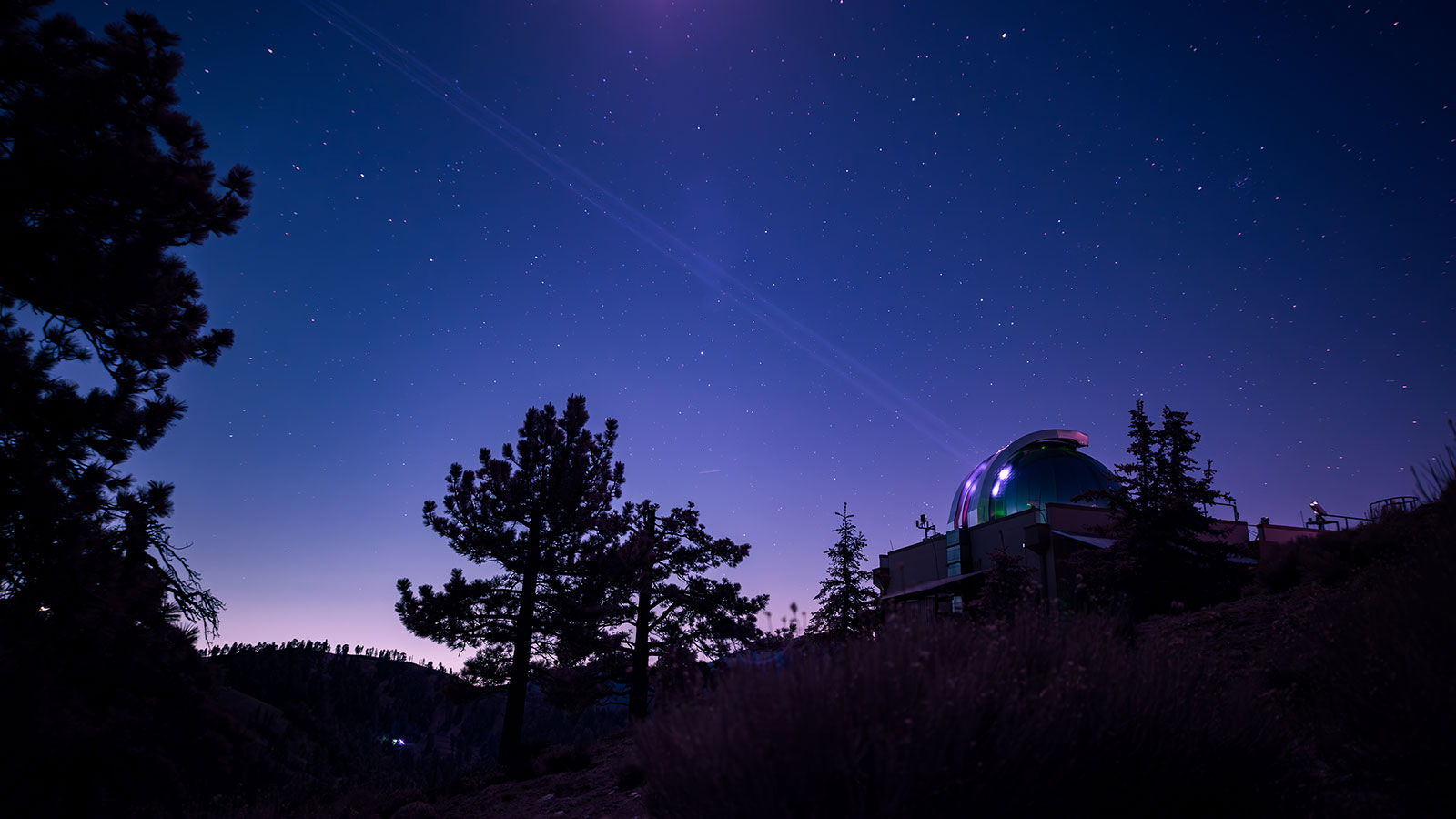
"Communications Telescope Laboratory at NASA’s Jet Propulsion Laboratory’s Table Mountain Facility near Wrightwood, California, beams its eight-laser beacon to the Deep Space Optical Communications (DSOC) flight laser transceiver aboard NASA’s Psyche spacecraft. At the time, when Psyche was about 143 million miles (230 million kilometers) from Earth.
Managed by JPL, DSOC successfully demonstrated that data encoded in laser photons could be reliably transmitted, received, and then decoded after traveling millions of miles from Earth out to Mars distances. Nearly two years after launching aboard the agency’s Psyche mission in 2023, the demonstration completed its 65th and final “pass” on Sept. 2, 2025, sending a laser signal to Psyche and receiving the return signal from 218 million miles (350 million kilometers) away."
In this infrared photograph, the Optical Communications Telescope Laboratory at JPL’s Table Mountain Facility near Wrightwood, California, beams its eight-laser beacon to the Deep Space Optical Communications flight laser transceiver aboard NASA’s Psyche spacecraft.
Sunday, August 17, 2025
President Trump signed Executive Order to Ease US Commercial Spaceflight
Good news! Bravo! Reduce government overregulation! Ready for take off! 😊
"“U.S. President Donald Trump signed an executive order on Wednesday to streamline federal regulation governing commercial rocket launches, a move that could benefit Elon Musk’s SpaceX and other private space ventures.
Trump’s order, among other things, directs the U.S. transportation secretary to eliminate or expedite environmental reviews for launch licenses administered by the Federal Aviation Administration, the White House said in a statement.”"
"... It is imperative that we build on the far-reaching actions taken by my Administration during my first term to ensure that new space-based industries, space exploration capabilities, and cutting-edge defense systems are pioneered in America rather than by our adversaries. ..."
Subscribe to:
Posts (Atom)