Showing posts with label operating system. Show all posts

Sunday, August 30, 2026

Google Play Store app annoyances

As of very recently, I get prompted all the time to enter a password or biometrics to access Google Play Store on my new Samsung android phone.

Very annoying! I have never purchased anything through Google Play! However, from time to time I like to install new, free apps or update apps etc.

For many years Google Play used to be accessible without authentication!

Friday, August 21, 2026

China joins Europe in scrapping Windows for Linux

Headline of the day! However, it appears to be sensational!

As a Linux user myself, I get it! 😊

"... key takeaways
  • The Chinese government is dumping Windows for some desktops.
  • A Linux desktop version will replace Windows.
  • The most likely candidates are Kylin OS or UOS.
According to a Bloomberg report, attributed to China's Ministry of State Security, the country has ordered some government agencies to drop Windows 10 China Government Edition for Chinese-made Linux distributions. ..."

"China is pulling the plug on an older version of Microsoft Corp.’s Windows tailored for government agencies, taking another step toward rooting out the world’s most popular PC software in a broader effort to reduce its dependence on foreign technology.

The Chinese Ministry of State Security recently told some state-linked entities to uninstall customized Windows 10 software from their machines, people familiar with the matter said. That moves up the schedule to discontinue the operating system by several months ..."

China joins Europe in scrapping Windows for Linux | ZDNET "The specialized Chinese version of Windows was already scheduled for retirement in February 2027, but now its end-of-life date has been moved up."

Saturday, May 16, 2026

The third major Linux kernel flaw in two weeks has been found - thanks to AI

Good news! I also noticed more than usual software update notifications lately with Fedora Linux on my laptop.

AI may not only find security vulnerabilities or software flaws much faster, but also may provide usable information how to fix them without breaking the operation system or causing a bug.

"... According to Linus's law, "Given enough eyeballs, all bugs are shallow," is fundamental to open source. ...

thanks to AI bug-finding tools, such as Claude Mythos and OpenAI Daybreak, behind most of those eyeballs are AI engines, and they're proving to be much faster at finding security problems than human ones. ..."

The third major Linux kernel flaw in two weeks has been found - thanks to AI | ZDNET "AI is exposing Linux security holes faster than developers can patch them. Fragnesia is the latest. Here's what we know about it."

Wednesday, April 29, 2026

Microsoft finally open sources DOS 1.0 OS (first released 1981) - and it's so much more than the code

Good news! Yes, I remember the DOS operating system, the predecessor of Windows. I used it way back then on my IBM PC, which was a gift of my late mother Irma Bingel.

"Before "Micro Soft" became Microsoft, Bill Gates wrote BASIC interpreters. Microsoft's first shipping operating system was a Unix distro called Xenix.
Then, in 1980, Microsoft got its shot at the big time: IBM needed an operating system for its planned IBM PC and asked Gates if he could deliver one. You betcha! The rest is history. ..."

Microsoft finally open sources DOS 1.0 - and it's so much more than the code | ZDNET "Want a blast from the past? Microsoft just open-sourced its very first operating system, offering a rare insight into the PC's earliest days."


Thursday, January 29, 2026

Linux after Linus? The kernel community finally drafts a plan for replacing Torvalds

What will happen to one of the best free operating systems of the world?

"ZDNET's key takeaways
  • If something happens to Linus Torvalds, there's now a succession plan.
  • Rather than naming a successor, the plan describes a process for selecting successors.
  • However, Torvalds has no plans to retire.
..."

Linux after Linus? The kernel community finally drafts a plan for replacing Torvalds | ZDNET "Linus plans to live forever. But just in case he doesn't, there's now a succession plan (though no actual successor)"


Linus Torvalds


Friday, June 27, 2025

Windows killed the Blue Screen of Death (BSOD) after 40 years

Headline of the day!

"... Yes, the iconic Windows error screen is getting a makeover nearly 40 years after its debut in the first version of Windows. Now the Blue Screen of Death (BSOD) will become the Black Screen of Death (BSOD). ..."

Windows killed the Blue Screen of Death | TechCrunch


The black screen of death


Tuesday, May 27, 2025

OpenAI’s o3 model helps discover a zero-day vulnerability in Linux kernel

Good news! The race between good guys and bad guys to discover critical vulnerabilities in operating systems etc. with ML & AI is on!

"A security researcher used OpenAI’s o3 model to discover CVE-2025-37899, a dangerous vulnerability in the Linux kernel’s ksmbd server. The researcher provided o3 with approximately 12,000 lines of code from the SMB protocol implementation, using only the standard API without additional frameworks or tools. The vulnerability occurs when multiple connections share session objects, allowing one thread to free memory while another thread still accesses it, potentially enabling arbitrary code execution in kernel context. This marks the first publicly documented case of an LLM finding this type of complex vulnerability, showing that LLMs (while still finding many false positives) can meaningfully assist expert vulnerability researchers. ..."

Google’s Veo 3 video generation model now available in more countries

Wednesday, April 02, 2025

Friday, March 28, 2025

Data Centers Can Slash Power Needs by up to 30% With One small operating system Coding Tweak

This sounds pretty good if confirmed! May improve faster and better machine learning and AI!

"... uncovered inefficiencies in how the Linux operating system (OS) processes network traffic at the kernel level ...

The OS also periodically polls the network to check for incoming packets before an interrupt request fires. This busy polling mechanism minimizes delays in network traffic processing at the cost of CPU power consumption. During low traffic conditions in particular, polling continues even without packets to process, leading to needless energy usage. ...

devised a technique such that busy polling happens during high network traffic periods, with unnecessary interrupt requests suspended. When network traffic dies down, interrupt-based delivery resumes. ...

“We piggyback on existing code in the Linux kernel, and we change the order in which things operate.”

That change led to around 30 lines of reworked code. They tested the functionality and performance of their modifications on different scenarios and workloads, and found that the kernel improvements can decrease power consumption by up to 30 percent. ...

The code has been implemented as part of the Linux kernel release version 6.13 in January. ..."

From the abstract:
"This paper reviews the performance characteristics of network stack processing for communication-heavy server applications. Recent literature often describes kernel-bypass and user-level networking as a silver bullet to attain substantial performance improvements, but without providing a comprehensive understanding of how exactly these improvements come about.
We identify and quantify the direct and indirect costs of asynchronous hardware interrupt requests (IRQ) as a major source of overhead. While IRQs and their handling have a substantial impact on the effectiveness of the processor pipeline and thereby the overall processing efficiency, their overhead is difficult to measure directly when serving demanding workloads.
This paper presents an indirect methodology to assess IRQ overhead by constructing preliminary approaches to reduce the impact of IRQs. While these approaches are not suitable for general deployment, their corresponding performance observations indirectly confirm the conjecture.
Based on these findings, a small modification of a vanilla Linux system is devised that improves the efficiency and performance of traditional kernel-based networking significantly, resulting in up to 45% increased throughput without compromising tail latency. In case of server applications, such as web servers or Memcached, the resulting performance is comparable to using kernel-bypass and user-level networking when using stacks with similar functionality and flexibility."

Cut Data Center Energy by 30% with This Simple Hack - IEEE Spectrum "Reworking 30 lines of Linux code could cut power use by up to 30 percent"

Wednesday, May 08, 2024

Huawei breaks free from Google ecosystem with homegrown OS

Bad news for Google! Competition is good!

"Huawei Technologies looks to complete its departure from Google's Android operating system this year with the rollout of a new OS developed fully in-house, further sidestepping U.S. export controls that had cramped the Chinese company's mobile business.

The new HarmonyOS Next ships with Huawei's flagship Mate 70 smartphone due out later this year. It uses memory three times as efficiently as the current operating system, HarmonyOS, and supports on-device artificial intelligence. ..."

Huawei breaks free from Google ecosystem with homegrown OS - Nikkei Asia HarmonyOS Next targets Internet of Things and car demand along with smartphones

Tuesday, March 26, 2024

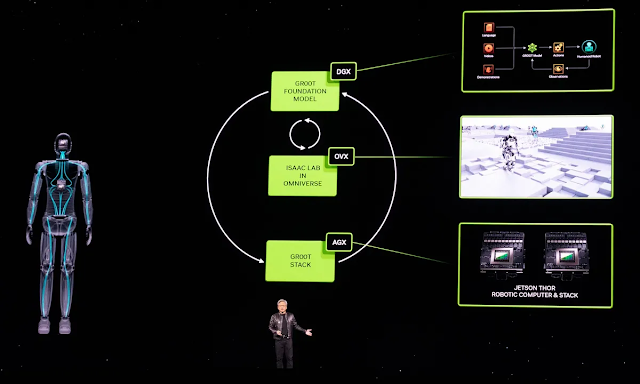
Nvidia Announces GR00T, a Foundation Model for Humanoids

Pardon, this is not the latest news, but it is very relevant and possibly consequential! More details are still to be released.

"... First, there’s Project GR00T  ... a foundation model for humanoid robots. And secondly, Nvidia has committed to be the founding platinum member of the Open Source Robotics Alliance, a new initiative from the Open Source Robotics Foundation intended to make sure that the Robot Operating System (ROS), a collection of open-source software libraries and tools, has the support that it needs to flourish. ..."

Nvidia Announces GR00T, a Foundation Model for Humanoids - IEEE Spectrum The company also announces long-term support for the Robot Operating System

Credits: Last Week in AI


Thursday, June 08, 2023

Mastering Concurrent Algorithms with TLA+: A webinar offered by the Linux Foundation

Just a few moments ago, I blogged here about TLA+, then I discovered this is now being offered! What a coincidence!

Concurrency is one of those very tricky subjects in software development.

Mastering Concurrent Algorithms with TLA+ Join a Complimentary Live Webinar from The TLA+ Foundation and The Linux Foundation

Tuesday, March 21, 2023

Linux Fedora 38 beta has arrived and it heralds a spectacular upcoming release

Since I use Fedora Linux for several years now, I am getting already excited!

Fedora 38 beta has arrived and it heralds a spectacular upcoming release | 
ZDNET Fedora 38 beta is here and it looks to once again prove this Linux desktop is ready for users of all kinds.

Monday, February 27, 2023

8 things you can do with Linux that you can't do with MacOS or Windows

Recommendable! As a long time Linux user myself, I can relate to this article!

It is not quite correct to claim "Upgrade without reboots". You actually do have to reboot quite often after system/software updates.

8 things you can do with Linux that you can't do with MacOS or Windows | ZDNET

Monday, October 17, 2022

Google shows off KataOS, a secure operating system for embedded and edge devices written in Rust

Good news! Rusty operating systems anyone? 😊 However, it is still work in progress.

"Google has unveiled KataOS, an early exploration into a new secure operating system for embedded systems on open-source RISC-V chips. ...
it eliminates entire classes of bugs, such as off-by-one errors and buffer overflows ... The project's GitHub page emphasizes that KataOS and its umbrella project name, Sparrow, "are definitely a work in progress". Sparrow is a reference implementation of KataOS. ...
The goal is to build verifiably secure systems for embedded hardware or edge devices like network-connected cameras used to capture images that are processed on-device or in the cloud for machine learning. ...
The OS is being built with the new sel4 "security-first" microkernel. It's open source ...
Data61, the digital arm of Australia's research agency CSIRO, announced sel4 in 2020 as a mathematically proven correct, bug-free kernel. ..."

Google shows off KataOS, a secure operating system written in Rust | ZDNET Smart devices need better security and Google thinks KataOS, written in the Rust programming language, could help.

Friday, September 23, 2022

The Apple macOS security landscape: Moving to become an enterprise and individual user risk

It appears for a long time Apple devices were not targeted as much as Windows devices, but this may change.

It also means that other Unix based operating systems (like Linux and its many derivatives) might by more at risk. I am, e.g. using Fedora Linux.

"Apple’s devices aren’t immune to hacking, but for years, they seemed to be. While other vendors like Microsoft faced the brunt of complex exploits targeting the enterprise market, macOS and iOS didn’t face the same level of pressure as a consumer-focused vendor. 
Yet, this appears to be changing. During the height of the COVID-19 pandemic, Atlas VPN reported that Apple’s product vulnerabilities increased by 467% in the second half of 2021 to 380 exploits. ..."

The Apple security landscape: Moving into the world of enterprise risk | VentureBeat

Wednesday, September 07, 2022

Stealthy Linux malware Shikitega starts off small but gradually takes control

As a Linux user should I be concerned? Sounds quite scary and sophisticated! 

Until know, I thought that Linux was much less vulnerable than Windows especially when you operate Linux primarily in user mode only!

The article is unfortunately kind of unspecific about what Linux installations are  exactly affected: 
1) Administrator mode v. user mode
2) Server vs. desktop
So much for sloppy journalism although ZDNET is a technology oriented publication.

"A stealthy new form of malware is targeting Linux systems in attacks that can take full control of infected devices – and it is using this access to install crypto-mining malware. 
Dubbed Shikitega, the malware targets endpoints and Internet of Things devices that run on Linux operating systems and has been detailed by cybersecurity researchers at AT&T Alien Labs. ...
The malware is delivered in a multi-stage infection chain, where each module responds to commands from the previous part of the payload and downloads and executes the next one.
By downloading the payload bit by bit – starting with a module that is just a few hundred bytes – Shikitega can avoid being uncovered by anti-virus software. It also uses a polymorphic encoder to make it more difficult to detect. ...
The initial method of infection is still unknown, but the malware gradually downloads more and more modules to provide full functionality, starting with the initial dropper, then going through several stages – including downloading Mettle, a Metasploit offensive security tool, which allows the attacker to deploy a wide range of attacks. ..."

From the AT&T cybersecurity blog:
"... With a rise of nearly 650% in malware and ransomware for Linux this year, reaching an all-time high in the first half year of 2022, threat actors find servers, endpoints and IoT devices based on Linux operating systems more and more valuable and find new ways to deliver their malicious payloads. ...
To achieve persistence, the malware will download and execute a total of 5 shell scripts. It persists in the system by setting 4 crontabs, two for the current logged in user and the other two for the user root. ..."

This stealthy Linux malware starts off small but gradually takes control | ZDNET 'Sophisticated' Shikitega malware secretly exploits known vulnerabilities in Linux.


Tuesday, June 28, 2022

Linus Torvalds is cautiously optimistic about bringing Rust into Linux kernel's next release

Seems to be some interesting news! I am not familiar with the Rust programming language, but a cursory look at it indicates this is a serious programming language to develop robust and safe software.

Could Linux one day be written in Rust (or similar language) instead of ancient C?

"For over three decades, Linux has been written in the C programming language. Indeed, Linux is C's most outstanding accomplishment. But the last few years have seen a growing momentum to make the Rust programming language Linux's second Linux language. At the recent Open Source Summit in Austin, Texas, Linux creator Linus Torvald said he could see Rust making it into the Linux kernel as soon as the next major release. ..."

Linus Torvalds is cautiously optimistic about bringing Rust into Linux kernel's next release | ZDNet Linux creator Linus Torvalds said that while he won't make any promises, he'd like to see Rust merging into the Linux kernel with the next release.

Tuesday, May 17, 2022

Fedora 36 Annoyances

I noticed following when you try to download files (e.g. PDF files) from the Internet to your laptop computer:

  1. The file download facility will not allow you to change the name of the file anymore before you start the download. This was possible with previous releases of Fedora.
  2. After you selected the folder into which you want to download the file, the content of the folder is not automatically ordered by folders first anymore despite me having specifically configured the Preferences of the files manager.