Showing posts with label female scientists. Show all posts

Wednesday, October 07, 2026

Rosalind Franklin didn’t miss the DNA helix in her iconic image in 1952

So why did she not publish her findings immediately? History waits for no one (not even women)! Publish or perish! Making a discovery is one thing, communicating the discovery is another!

Did Ms. Franklin talk to Mr. Watson about her discovery?

How many times have similar things happened to male lab technicians?

Another nice attempt to show that a woman actually made a major discovery before any men? Or behind every great man was a woman?

"... Rosalind Franklin, an x-ray crystallographer at King’s College London, had produced the image days earlier in 1952. But Watson’s 1968 book implied the flash of insight was his alone.

Watson’s slight took hold partly because Franklin’s lab notes, usually thorough and meticulous, said little about photograph 51. But in a new paper in the Journal of the History of Biology, Sponsel and Sutton draw attention to an earlier image, photograph 49. Franklin’s notes on that image show she recognized the helical structure and calculated, for the first time, the length of each turn—34 angstroms—and the number of bases “per turn of helix (if there is a helix).” ..."

From the abstract:
"This essay, co-authored by a historian of science and an X-ray crystallographer, sheds new light on Rosalind Franklin’s Photograph 51. We refute the infamous claim that, unlike James Watson, Franklin failed to see the picture’s potential significance for interpreting the helical structure of DNA.
Rather, Franklin decided to take Photograph 51 precisely because she knew that key parameters of DNA’s B form helix could be calculated from the resulting image.
We show that she had in fact already made those calculations — on her earlier Photograph 49 — and she reused the same DNA sample for Photograph 51 to create a better-centered but otherwise identical diffraction image that would be suitable for publication. Thus Photograph 51 was not the result of an experiment in need of analysis, but was refined documentation for calculations that she had already performed on the earlier photograph. We argue that colleagues and later commentators did not merely overlook Franklin’s original reason for creating the strikingly clear and informative Photograph 51, they rhetorically erased her skill and judgment by describing it as though nature spoke for itself through the image — and to Watson, but not to Franklin."

ScienceAdviser


Rosalind Franklin’s photograph 51 (right) revealed DNA’s helical structure. But she had already recognized it in an earlier, flawed image: photograph 49 (left).


Rosalind Franklin


Thursday, December 18, 2025

The Three Biggest Breakthroughs in Mathematics: 2025

Very recommendable! Excellent video! Notice also how female mathematicians were involved, contributed and are featured in this video.

Thursday, October 02, 2025

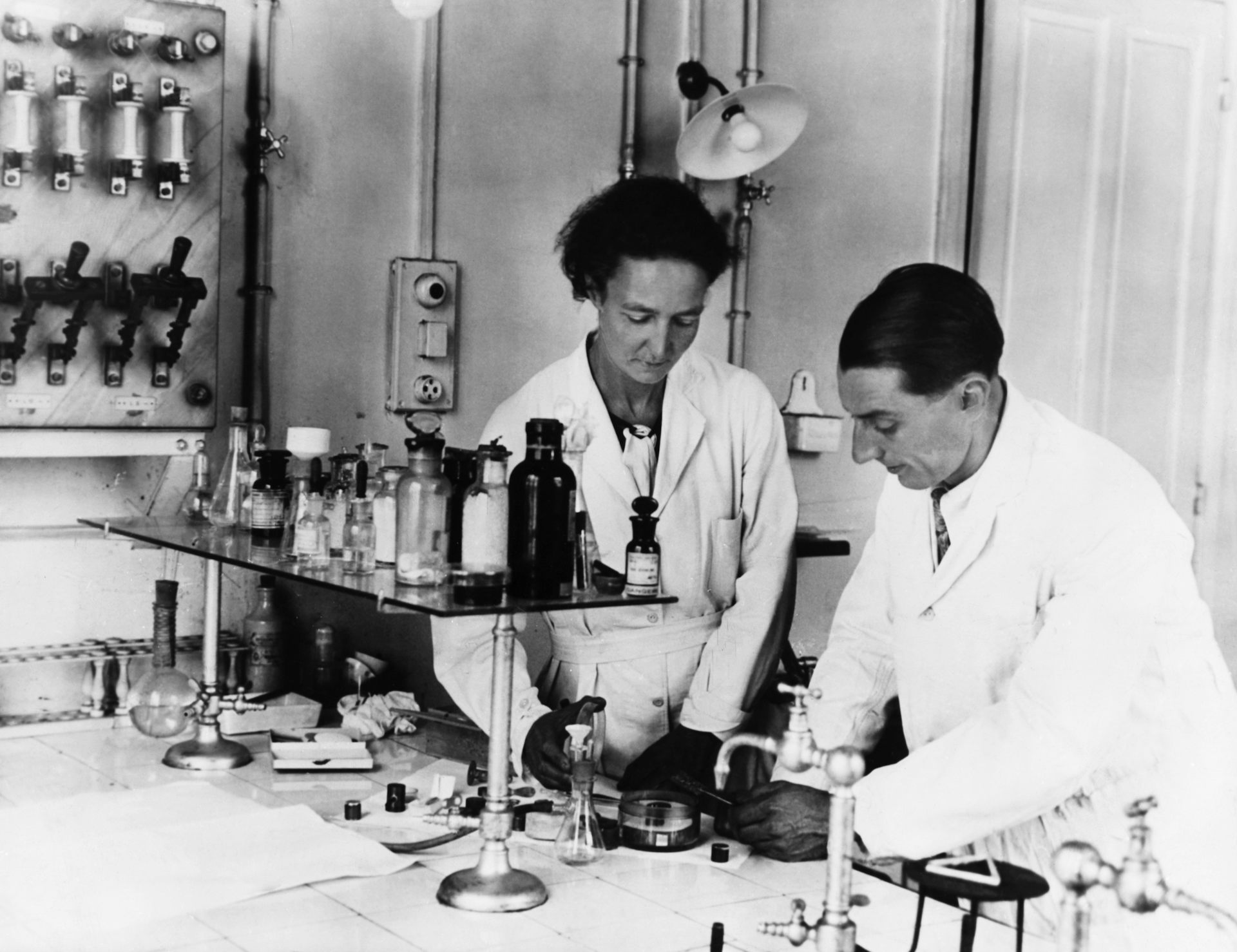
Meet Irene Curie, the Nobel-winning atomic physicist who together with her husband discovered artificial radioactivity

Very recommendable! The many similarities between Marie Curie & Pierre Curie and Irene Curie &  Frederic Joliot are stunning!

She was homeschooled!

"The adage goes “like mother like daughter,” and in the case of Irene Joliot-Curie, truer words were never spoken. She was the daughter of two Nobel Prize laureates, Marie Curie and Pierre Curie, and was herself awarded the Nobel Prize in chemistry in 1935 together with her husband, Frederic Joliot.

While her parents received the prize for the discovery of natural radioactivity, Irene’s prize was for the synthesis of artificial radioactivity. This discovery changed many fields of science and many aspects of our everyday lives. Artificial radioactivity is used today in medicine, agriculture, energy production, food sterilization, industrial quality control and more. ...

World War I started in 1914, when Irene was only 17, and she interrupted her studies to help her mother find fragments of bombs in wounded soldiers using portable X-ray machines. She soon became an expert in these wartime radiology techniques, and on top of performing the measurements herself, she also spent time training nurses to use the X-ray machines.

After the war, Irene went back to her studies in her mother’s lab at the Radium Institute. This is where she met fellow researcher Frederic Joliot, whom she later married. The two worked together on many projects, which led them to their major breakthrough in 1934. ..."

Meet Irene Curie, the Nobel-winning atomic physicist who changed the course of modern cancer treatment


Irene and Frederic Joliot-Curie shared the Nobel Prize in 1935. 


"In Irene and Frederic’s experiments, an isotope of aluminum was hit with an alpha particle (two neutrons and two protons bound together). The collision resulted in two protons and a neutron from the alpha particle binding to the aluminum, making it an isotope of phosphorus, which decayed, releasing a particle called a positron." 


"Scientists graph the known isotopes in the chart of nuclei. They have discovered roughly 3,000 radioisotopes (shown with cyan boxes) and predict the existence of another 4,000 radioisotopes (shown with gray boxes)."


Thursday, March 14, 2024

Weibliche Expertise und viele Patente in der Pharmaindustrie

Good news! 

Viele Pillendreher sind weiblich nicht nur in der Apotheke! 😊

"... 41 Prozent der Mitarbeiter in pharmazeutischen Unternehmen sind Frauen – ein deutlich höherer Anteil als in anderen Spitzentechnologiebranchen. ..."

Weibliche Expertise in der Pharmaindustrie - iwd.de Wenige Frauen melden in Deutschland Patente an oder sind daran beteiligt. Eine Ausnahme bildet die Pharmazie. Dort geht im Durchschnitt jedes fünfte angemeldete Schutzrecht auf das Konto einer Frau. Künftig könnte sich der Anteil weiter erhöhen.

In der Biotechnologie lag der Anteil mit 25 Prozent noch einmal höher. Zum Vergleich: In allen anderen Branchen gingen 2020 im Schnitt nur 5,5 Prozent der Patente auf Frauen zurück.


India's 'divine daughter' R Sheena Rani who spearheaded Agni-V balistic missile (MIRV) success with Molly Gambhir

Recommendable! Indian women power!

Saturday, September 02, 2023

Anna Atkins: pioneering botanical photographer who captured algae and ferns in ghostly blue images

Amazing stuff!

"Before the twentieth century, botany was one of the few spaces in which women were free to express their curiosity about the natural world. Anna Atkins (1799–1871) was one of its pioneers. As well as producing studies of algae and ferns, she adopted a new photographic approach to document her finds. In 1843, using the cyanotype technique, which was invented by the astronomer John Herschel the previous year, she published the first book containing photographic illustrations: Photographs of British Algae: Cyanotype Impressions. ...
Natural history illustrations up to this point were typically hand-drawn, printed as woodcuts or engravings and often hand-coloured. Well-known exponents of this method included German entomologist Maria Sibylla Merian, British American physician Elizabeth Blackwell and English illustrator Sarah Drake. ...
In 1839, she became a member of the Botanical Society of London, one of the few learned societies to admit women at the time. ..."

Anna Atkins: pioneering botanical photographer who captured algae and ferns in ghostly blue images A compilation of 550 original plates reveals the dedicated work of the nineteenth-century woman who was the first to publish a book with cyanotypes of specimens.


Anna Atkins


Thursday, September 22, 2022

Elizabeth Fulhame, the 18th century chemistry pioneer who faded from history

Recommendable!

Please also note the support from her husband for her research and other male contemporary chemists who encouraged her work! Feminists usually like to suppress that!

Elizabeth Fulhame, the 18th century chemistry pioneer who faded from history | Opinion | Chemistry World More than 200 years ago, a female chemist introduced the concept of catalysis and made early steps towards photography.