Showing posts with label dark energy/matter. Show all posts

Wednesday, August 05, 2026

Diffuse puffs of “missing” matter surround most galaxies. Really!

Is the Big Bang real? What came before the Big Bang? God?

Is so called dark matter finally becoming matter?

However, it appears that the journalistic article promises/exaggerates/diverges too much relative to the abstract of the paper. Even the preprint does not agree! Regrettable!

"Now MIT scientists, as part of the CHIME/FRB Collaboration, are using far-off radio signals to reveal missing matter in the vast space between galaxies. The team has developed a new method to search out missing matter by combining locations of galaxies with detections of fast radio bursts. ...

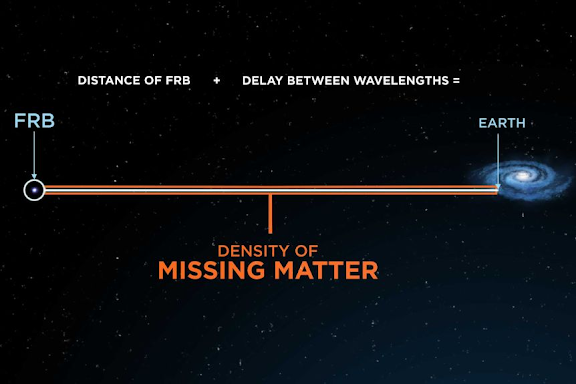
A fast radio burst, or FRB, is an ultrabright, millisecond flash of radio waves emitted by extremely energetic phenomena in the distant universe. As it travels through space, the signal from a fast radio burst gets stretched, or “smeared,” in time. The more missing matter that it passes through, the more smeared the signal becomes. 

The MIT-led team measured the degree of smearing experienced by thousands of FRB signals detected on Earth. Then they compared each FRB smear with locations of galaxies across the universe to determine how much of an FRB’s smearing was due to galaxy matter versus other, missing matter. 

The new method revealed not only whether missing matter was present, but also where. Specifically, the researchers discovered that it exists in very diffuse clouds surrounding groups of galaxies. These clouds extend out from the galaxies, to much further distances than scientists had predicted. ..."

From the abstract:
"The dispersion of extragalactic fast radio bursts (FRBs) can serve as a powerful probe of the diffuse plasma between and surrounding galaxies, which contains most of the Universe’s baryons.
By cross-correlating the dispersion of background FRBs with the locations of foreground galaxies, we can study the relative spatial distributions of plasma and galaxies on scales of 0.1 to 50 Mpc, which are strongly affected by feedback processes in galaxy formation.
Here, we present the measurement of the dispersion-galaxy angular cross-power spectrum between 2870 FRBs from the Second CHIME/FRB Catalog and nearly 6 million galaxies from the Dark Energy Spectroscopic Instrument (DESI) Legacy Imaging Survey.
Over five photometric galaxy redshift bins spanning 0.05 <𝑧 <0.5 and at 4.9⁢𝜎 significance, we make the first definitive detection of spatial correlations in FRB dispersion measure due to cosmic structure.
While parameter inferences should be interpreted with caution because of incomplete modeling of both the signal and systematic errors, our data indicate that the plasma-galaxy cross-power spectrum cuts off relative to the matter power spectrum at a scale 𝑘−1 cut=0.8⁢4+0.46 −0.34  ⁢Mpc.
This scale is consistent with those x-ray stacking analyses that suggest dark-matter halos with group-scale masses are largely evacuated of their baryons by feedback processes.
Our Letter demonstrates that FRBs are promising tools to discern the physics of baryonic structure formation and will only become more powerful as FRB surveys expand."

Diffuse puffs of “missing” matter surround most galaxies | MIT News | Massachusetts Institute of Technology "An MIT-led team used bright radio bursts to illuminate a vast source of matter that was previously unaccounted for"

Tuesday, April 08, 2025

A new side to dark energy steps into the light

Recommendable perspective/overview article on dark energy and latest findings!

"... Then, last year, the Dark Energy Spectroscopic Instrument [DESI] uncovered a hint that all is not what it seems. ...

DESI was able to stitch together a flip-book of snapshots from the early universe until now. They then combined that data with studies of supernovae from another survey, the Dark Energy Survey. And what they found was that for the past few billion years or so, dark energy seems to have been weakening over time.  

Scientists were skeptical of the 2024 result; it would take compelling evidence to upend their decades-old paradigm of the cosmos. But on March 19 [2025], DESI’s team presented new results at the Global Physics Summit in Anaheim, California. One year and nine million more galaxies after their earlier announcement, the hypothesis that DESI is seeing a change in dark energy carries more weight than ever before.  ..."

A new side to dark energy steps into the light | symmetry magazine

Saturday, March 22, 2025

Dark energy/matter seems to be changing or evolving, rattling our view of universe

Like living in the Dark Ages again? 😊 I personally never liked these terms, i.e. Dark Energy or Dark Matter.

"If dark energy is in fact weakening, it would likely mean that science's understanding of how the universe works will need to be rewritten.

The new findings come from the Dark Energy Spectroscopic Instrument (DESI), which sits on a telescope at the Kitt Peak National Observatory in the U.S. state of Arizona. ..."

"The Dark Energy Spectroscopic Instrument used millions of galaxies and quasars to build the largest 3D map of our universe to date. Combining the DESI data with other experiments shows signs that the impact of dark energy may be weakening over time — and the standard model of how the universe works may need an update. 

Key Takeaways
  • The DESI collaboration published a new analysis of dark energy using their first three years of collected data, which spans nearly 15 million galaxies and quasars.
  • Researchers combined the DESI data with information from studies of the cosmic microwave background, supernovae, and weak gravitational lensing.
  • The standard model of cosmology struggles to explain all the observations when taken together — but a model where dark energy’s influence changes over time seems to fit the data well.
..."

Dark energy seems to be changing, rattling our view of universe "Dark energy, the mysterious force thought to be driving the ever-faster expansion of the universe, appears to be changing over time, according to new observations released Wednesday."


DESI is a state-of-the-art instrument and can capture light from up to 5,000 celestial objects simultaneously. Mayall Telescope interior


Tuesday, March 18, 2025

Mysterious phenomenon at heart of Milky Way galaxy linked to new type of dark matter

Amazing stuff!

"“At the centre of our galaxy sit huge clouds of positively charged hydrogen, a mystery to scientists for decades because normally the gas is neutral,”  ...

“So, what is supplying enough energy to knock the negatively charged electrons out of them?”

Astronomers have called this area of ionised hydrogen gas clouds the Central Molecular Zone (CMZ). ..."

"... In this first of its kind study, scientists have taken a step closer to understanding the elusive mystery [dark] matter. They believe a reimagined candidate for dark matter could be behind unexplained chemical reactions taking place in the Milky Way. ...

The most established theory for dark matter is that it is likely a group of particles known as ‘Weakly Interacting Massive Particles’ (WIMPs), which pass through regular matter without much interaction – making them extremely hard to detect.

However, this study ... has potentially revived another type of dark matter with much, lower mass than a WIMP.

The researchers think that these tiny dark matter particles are crashing into each other and producing new charged particles in a process called ‘annihilation’. These newly produced charged particles can subsequently ionise the hydrogen gas. ...

This finding may simultaneously explain wider mysteries of our Galaxy, such as a specific type of X-ray observation found at the centre of the Milky Way – known as the ‘511-keV emission line’. This specific energy signature could also be due to the same low-mass dark matter colliding and producing charged particles."

From the abstract:
"We demonstrate that the anomalous ionization rate observed in the Central Molecular Zone can be attributed to MeV dark matter annihilations into 𝑒+⁢𝑒− pairs for galactic dark matter profiles with slopes 𝛾 >1. The low annihilation cross sections required avoid cosmological constraints and imply no detectable inverse Compton, bremsstrahlung, or synchrotron emission in radio, x- and 𝛾 rays. The possible connection with the source of the unexplained 511 keV line emission in the Galactic Center suggests that both observations could be correlated and have a common origin."

Mysterious phenomenon at heart of Milky Way galaxy linked to new type of dark matter "Unexplained chemical reactions observed at the centre of the Milky Way galaxy could be caused by the existence of a type of dark matter not accounted for in current physics."

Mysterious phenomenon at centre of galaxy could reveal new kind of dark matter (original news release) "A mysterious phenomenon at the centre of our galaxy could be the result of a different type of dark matter."

Saturday, November 16, 2024

A formula for life? New model calculates chances of intelligent beings in our universe and beyond

Maybe more life can be found in another universe? Or what has dark matter/energy to do with life?

Even though the abstract does not mention intelligent life, the article references it at least twice.

"In the 1960s, American astronomer Dr Frank Drake came up with an equation to calculate the number of detectable extraterrestrial civilisations in our Milky Way galaxy.

More than 60 years on, researchers at Durham, the University of Edinburgh and the Université de Genève, have produced a new model based on the conditions created by the acceleration of the Universe’s expansion and the amount of stars formed instead. ...

This new research has calculated the fraction of ordinary matter converted into stars over the entire history of the Universe, for different dark energy densities.

The model predicts this fraction would be approximately 27 per cent in a universe that is most efficient at forming stars, compared to 23 per cent in our Universe.

The new model could allow scientists to understand the effects of differing densities of dark energy on the formation of structures in the Universe and the conditions for life to develop in the cosmos. ...

However, for life to develop, there would need to be regions where matter can clump together to form stars and planets, and it would need to remain stable for billions of years to allow life to evolve.

Since stars are a precondition for the emergence of life as we know it, this new calculation could be used to estimate the probability of generating intelligent life in our Universe, and in a multiverse scenario of hypothetical different universes. ..."

"... However, this argument neglects the question of how long intelligent life may to take to emerge following the formation of a star. This is an issue on which cosmologists are unlikely to have a reliable opinion. ..."

From the abstract:
"We present an extended analytical model for cosmic star formation, with the aim of investigating the impact of cosmological parameters on the star formation history within the CDM paradigm. Constructing an ensemble of flat CDM models where the cosmological constant varies between and  times the observed value, ⁠, we find that the fraction of cosmic baryons that are converted into stars over the entire history of the universe peaks at  27 per cent for ⁠. We explain, from first principles, that the decline of this asymptotic star formation efficiency for lower and higher values of  is driven, respectively, by the astrophysics of star formation, and by the suppression of cosmic structure formation. However, the asymptotic efficiency declines slowly as  increases, falling below 5 per cent only for ⁠. Making the minimal assumption that the probability of generating observers is proportional to this efficiency, and following Weinberg in adopting a flat prior on ⁠, the median posterior value of  is ⁠. Furthermore, the probability of observing  is only 0.5 per cent. Although this work has not considered recollapsing models with⁠, the indication is thus that  appears to be unreasonably small compared to the predictions of the simplest multiverse ensemble. This poses a challenge for anthropic reasoning as a viable explanation for cosmic coincidences and the apparent fine-tuning of the Universe: either the approach is invalid or more parameters than  alone must vary within the ensemble."

A formula for life? New model calculates chances of intelligent beings in our universe and beyond "The chances of intelligent life emerging in our universe—and in any hypothetical ones beyond it—can be estimated by a new theoretical model which has echoes of the famous Drake Equation."

Formula for alien life: Drake Equation gets a dark energy update

New model could calculate probability of intelligent life in our Universe and beyond (original news release) "A team of astrophysicists, led by our Institute for Computational Cosmology, have developed a new model that could estimate how likely it is for intelligent life to emerge in our Universe and beyond."


How the same region of the Universe would look in terms of the amount of stars for different values of the dark energy density.


Saturday, September 14, 2024

Early dark energy could resolve cosmology’s two biggest puzzles

Dark matter/energy were in the news again recently! See also my blog post here about dark matter.

What is the difference between speculation and science?

The so called Big Bang is another one of those speculations!

"A new study ... proposes that a mysterious force known as early dark energy could solve two of the biggest puzzles in cosmology and fill in some major gaps in our understanding of how the early universe evolved.

One puzzle in question is the “Hubble tension,” which refers to a mismatch in measurements of how fast the universe is expanding. The other involves observations of numerous early, bright galaxies that existed at a time when the early universe should have been much less populated.

Now, the MIT team has found that both puzzles could be resolved if the early universe had one extra, fleeting ingredient: early dark energy. Dark energy is an unknown form of energy that physicists suspect is driving the expansion of the universe today. Early dark energy is a similar, hypothetical phenomenon that may have made only a brief appearance, influencing the expansion of the universe in its first moments before disappearing entirely. ..."

From the abstract (abstract contains images):
"JWST has revealed a large population of UV-bright galaxies at [] 
 and possibly overly massive galaxies at ⁠[], challenging standard galaxy formation models in the ΛCDM cosmology. We use an empirical galaxy formation model to explore the potential of alleviating these tensions through an Early Dark Energy (EDE) model, originally proposed to solve the Hubble tension. Our benchmark model demonstrates excellent agreement with the UV luminosity functions (UVLFs) at in both ΛCDM and EDE cosmologies. In the EDE cosmology, the UVLF measurements at  based on spectroscopically confirmed galaxies (eight galaxies at ⁠) exhibit no tension with the benchmark model. Photometric constraints at  can be fully explained within EDE via either moderately increased star-formation efficiencies (⁠ at ⁠) or enhanced UV variabilities (⁠ mag at ⁠) that are within the scatter of hydrodynamical simulation predictions. A similar agreement is difficult to achieve in CDM, especially at ⁠, where the required 
 exceeds the maximum value seen in simulations. Furthermore, the implausibly large cosmic stellar mass densities inferred from some JWST observations are no longer in tension with cosmology when the EDE is considered. Our findings highlight EDE as an intriguing unified solution to a fundamental problem in cosmology and the recent tensions raised by JWST observations. Data at the highest redshifts reached by JWST will be crucial for differentiating modified galaxy formation physics from new cosmological physics."

Study: Early dark energy could resolve cosmology’s two biggest puzzles | MIT News | Massachusetts Institute of Technology "In the universe’s first billion years, this brief and mysterious force could have produced more bright galaxies than theory predicts."

Early galaxies and early dark energy: a unified solution to the hubble tension and puzzles of massive bright galaxies revealed by JWST (open access)


Early dark energy could have triggered the formation of numerous bright galaxies, very early in the universe, a new study finds. The mysterious unknown force could have caused early seeds of galaxies (depicted at left) to sprout many more bright galaxies (at right) than theory predicts.


Thursday, September 12, 2024

Hyped Signal of Decaying Dark Matter becomes phantom signal in Updated Analysis

What is dark matter/energy anyway? A fig leaf of the imagination? Like the infamous terra incognita?

"In 2014, astrophysicists caught a glimpse of what they thought was their white whale: evidence of the nature of the mysterious and elusive dark matter that makes up 85 percent of the universe’s material. They spotted X-ray activity thought to result from decaying dark matter, as typical matter would not have been able to produce such a signal. With this exciting discovery, a window seemed to have finally opened into dark matter’s secrets.

The problem, however, is that according to new research, the signal (called the 3.5 keV line) probably never existed in the first place. By re-creating the original studies’ analysis techniques and applying new, more comprehensive tools, a team of astrophysicists concluded that the 3.5 keV line originally arose from flaws in data analysis. The team reports their findings in the April 1 issue of The Astrophysical Journal. ..."

From the abstract:
"The 3.5 keV line is a purported emission line observed in galaxies, galaxy clusters, and the Milky Way whose origin is inconsistent with known atomic transitions and has previously been suggested to arise from dark matter decay. We systematically reexamine the bulk of the evidence for the 3.5 keV line, attempting to reproduce six previous analyses that found evidence for the line. We only reproduce one of the analyses; in the other five, we find no significant evidence for a 3.5 keV line when following the described analysis procedures on the original data sets. For example, previous results claimed 4σ evidence for a 3.5 keV line from the Perseus cluster; we dispute this claim, finding no evidence for a 3.5 keV line. We find evidence for background mismodeling in multiple analyses. We show that analyzing these data in narrower energy windows diminishes the effects of mismodeling but returns no evidence for a 3.5 keV line. We conclude that there is little robust evidence for the existence of the 3.5 keV line. Some of the discrepancy of our results from those of the original works may be due to the earlier reliance on local optimizers, which we demonstrate can lead to incorrect results. For ease of reproducibility, all code and data are publicly available."

Hyped Signal of Decaying Dark Matter Vanishes in Updated Analysis "In 2014, scientists observed X-ray activity from distant galaxies that was thought to be the first evidence of dark matter decay — a landmark discovery that could significantly advance efforts to characterize this puzzling substance. However, a new study from the Flatiron Institute and collaborators suggests that imperfect analysis methods used to detect the activity — called the 3.5 keV line — likely produced a phantom signal."

Was There a 3.5 keV Line? (open access)


Two views of the Perseus galaxy cluster — one of the original sites thought to exhibit a 3.5 keV line — captured by the XMM-Newton and Chandra telescopes


Saturday, August 31, 2024

Dark matter could have helped make supermassive black holes in the early universe

Recommendable! Amazing stuff! A universe of mysteries!

"Key takeaways
  • Supermassive black holes typically take billions of years to form. But the James Webb Space Telescope is finding them not that long after the Big Bang — before they should have had time to form.
  • ... astrophysicists have discovered that if dark matter decays, the photons it emits keep the hydrogen gas hot enough for gravity to gather it into giant clouds and eventually condense it into a supermassive black hole.
  • In addition to explaining the existence of very early supermassive black holes, the finding lends support for the existence of a kind of dark matter capable of decaying into particles such as photons.
... Why, then, is the James Webb Space Telescope discovering supermassive black holes near the beginning of time itself, eons before they should have been able to form? ... astrophysicists have an answer as mysterious as the black holes themselves: Dark matter kept hydrogen from cooling long enough for gravity to condense it into clouds big and dense enough to turn into black holes instead of stars. ..."

From the abstract:
"We investigate the formation of high-redshift supermassive black holes (SMBHs) via the direct collapse of baryonic clouds, where the unwanted formation of molecular hydrogen is successfully suppressed by a Lyman-Werner (LW) photon background from relic particle decay. We improve on existing studies by dynamically simulating the collapse, accounting for the adiabatic contraction of the DM halo, as well as the in situ production of the LW photons within the cloud which reduce the impact of the cloud’s shielding. We find a viable parameter space where the decay of either some of the dark matter or all of a subdominant decaying species successfully allows direct collapse of the cloud to a SMBH."

Dark matter could have helped make supermassive black holes in the early universe | UCLA "Radiation from dark matter may have kept hydrogen gas hot enough to condense into black holes"

Direct Collapse Supermassive Black Holes from Relic Particle Decay (no public access)


A view of the Milky Way supermassive black hole Sagittarius A* in polarized light.


Monday, August 26, 2024

LZ experiment sets new record in search for dark matter

Amazing stuff! Where is the WIMP hiding? More success in narrowing down the possible hiding place.

What if these hypothetical particles, i.e. WIMPs, do not exist?

"... New results from the world’s most sensitive dark matter detector, LUX-ZEPLIN, have narrowed down possibilities for one of the leading dark matter candidates: weakly interacting massive particles, or WIMPs. ...
The collaboration found no evidence of WIMPs above a mass of 9 gigaelectronvolts/c2 (GeV/c2). (For comparison, the mass of a proton is slightly less than 1 GeV/c2.) The experiment's sensitivity to faint interactions helps researchers reject potential WIMP dark matter models that don't fit the data, leaving significantly fewer places for WIMPs to hide. ...
Dark matter, so named because it does not emit, reflect or absorb light, is estimated to make up 85% of the mass in the universe but has never been directly detected, though it has left its fingerprints on multiple astronomical observations. ...
LZ uses 10 tonnes of liquid xenon ..."

"LUX-ZEPLIN (LZ) collaboration ... hunts for dark matter from a cavern nearly one mile underground at the Sanford Underground Research Facility (SURF) in Lead, South Dakota. ..."

LZ experiment sets new record in search for dark matter | symmetry magazine "New results from the world’s most sensitive dark matter detector put the best-ever limits on particles called WIMPs, a leading candidate for what makes up our universe’s invisible mass."

LZ Experiment at SURF Sets New Record in Search for Dark Matter (original news release) "The experiment’s new results explore areas never searched before and further limits what WIMPs could be."

LZ’s central detector, the time projection chamber, in a surface lab clean room before delivery underground.


Sunday, July 05, 2020

Astronomers find 'missing matter', solving decades-long mystery of outer space

Amazing stuff! Has the puzzle over Dark Matter/Energy been resolved? I get it that the intergalactic matter is very thinly dispersed (sparse) and very difficult to measure, but why did it take so long and why were speculations/hypotheses over intergalactic matter not more well known? 

Even pure logic would have suggested that this missing matter might to be found in intergalactic space. Or was the Dark Matter/Energy speculation so much more popular and captivating that it drowned out other, more bland sounding theories.

"After an intergalactic search lasting more than two decades, an Australian-led team of scientists say they have finally found the universe's "missing matter", solving a mystery that has long stumped astronomers.
Since the mid-90s, scientists have been trying to locate half of the universe's ordinary matter. ... "It's been a true embarrassment that we haven't been able to find it," said Professor Xavier Prochaska, an astronomer from the University of California, Santa Cruz. ...
That was until they started to measure fast radio bursts — brief flashes of intense energy found racing across the universe — and discovered the missing matter hiding in the cold dispersed gas between galaxies."

"More than three-quarters of the baryonic content of the Universe resides in a highly diffuse state that is difficult to detect, with only a small fraction directly observed in galaxies and galaxy clusters ... Censuses of the nearby Universe have used absorption line spectroscopy to observe the ‘invisible’ baryons, but these measurements rely on large and uncertain corrections and are insensitive to most of the Universe’s volume and probably most of its mass."

Astronomers find 'missing matter', solving decades-long mystery of outer space - ABC News

Here is the underlying research paper:
A census of baryons in the Universe from localized fast radio bursts

Saturday, February 15, 2020

What we know about dark matter

Very recommendable! A concise summary/overview! "In short, dark matter is still pretty mysterious. "

'Dark matter formed very early on in the universe’s history. The evidence of this is apparent in the cosmic microwave background, or CMB ... The fact that so much dark matter still seems to be around some 13.7 billion years later ... we can say that it accounts for 85% of the known matter in the universe."

What we know about dark matter | symmetry magazine: Although scientists have yet to find the spooky stuff, they aren’t completely in the dark.

Wednesday, February 05, 2020

The other dark matter candidate

Very recommendable! Fascinating research into dark matter!

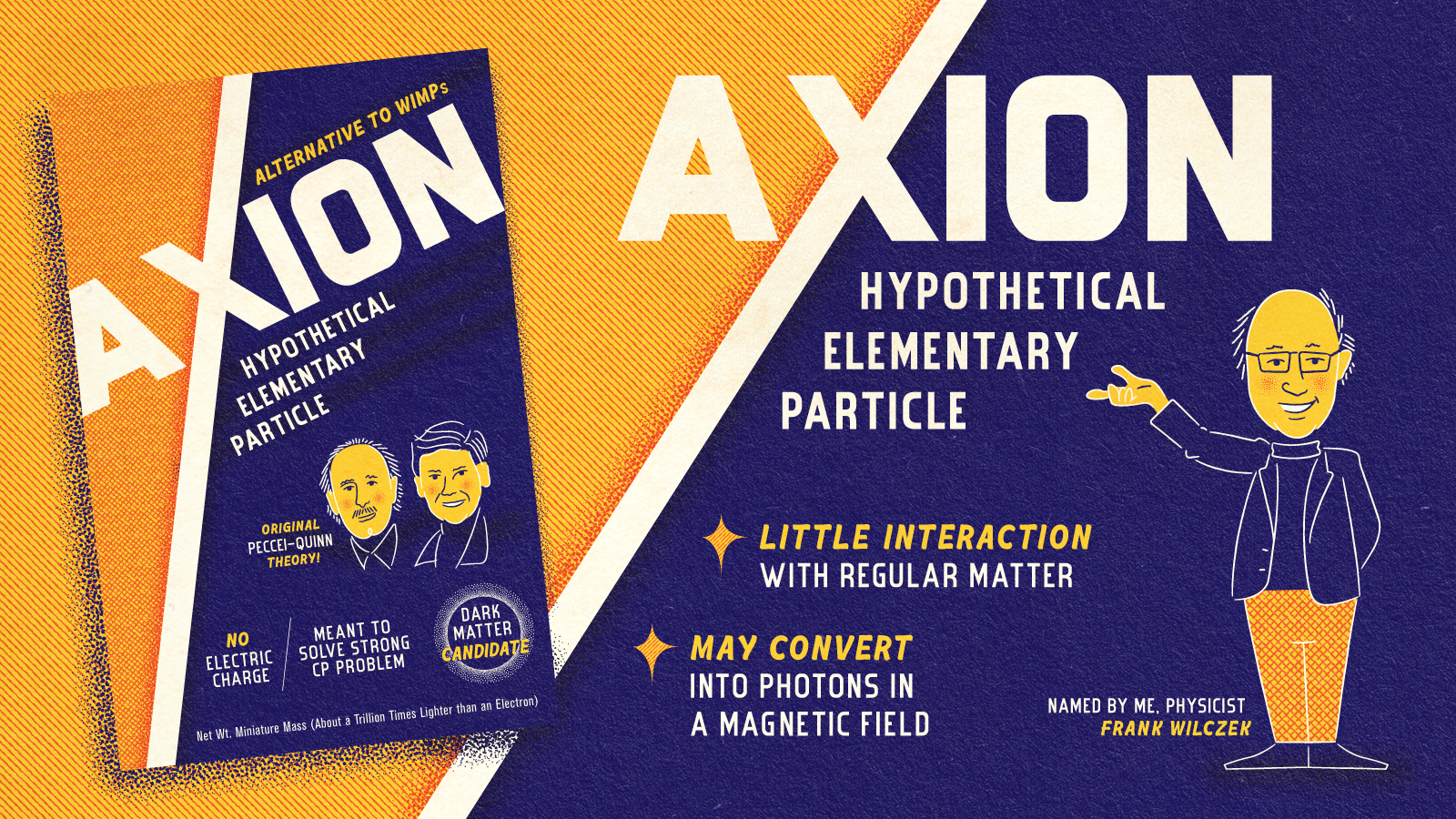
Axions are in WIMPS are out!

"Axions are even trickier than WIMPs. They’re theorized to be extremely light—a millionth of an electronvolt or so, about a trillion times lighter than the already tiny electron—making them next to impossible to produce or study in a traditional particle physics experiment. ... That means they exist all around us, as many as 10 trillion per cubic centimeter, waiting to be detected. ... In the presence of an electromagnetic field, they should sometimes spontaneously convert to easily detectable photons."

The other dark matter candidate | symmetry magazine: As technology improves, scientists discover new ways to search for theorized dark matter particles called axions.


Advertisement and packaging

Tuesday, November 26, 2019

19 more galaxies mysteriously missing dark matter have been found | Science News

Amazing stuff! Dark matter matters! Mysteries of the universe!

19 more galaxies mysteriously missing dark matter have been found | Science News: The finding reveals a population of dwarf galaxies that defy common wisdom about how these star systems form and evolve.

Wednesday, April 03, 2019

Major Upgrade Of Kitt Peak National Observatory

Posted: 4/3/2019


After decades of being kind of overshadowed by other astronomical observatories, Kitt Peak near Tucson, Arizona is going to become again a world leading research institution.


“On April 1 the dome of the Mayall Telescope … opened to the night sky, and starlight poured through the assembly of six large lenses that were carefully packaged and aligned for a new instrument that will launch later this year. Just hours later, scientists produced the first focused images with these precision lenses—the largest is 1.1 meters in diameter” What an incredible moment!


This new telescope features the “Dark Energy Spectroscopic Instrument, or DESI”. A marvel of technology:
“The finished DESI will measure the light of tens of millions of galaxies reaching back 12 billion light-years across the universe. It is expected to provide the most precise measurement of the expansion of the universe and provide new insight into dark energy, which scientists explain is causing this expansion to accelerate.
DESI’s array of 5000 independently swiveling robotic positioners, each carrying a thin fiber-optic cable, will automatically move into preset positions with accuracy to within several microns (millionths of a meter). Each positioner is programed to point its fiber-optic cable at an object to gather its light.
” (emphasis added)

Stay tuned!

Sunday, December 18, 2016

Will Dark Matter Become A Footnote In Science History?

Posted: 12/18/2016

Amazing stuff! This could be a huge discovery and possibly a new theory of gravity! Very exciting stuff!


Excerpts (emphasis added):

  1. “In 2010, Erik Verlinde surprised the world with a completely new theory of gravity. According to Verlinde, gravity is not a fundamental force of nature, but an emergent phenomenon. In the same way that temperature arises from the movement of microscopic particles, gravity emerges from the changes of fundamental bits of information, stored in the very structure of spacetime.” (S2)
  2. “One of the ingredients in Verlinde's theory is an adaptation of the holographic principle, introduced by his tutor Gerard 't Hooft (Nobel Prize 1999, Utrecht University) and Leonard Susskind (Stanford University). … all the information in the entire universe can be described on a giant imaginary sphere around it. Verlinde now shows that this idea is not quite correct—part of the information in our universe is contained in space itself. This extra information is required to describe ... Dark energy, which is believed to be responsible for the accelerated expansion of the universe.” (S2)
  3. “Gravity is in dire need of new approaches like the one by Verlinde, since it doesn't combine well with quantum physics. Both theories, crown jewels of 20th century physics, cannot be true at the same time.” (S2)
  4. “We might be standing on the brink of a new scientific revolution that will radically change our views on the very nature of space, time and gravity."” (S2)
  5. “A team led by astronomer Margot Brouwer (Leiden Observatory, The Netherlands) has tested the new theory of theoretical physicist Erik Verlinde (University of Amsterdam) for the first time through the lensing effect of gravity. Brouwer and her team measured the distribution of gravity around more than 33,000 galaxies to put Verlinde's prediction to the test. She concludes that Verlinde's theory agrees well with the measured gravity distribution.” (S1)