Recommendable!
Showing posts with label history of China. Show all posts
Showing posts with label history of China. Show all posts
Saturday, May 31, 2025

Thursday, December 12, 2024
Monday, October 21, 2024
Thursday, September 26, 2024
British Museum: Smuggling Domesticated Silkworms along the Silk Roads
Very recommendable!
A princess smuggled the silkworm eggs and seeds of the mulberry tree in her headdress about 1.300 years ago

Saturday, July 27, 2024
Tang dynasty tomb uncovered with a blond haired camel trader
Amazing stuff! About the Silk Road!
"Archaeologists in northern China have uncovered an ancient Tang dynasty tomb (A.D. 618-907) with remarkable murals depicting everyday life, Livescience reported mid-July. ...
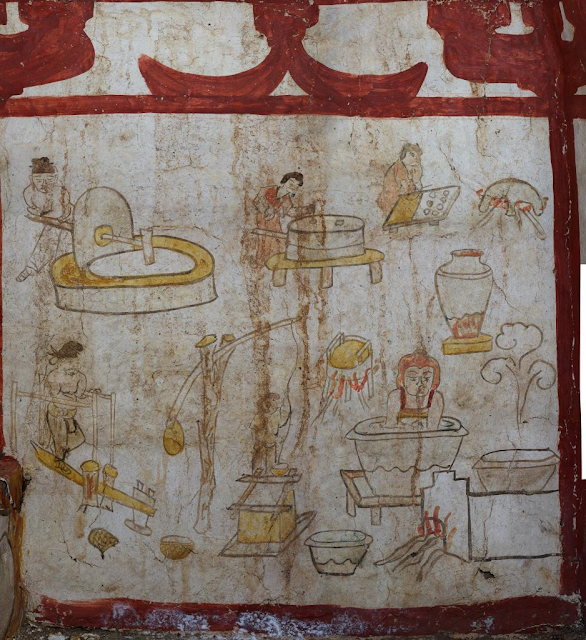
Inside the tomb, archeologists found murals vividly portraying scenes of daily life during the Tang period, including men threshing grain, making noodles, and engaging in other everyday activities. However, one mural includes a “Westerner” figure with blond hair and a beard, likely from Central Asia, according to the report. ...
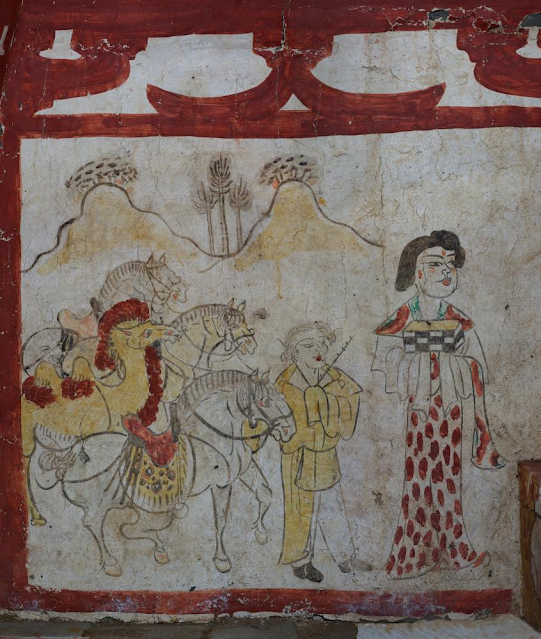
The unique mural depicts a blond man, not of Han descent, leading camels. His clothing and features suggest he is a Sogdian from Central Asia, who were known for their role as traders along the Silk Road between Asia and Europe. ..."
Inside the tomb, archeologists found murals vividly portraying scenes of daily life during the Tang period, including men threshing grain, making noodles, and engaging in other everyday activities. However, one mural includes a “Westerner” figure with blond hair and a beard, likely from Central Asia, according to the report. ...
The unique mural depicts a blond man, not of Han descent, leading camels. His clothing and features suggest he is a Sogdian from Central Asia, who were known for their role as traders along the Silk Road between Asia and Europe. ..."
Stunning Tang dynasty mural in tomb unearthed in China may portray a 'Westerner' man with blond hair
This is a picture of the living workshop inside the tomb.
This is a picture of camels and horses in the tomb. I guess, it also shows the blond haired man
Sunday, July 21, 2024
Sun Tzu - The Art of War Documentary
Recommendable! Hopefully, future archaeological or other discoveries will shed more light on The Art of War.
Tuesday, April 02, 2024
A Worldwide Perspective on Chinese People | Insights into Chinese Society | Thomas Sowell
Very recommendable! This video is about the globally widespread Chinese diaspora. Unfortunately, a bit outdated as it stops around mid 1990s.
Monday, April 01, 2024
Using DNA to work out what a 6th century Chinese emperor looked like
Amazing stuff!
"Researchers have reconstructed the face of Chinese Emperor Wu of Northern Zhou who lived 1,500 years ago.
Deep DNA analysis of single nucleotide polymorphisms, frequently called SNPs (pronounced “snips”), are the most common type of genetic variation among people and analysing them unlocked the facial features of Wu. ...
Wu’s rule was cut short when he died at 36 years old. Apart from giving us a glimpse at this ancient Chinese ruler, the research also suggests that Wu may have died from a stroke. His tomb was found in northwestern China in 1996.
Emperor Wu was ethnically Xianbei. These were a nomadic people who lived in what is today Mongolia and northern and northeastern China. ..."
From the highlights and abstract:
"Highlights
• Wudi had a typical East or Northeast Asian facial appearance
• Pathogenic SNPs suggest an increased susceptibility of Wudi to stroke
• Wudi derived ancestry from Northeast Asians but also has Han-related admixture
Summary
Emperor Wu (武帝, Wudi) of the Xianbei-led Northern Zhou dynasty, named Yuwen Yong (宇文邕, 543–578 CE), was a highly influential emperor who reformed the system of regional troops, pacified the Turks, and unified the northern part of the country. His genetic profile and physical characteristics, including his appearance and potential diseases, have garnered significant interest from the academic community and the public. In this study, we have successfully generated a 0.343×-coverage genome of Wudi with 1,011,419 single-nucleotide polymorphisms (SNPs) on the 1240k panel. By analyzing pigmentation-relevant SNPs and conducting cranial CT-based facial reconstruction, we have determined that Wudi possessed a typical East or Northeast Asian appearance. Furthermore, pathogenic SNPs suggest Wudi faced an increased susceptibility to certain diseases, such as stroke. Wudi shared the closest genetic relationship with ancient Khitan and Heishui Mohe samples and modern Daur and Mongolian populations but also showed additional affinity with Yellow River (YR) farmers. We estimated that Wudi derived 61% of his ancestry from ancient Northeast Asians (ANAs) and nearly one-third from YR farmer-related groups. This can likely be attributed to continuous intermarriage between Xianbei royal families, and local Han aristocrats. Furthermore, our study has revealed genetic diversities among available ancient Xianbei individuals from different regions, suggesting that the formation of the Xianbei was a dynamic process influenced by admixture with surrounding populations."

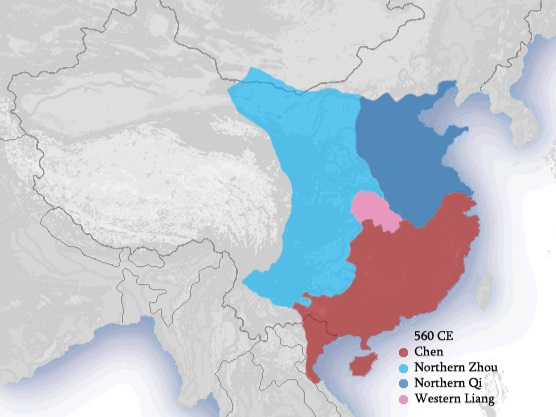
Territories of China in 560 CE.
Sunday, March 17, 2024
Extraordinary Women: Madame Chiang Kai-shek or Soong Mei-ling
Recommendable! I must admit, I was not aware of her despite my basic knowledge of modern Chinese history.
Saturday, September 09, 2023
The Qing Dynasty ruled China for 250 years before it suddenly collapsed. Scholars now think they know why
Recommendable!
The demise of the last Chinese dynasty in 1912 is not that surprising. There were several events that preceded it. E.g. industrial revolution in Russia and early Russian revolution in 1905, the Meiji Restoration in Japan since 1868.
Then there was the backwardness, social rigidity, and self imposed isolation of China. Latter was a sign of hubris by the Chinese emperors thinking that China was so advanced relative to the primitive rest of the world (e.g. Chinese Wall).
"... Yet, a pivotal moment in that history—the collapse of the Qing Dynasty in 1912— has always been difficult to interpret for historians. A new study has put this historic event once again in the spotlight, untangling the forces that dismantled China's last imperial stronghold but also offering a cautionary tale for contemporary China and beyond. ...
In 1820 at the height of the Qing, China was responsible for a staggering 32.9% of the world's GDP ...
Contrary to previous assumptions, social tensions peaked between 1840 and 1890 and didn't escape the Qing rulers' notice. This underscores the dynasty's institutional robustness. Yet, their solutions often proved shortsighted, exacerbating the brewing tensions."
In 1820 at the height of the Qing, China was responsible for a staggering 32.9% of the world's GDP ...
For centuries, scientists have grappled with uncovering the Qing Dynasty's downfall. Environmental disasters, foreign invasions, famines, and uprisings were all previously considered culprits. Yet, none offered a comprehensive explanation.
In their new study, Turchin and colleagues have identified three surprising key elements that could have fueled the socio-political collapse of the once mighty Qing Dynasty.
Population Explosion: Between 1700 and 1840, China's population quadrupled, leading to decreased land per capita and increased rural impoverishment.
Elite Competition: As more individuals vied for prestigious positions, the number of awarded academic degrees declined, creating a pool of frustrated elite aspirants. This mismatch stirred the pot, with many disgruntled would-be elites participating in the bloodiest civil war in human history—the Taiping Rebellion.
Financial Burden: The state's financial burden grew due to the costs of suppressing unrest, declining productivity, and trade deficits due to depleting silver reserves and opium imports.
Together, these factors ignited a series of uprisings that marked the Qing Dynasty's demise and the loss of countless Chinese lives.Contrary to previous assumptions, social tensions peaked between 1840 and 1890 and didn't escape the Qing rulers' notice. This underscores the dynasty's institutional robustness. Yet, their solutions often proved shortsighted, exacerbating the brewing tensions."
From the abstract:
"This paper analyzes the collapse of the Qing dynasty (1644–1912) through the lens of the Structural Demographic Theory (SDT), a general framework for understanding the drivers of socio-political instability in state-level societies. Although a number of competing ideas for the collapse have been proposed, none provide a comprehensive explanation that incorporates the interaction of all the multiple drivers involved. We argue that the four-fold population explosion peaking in the 19th century, the growing competition for a stagnant number of elite positions, and increasing state fiscal stress combined to produce an increasingly disgruntled populace and elite, leading to significant internal rebellions. We find that while neither the ecological disasters nor the foreign incursions during the 19th century were sufficient on their own to bring down the Qing, when coupled with the rising internal socio-political stresses, they produced a rapid succession of triggering events that culminated in the Qing collapse."
Structural-demographic analysis of the Qing Dynasty (1644–1912) collapse in China (open access)

The Qing Empire in 1820.
Friday, August 25, 2023
Tuesday, November 01, 2022
The All-Female Shang-Era Troops Led by Queen Fu Hao | Smithsonian Channel
Meet the Chinese Amazons and Saint Joan of Arc!
Poorly done video! Too much Hollywood action, too little historical background etc.! Plus the video is also too short to cover this subject adequately!
Poorly done video! Too much Hollywood action, too little historical background etc.! Plus the video is also too short to cover this subject adequately!
Friday, June 10, 2022
The myth behind the Chinese zodiac
Very recommendable! Amazing stuff! The Chinese zodiac system is much more complex than the Western zodiac.
Saturday, April 10, 2021
Hoover Acquires Personal Papers Of Wang Zuanxu, A Nationalist Chinese Military Leader From Sichuan Province
Good news! The tumultuous history of China in the first half of the 20th century certainly deserves to be researched more!
This man's life reflects the dramatic course of history of this period:
"Wang Zuanxu (1885–1960) was a native of Xichong, Sichuan Province. He began to rise to prominence in China’s military and political scene in the early 1920s, when he commanded divisions of the Sichuan army and created his own sphere of political influence. After Chiang Kai-shek completed the Northern Expedition in 1928—an effort of the National Revolutionary Army to reunify China under the Chinese Nationalist Party, or Kuomintang, after being fractured by the Revolution of 1911—Wang, together with a dozen regional military leaders in Sichuan, declared their nominal allegiance to the new Nationalist government in Nanjing. In 1938, shortly after the outbreak of the Sino-Japanese war, Wang was appointed provincial governor of Sichuan. A year later, as the Chinese Nationalists entered the darkest stage of the war, Wang resigned from the governorship and led an army of 100,000 to fight with the Japanese on the Hubei and Henan fronts. During the Chinese Civil War (1946–49), Wang was assigned the task of managing Chiang Kai-shek’s garrison command in Chongqing. When Wang saw the defeat of Chiang was inevitable, he decided to switch his political allegiance and joined the Chinese Communists. In 1957, as the Anti-Rightist Campaign began to surge, Wang, who was being labelled a rightist, fled China. He was arrested on November 15 at 9 pm while attempting to cross the Guangdong–Hong Kong border. He was subsequently thrown into a prison in Chengdu, where he died three years later."

Saturday, February 20, 2021
China's Lost Tang Dynasty Tomb Murals
Very recommendable! Learn among other things about the ruthless female ruler Wu Zetian. Many paintings of the Tang dynasty did not survive, because they were painted on silk. Thus these tomb murals are exceptional. Many of the Tang dynasty tombs have not yet even been excavated.
Friday, August 14, 2020
Thursday, July 30, 2020
Saturday, July 18, 2020
Sunday, May 24, 2020
The short life of Qiu Jin
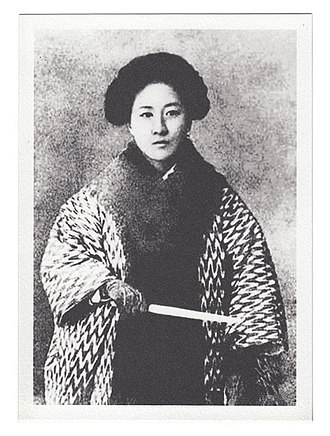
A woman most people are probably not familiar with! She was a revolutionary martyr, a poet, and an early Chinese feminist. She joined forces with Sun Yat-sen. I am not sure whether she was more republican or communist. Maybe we will never know, because she was executed at age 31 by imperial forces.
Qiu Jin - Wikipedia (1875-1907)
Qiu Jin - Wikipedia (1875-1907)
Here is a recent New York Times article about her (I did not read the whole article):
Subscribe to:
Posts (Atom)