Showing posts with label public education. Show all posts

Saturday, November 22, 2025

K-12 Education Spending Spotlight 2025: Annual public school spending nears $1 trillion

How much more can government spend on child public education? Like a bottomless pit? Of course, we all want the best education for our children, but at what price?

How much of it is wasted?

Notice also the wide range of government spending from lowest under $13,000 (Utah) to almost $37,000 (NY) per student. How is that possible?

"... Nationwide, public school funding increased by 35.8% between 2002 and 2023, rising from $14,969 per student to $20,322 per student after adjusting for inflation ...

The lowest-spending state, Idaho, was the only state spending less than $12,000 per student. Utah, Oklahoma and North Carolina spent less than $14,000 per student. ..."

K-12 Education Spending Spotlight 2025: Annual public school spending nears $1 trillion "Eight states spend more than $25,000 per student: New York, New Jersey, Vermont, Connecticut, Pennsylvania, California, Rhode Island and Hawaii. Public school enrollment fell in 39 states from 2020 to 2023."

Saturday, October 11, 2025

Schools and Cell Phone Bans in the US

A controversial, but pertinent topic! In general, prohibition is in many cases the dumbest way to regulate!

Is there a smart way to integrate smartphones into K-12 education? I would think so.

Banning smartphone to prevent inappropriate photos and video recordings in restrooms, locker rooms etc. Should it not suffice to punish specifically those few students doing such things instead of banning all smartphones?

"Across the United States, cell phones seem to be causing issues for students and headaches for educators. That's why more than two dozen states have passed legislation restricting cell phone use in K–12 schools. Many school districts have rolled out their own bans, too. ...

What schools are doing: Nearly all K–12 schools that took part in the survey allow students to bring their phones to school. But two-thirds prohibit cell phone use from “bell to bell”—that is, during the entire school day. Other policies range from allowing cell phone use at teachers' discretion to all-out bans. ...

Sixty percent of youth support at least some limits on cell phones, mainly to cut down on distractions. But most are skeptical of bell-to-bell restrictions. ..."

"Cell phones are overwhelming K–12 schools. Teachers are pushing for cell phones to be removed from schools, citing constant disruptions to classroom instruction and concerns about what responsibility they might have for the content that students post while in their classrooms (Hatfield, 2024; Langreo, 2023; Walker, 2025).
School administrators are worried that cell phones have negatively affected students’ academic learning, mental health, and attention spans (National Center for Education Statistics, 2025). Beyond the impacts of cell phone use on student learning and mental health, cell phone and social media use have created a rash of safety problems for schools, including cyberbullying and threats (Moore et al., 2024; Vogels, 2022). ...

As of June 2025, 29 states have passed legislation restricting cell phone use in K–12 schools (Ballotpedia, undated), and many school districts in states with and without state-level policies have enacted their own cell phone policies. In fact, in a survey administered to school districts in spring 2025, nine in ten said that they now have some form of a cell phone policy  ..."

Policy Currents Newsletter: October 9, 2025 | RAND

Principals See Many Benefits of Cell Phone Policies, but Youth Remain Skeptical "Selected Findings from the American School Leader Panel and the American Youth Panel"


Figure 2. Percentage of Schools with Cell Phone Policies, by Grade Level
bar chart showing various grade levels and their cell phone policies


Figure 3. Percentage of Principals Reporting School Safety–Related Benefits or Drawbacks of Cell Phone Policies
chart showing a survey from principals on the benefits and drawbacks of cell phone bans

Wednesday, September 17, 2025

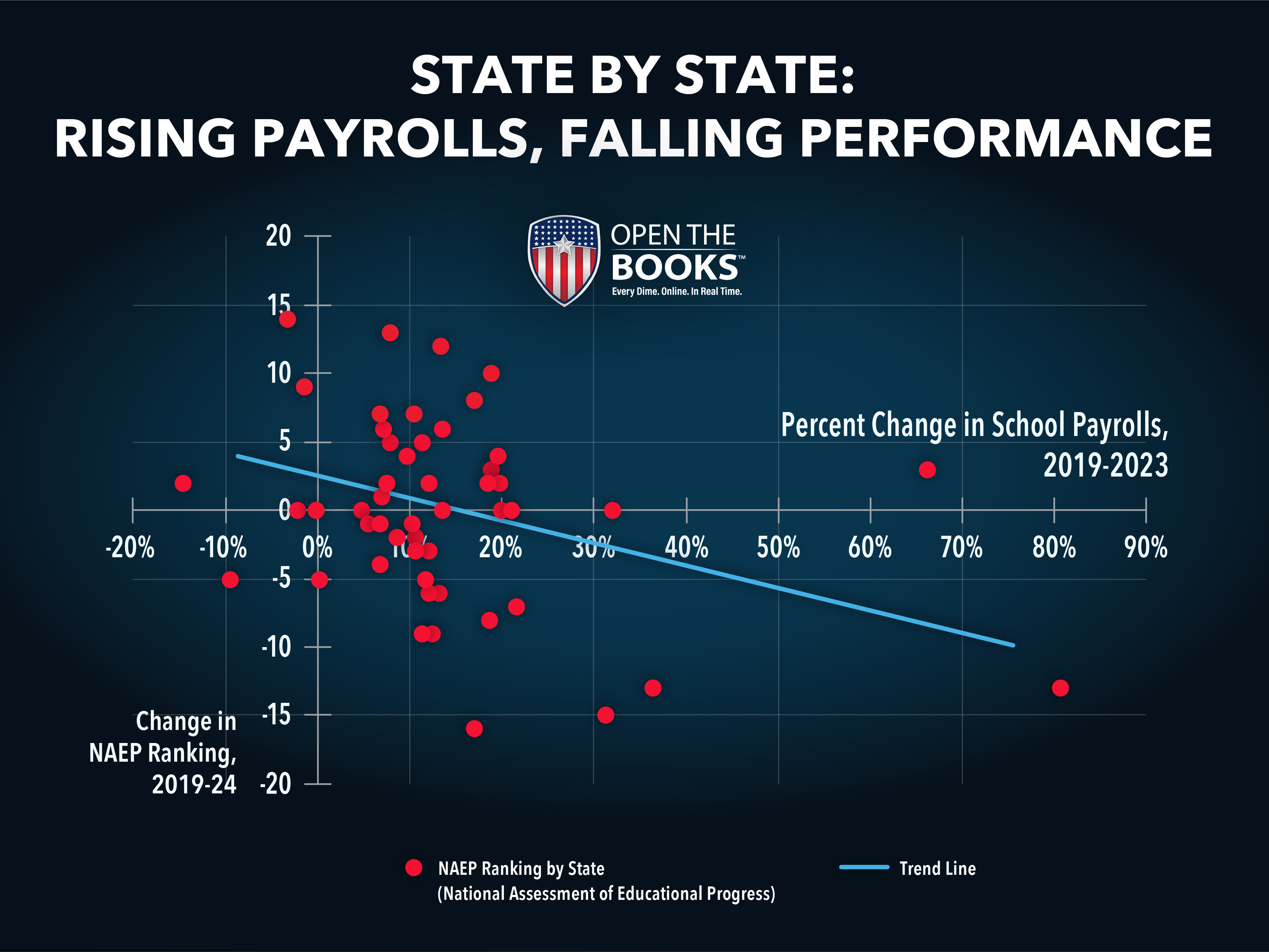
The Public School Crisis: Higher Payrolls Associated with Worse Student Performance. Really!

What is wrong with the chart below?

The study covered only the time span 2019-2025. Not enough data (probably you need at least 10 years of data)! For example, it was reported that school attendance is still not back to normal since Covid-19.


"Debates about public school funding sometimes include an underlying assumption that more funding results in better student outcomes. Available data tells a more complex story. Our review of 12,531 school districts across the country shows a negative correlation between overhead and student performance. In other words, districts that spent more on teacher and administrative pay saw their students’ standardized test scores drop. ..."

The Public School Crisis: Higher Payrolls Associated with Worse Student Performance

Friday, August 15, 2025

Chronic student Absenteeism Is Still a Struggle in many US cities

Bad news! What are these absent students doing? 

Are many of these absent students learning by alternative ways (e.g. home schooling, online learning)?

"New RAND surveys of school district leaders and American youths reveal several key insights about this persistent challenge:

  • Chronic absenteeism in the 2024–2025 school year remained above pre-pandemic levels.
  • In roughly half of urban school districts, more than 30 percent of students were chronically absent. That’s a far higher share of students than in rural or suburban districts.
  • One-quarter of youths do not think being chronically absent is a problem.
..."

Policy Currents Newsletter: August 14, 2025 | RAND

Wednesday, March 26, 2025

Microschools as an Emerging Education Model: Implications for Research and Evaluation

Who needs teachers and schools anymore in the age of machine learning and AI?

"Microschools are an alternative to traditional schools for families who might be dissatisfied with local school options. Typically, microschools are defined as small, tuition-based schools (serving around 15 students) that are designed to offer a more personalized and flexible learning experience compared with traditional schools. Interest in microschools has grown steadily in recent years, but the impacts of microschools on student academic achievement are yet to be rigorously evaluated. ..."

Microschools as an Emerging Education Model: Implications for Research and Evaluation | RAND "Implications for Research and Evaluation"

Friday, March 21, 2025

Hessen verbietet Handys an Schulen: Auswirkungen auf den Schulalltag. Wirklich!

Achtung, die Hesse kommen!

Staatliche Verbote sind meist doof und einfallslos! Das ist auch sicher hier der Fall! Dann ist da noch der Rückschritt also Folge dieses Verbots!

Die Nutzung von Handy sollte in den Schulunterricht sinnvoll und effektiv integriert werden zum Vorteil der Schüler. Lernen mit Handys bitte!

Hessen verbietet Handys an Schulen: Auswirkungen auf den Schulalltag "Mit einer Änderung des Schulgesetzes schränkt Hessen die Smartphone-Nutzung an Schulen drastisch ein. Welche Auswirkungen hat das auf den Schulalltag?"

Sunday, June 16, 2024

Empty Desks: The Policy Response to Declining Public School Enrollment

Food for thought! Maybe the recent mass illegal immigration/invasion across the southern border will fill class rooms again. Caution: satire.

The drop of enrollment was around 1.1 million between 2013 and 2023. As usual governments just keep throwing more money at the public school system. A well known waste of taxpayer money for many years.

If my wife and I were a parent of small children today we would probably enroll them in a private school of our choice or opt for home schooling.

Unfortunately, the Executive Summary of the article/report below is poorly or amateurishly written.

"In many parts of the country, enrollment in traditional public schools has fallen to its lowest point in decades. However, states, cities, and school districts have been slow to respond to the reality of empty desks. This report examines trends in school enrollment, focusing on several of America’s most populous cities, as well as the budgetary and staffing responses to those trends. It also examines the states where these large cities are located. ...
Between 2013 and 2023, public school enrollment fell nationally by 2% from 49.9 million to 48.8 million. Other studies have documented large declines in K–12 student enrollment in public schools at the state and district levels since the Covid-19 pandemic. However, according to the National Center for Education Statistics (NCES), the number of public school teachers was 11% higher in 2021 (3.8 million) than in 2011 (3.4 million). Furthermore, NCES reports that public schools spent an average of $16,280 per pupil in 2020, an increase of 13% from 2010. Roughly 80% of school spending is on salaries and benefits for staff (teachers, administrators, paraprofessionals, and so on). ..."

Empty Desks: The Policy Response to Declining Public School Enrollment | Manhattan Institute

Tuesday, September 26, 2023

Over 1,000 school districts allow teachers to hide transgender status of students from their guardians, parents' group claims. Really!

Bad news! Concerning! The high number is possibly inflated. I did not have the time to double check the claims of this organisation.

The organisation Parents Defending Education does not appear to explain how they define "Transgender/Gender Nonconforming Policies" and whether they confirmed in each case whether indeed parents are not being notified according to policy or in practice.

Over 1,000 school districts allow teachers to hide transgender status of students from their guardians, parents' group claims - TheBlaze

List of School District Transgender – Gender Nonconforming Student Policies Below is a list of school districts by state that have Transgender/Gender Nonconforming Policies that openly state that district personnel can or should keep a student’s transgender status hidden from parents.

Wednesday, November 10, 2021

K-12 Education and the U.S. Constitution

Why in the U.S. the overwhelming majority of K-12 education is provided by government run schools is more than surprising! To leave the indoctrination of children to government and labor unions has been a big mistake!

Given the technological advances in recent decades, home schooling is much more affordable and achievable! More private schools please!

"... the U.S. Constitution grants no authority over education to the federal government. Education is not mentioned in the Constitution of the United States, and for good reason. The Founders wanted most aspects of life managed by those who were closest to them, either by state or local government or by families, businesses, and other elements of civil society. Certainly, they saw no role for the federal government in education. ..."

Education and the Constitution | Cato at Liberty Blog

Saturday, September 25, 2021

Public schools or K-12 education now costlier than college in the U.S.

What a waste of taxpayers money! Why don't we give $14,000 directly to every eligible K-12 child so parents can make choices where they want their children to be educated?

I bet the situation is similar in other states than Arizona!

"As newly reported by the nonpartisan Joint Legislative Budget Committee, Arizona public schools are now so awash in funding that they will have $14,326 to spend per student in the 2021-2022 school year. By comparison, according to the same budget analysts, tuition and fees at Arizona State University cost around $3,000 less, coming in at $11,348. ...
the fact that Arizona’s per pupil K-12 funding has risen more than 40% over the past four decades (even adjusting for inflation and even before Arizona’s share of the latest two rounds of the $200 billion of federal Covid stimulus funds are even factored in).  ..."

Public schools now costlier than college | Arizona Capitol Times: Arizona public schools just hit a major milestone — they’re officially more expensive than the full freight tuition cost of sending a child to college at a four-year university here in the Grand Canyon State Arizona

Saturday, June 09, 2018

The Relation Of The Declaration Of Independence And The Constitution

Posted: 6/9/2018

Today, I was truly shocked at work to find out that two of my bright and brilliant American born and raised colleagues of mostly conservative disposition would argue that these two basic documents of the United States are not closely linked or that one is unrelated of the other.

Was this one of the results of the appalling public education suffered by students of public schooling in the U.S. I seriously fear so!

If an American citizen fails to recognize that the Declaration of Independence contains foundational principles (such as “... We hold these truths to be self-evident, that all men are created equal, that they are endowed by their Creator with certain unalienable Rights, that among these are Life, Liberty and the pursuit of Happiness.--That to secure these rights, Governments are instituted among Men, deriving their just powers from the consent of the governed ….”) that substantially guided the drafting and ratification of the U.S. Constitution then something is terribly wrong!

Wednesday, January 01, 2014

Reminiscences Of A Day Trader


An Apology First

I hope, Jesse Lauriston Livermore will forgive me for adopting the title “Reminiscences of a Stock Operator” of his famous biography for my purposes.

And I have to admit, I have read this book only in excerpts.

No Get Rich Advice Here

Sorry to disappoint!

If you think, you can get rich quickly by trading you may already be doomed. As they say, trading can be a very humbling experience. Only under lucky circumstances you will make beaucoup money with one or a few trades. But then, you will have to resist overconfidence and greed.

More Fun Than Some Digital Games

Definitely more skills required and offers more thrills when you put your money on the line!

Beats Lottery Or Casinos Hands Down Anytime!

To be politically incorrect, state run lotteries are a racket to extract money beyond taxation from gullible people. The odds of a big win are totally stacked against you.

Casinos are probably not much better in terms of winning money!

Unlike lottery or casino, trading in financial instruments requires knowledge, skills, and a certain temperament.

More Active Trading For Everyone

I do not know exactly how many people actually trade frequently (like several times a week) and over a long period of time in any financial instruments. However, I suppose it is a minority.

I wish there were more traders. Trading should be taught in high school. Trading is a good tool to learn important lessons like discipline (e.g. follow rules), self-confidence, prudence, to retain composure when your money is at risk, resisting temptation and much more.

Well functioning financial markets are so important to the well being of humans everywhere. Thus, participating in the financial markets is a civic duty like voting.

Trading Platforms

Trading platforms have come a long way. They are much more powerful and affordable today. There is some tool equality between the big players on the financial markets and individuals.

I have always lived by the motto the best available tool is just good enough! (Must be my German background)

I have tried other trading platforms before I settled on Tradestation. But I do not claim to be an expert in any other platform.

I personally use the Tradestation desktop platform, but I cannot highly recommend it. It is a dated, convoluted, monolithic all-in-one platform. The scripting language and programming environment is being updated, but I believe it is still too limited and cumbersome. Tradestation platform is not modular, if you are trading only in Forex, you still have all the equity/futures/options trading functionality etc. Very annoying and bloated!

I would like to program a trading strategy, but unfortunately, Tradestation is not the best tool for that (see above).

Some Advice

  1. Do not follow the latest fads or tweaks of existing indicators etc.!
  2. Do not be fooled by fancy sounding trading strategies or indicators, e.g. Elliott Wave or Fibonacci or some Japanese named charting technique (forgot the name of it) etc.
  3. Do not use stops! Yes, e.g. a flash crash can wipe you out, but such events do not occur frequently and there is usually a bounce back. In my experience, I would have lost too much money, because stops were triggered. However, if you trade a single company equity you may need a stop in case e.g. the company makes an unexpected announcement or a court of law comes down with a negative verdict affecting the stock price over a long time.
  4. Tight stops are particularly useless. If you only feel comfortable trading with tight stops, perhaps trading is not for you.
  5. Forex trading is comparatively cheap and 24 hours. Major currencies pairs are fairly stable over time. Very flexible in the size/quantity you want to trade.
  6. Sit tight when the going appears to get rough! Always remember the generally mean reversing property of financial asset prices! Financial markets often attempt to take you for a ride like a bronco. Trading is not for the timid or faint hearted! Plus the big players have more money and they can sustain bigger losses than you can.

Technical Analysis & Indicators

Since I mostly trade Forex my recommendations apply foremost to this market.

To understand the long term performance of an asset I use 10 years of daily data to chart:
  1. Bollinger bands with 1,2, and 3 standard deviations plus mid-points between these standard deviations
  2. Simple moving averages (5, 10 years) plus multiple bands above and below the SMA at multiples of 5% or 10% around the SMA
  3. Highs/lows plus 75%, 67%, 50%, 33%, and 25% levels between highs and lows

To understand the annual performance of an asset I use again daily data to chart:
  1. Year to date highs/lows plus the above mentioned levels
  2. 12 months moving highs/lows plus the above mentioned levels
  3. A simple moving average (52 * 5 days) plus multiple bands above and below the SMA of 5% around the SMA

To understand the short-term performance of an asset I use again daily data to chart:
  1. The five day highs/lows plus the above mentioned levels

For entry/exit I focus besides the above mentioned charts on:
  1. 15 minute chart showing again highs/lows plus the above mentioned levels; plus open, close/high/low of current day; open/close/high/low of previous day
  2. 1 minute chart showing showing simple moving average (24 hours) plus bands as described above, but using 1%.

Time Frames

Since I mostly trade Forex my recommendations apply foremost to this market.

Long term: Daily (not higher like weekly, monthly)
Short term: Hourly, 15 minutes, 1 minute