Showing posts with label lead poisoning. Show all posts

Wednesday, January 08, 2025

Lead pollution in Arctic ice cores likely caused IQ declines in the Roman Empire. Really!

This appears to be junk science or at least exaggerated claims! Computer models still can not predict today's weather accurately beyond more than 48 hours.

What about lead smelting in other regions of the world like Asia?

This seems to be another very or extremely eurocentric study!

It is very popular and convenient to blame or associate lead exposure to all sorts of things!

"... The study examined measurements of lead pollution in 3 Arctic ice cores dating from 500 BCE to 600 CE, an era spanning the rise of the Roman Republic through to the fall of the Roman Empire.

Researchers used computer models of atmospheric movement  to map atmospheric lead pollution across Europe to estimate exposure levels and human health impacts.  ..."

"... The study, published ... in Proceedings of the National Academy of Sciences (PNAS), examined three ice core records to identify lead pollution levels in the Arctic between 500 BCE through 600 CE. This era spans the rise of the Roman Republic through the fall of the Roman Empire, with the study focusing on the approximately 200-year height of the Empire called the Pax Romana. Lead isotopes allowed the research team to identify mining and smelting operations throughout Europe as the likely source of pollution during this period. Advanced computer modeling of atmospheric movement then produced maps of atmospheric lead pollution levels across Europe. Combined with research linking lead exposure to cognitive decline, the research team also identified likely reductions in IQ levels of at least 2 to 3 points among the European population. ..."

"Significance
The detrimental effects of modern lead exposure on human health are widely recognized. Evidence from the Roman era indicates substantial lead exposure that potentially impacted human health more than 2,000 y ago. The most significant exposure for the rural, nonelite population may have been to background air pollution from silver mining and smelting that underpinned the Roman economy. Using detailed records of Roman-era lead pollution measured in Arctic ice cores and atmospheric modeling, we show that lead emissions from these activities elevated air concentrations throughout Europe. Based on modern epidemiological studies, this air pollution enhanced childhood blood lead levels (BLLs) by about 2.4 µg/dl leading to widespread cognitive decline including an estimated 2.5-to-3 point reduction in intelligence quotient.
Abstract
Ancient texts and archaeological evidence indicate substantial lead exposure during antiquity that potentially impacted human health. Although lead exposure routes were many and included the use of glazed tablewares, paints, cosmetics, and even intentional ingestion, the most significant for the nonelite, rural majority of the population may have been through background air pollution from mining and smelting of silver and lead ores that underpinned the Roman economy.
Here, we determined potential health effects of this air pollution using Arctic ice core measurements of Roman-era lead pollution, atmospheric modeling, and modern epidemiology-based relationships between air concentrations, blood lead levels (BLLs), and cognitive decline.
Findings suggest air lead concentrations exceeded 150 ng/m3 near metallurgical emission sources, with average enhancements of >1.0 ng/m3 over Europe during the Pax Romana apogee of the Roman Empire. The result was blood lead enhancements in young children of about 2.4 µg/dl above an estimated Neolithic background of 1.0 µg/dl, leading to widespread cognitive decline including a 2.5-to-3 point reduction in intelligence quotient throughout the Roman Empire."

Lead pollution likely caused IQ declines in the Roman Empire


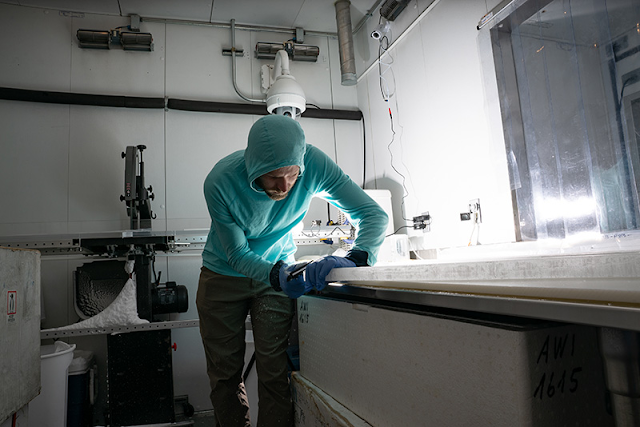
Carefully preparing the longitudinal ice core samples for high-resolution lead measurements 

Tuesday, December 05, 2023

Indian companies are bringing one of the world’s most polluting industry, i.e. battery recycling, to Africa. People are getting sick.

This is my second blog in two days about dubious business practices by Indian companies. The first one was about cough syrup for children.

It seems, the ascending superpower India has some clean up to do.

"Battery recycling is considered one of the most polluting industries in the world, with related lead contamination afflicting surrounding environments for generations, and the body “for a lifetime.”

While the process has become more regulated in India, companies there have moved the toxic industry to African nations with few protections. 

In a must-read investigation, The Examination, The Museba Project, and Ghana Business News looked at the toll Indian-owned battery recycling plants take on surrounding communities. ..."

Indian companies are bringing the world’s most polluting industry to Africa. People are getting sick. | The Examination Families near battery recycling plants face “dangerous" levels of lead in their blood and in soil, testing shows.


The Examination commissioned blood tests of people who live near the Metssa Congo plant and had them analyzed for lead levels by a laboratory in France.


Monday, September 25, 2023

Turmeric’s unexpected link to lead poisoning in Bangladesh and its remedy, a successful anti-lead campaign

Good news! I like turmeric a lot! Spice is the variety of life (pardon my permutation)!

But beware of shiny yellow turmeric.

From the highlights and abstract:
"Highlights
• The impact of an intervention to reduce lead in turmeric in Bangladesh is assessed.
• The percent of market turmeric samples containing lead decreased from 47% to 0%.
• The percent of mills adding lead chromate to turmeric decreased from 30% to 0%.
• Turmeric mill worker blood lead levels dropped a median of 30% (IQR: 21–43%).
• Future research should evaluate if this intervention can be replicated elsewhere.
Abstract
Turmeric adulterated with lead chromate pigment has been previously identified as a primary source of lead exposure in Bangladesh. This study assesses the impact of a multi-faceted intervention between 2017 and 2021 to reduce lead-tainted turmeric in Bangladesh. The intervention involved:
i) disseminating findings from scientific studies via news media that identified turmeric as a source of lead poisoning,
ii) educating consumers and businesspeople about the risks of lead chromate in turmeric via public notices and face-to-face meetings, and
iii) collaborating with the Bangladesh Food Safety Authority to utilize a rapid lead detection technology to enforce policy disallowing turmeric adulteration. Before and after the intervention, evidence of lead chromate turmeric adulteration was assessed at the nation's largest turmeric wholesale market and at turmeric polishing mills across the country. Blood lead levels of workers at two mills were also assessed. Forty-seven interviews were conducted with consumers, businesspeople, and government officials to assess changes in supply, demand, and regulatory capacity.
The proportion of market turmeric samples containing detectable lead decreased from 47% pre-intervention in 2019 to 0% in 2021 (n = 631, p < 0.0001).
The proportion of mills with direct evidence of lead chromate adulteration (pigment on-site) decreased from 30% pre-intervention in 2017 to 0% in 2021 (n = 33, p < 0.0001).
Blood lead levels dropped a median of 30% (IQR: 21–43%), while the 90th percentile dropped 49% from 18.2 μg/dL to 9.2 μg/dL 16 months after the intervention (n = 15, p = 0.033). Media attention, credible information, rapid lead detection tools and swift government action to enforce penalties all contributed to the intervention's success. Subsequent efforts should evaluate if this is an example of an effective intervention that can be replicated to reduce lead chromate adulteration of spices globally."

Turmeric’s unexpected link to lead poisoning in Bangladesh A hunt for the sources of lead poisoning in Bangladesh. The rural areas of Bangladesh are quilted with verdant rice paddies nestled between glittering, blue river tributaries. Women wrapped in fuchsia, pomegranate-red and tangerine-orange saris walk among tan-and-brown cows. Market stalls are piled high with multicolored produce and spices. It is a country of vibrant colors.


Fig. 1. Bangladesh Food Safety Authority flyer of which they printed and distributed more than 50,000 copies.


Saturday, April 09, 2022

Demographic implications of lead poisoning for eagles across North America. Really!

The lead poisoning threat to birds has been reported many times now for at least 50 or more years! If it was such a serious problem, most birds would be dead by now!

Notice computer models are used again (hint climate change) to create a sense of urgency! There are lies, damned lies and computer models!

"... Despite this headway, anthropogenic lead remains an underappreciated threat to wildlife. ..."

From the abstract:
"Lead poisoning occurs worldwide in populations of predatory birds, but exposure rates and population impacts are known only from regional studies. We evaluated the lead exposure of 1210 bald and golden eagles from 38 US states across North America, including 620 live eagles. We detected unexpectedly high frequencies of lead poisoning of eagles, both chronic (46 to 47% of bald and golden eagles, as measured in bone) and acute (27 to 33% of bald eagles and 7 to 35% of golden eagles, as measured in liver, blood, and feathers). Frequency of lead poisoning was influenced by age and, for bald eagles, by region and season. Continent-wide demographic modeling suggests that poisoning at this level suppresses population growth rates for bald eagles by 3.8% (95% confidence interval: 2.5%, 5.4%) and for golden eagles by 0.8% (0.7%, 0.9%). Lead poisoning is an underappreciated but important constraint on continent-wide populations of these iconic protected species."

Demographic implications of lead poisoning for eagles across North America