Showing posts with label limb regeneration. Show all posts

Saturday, April 11, 2026

Oxygen sensing helps explain why amphibians regenerate limbs but mammals cannot

Amazing stuff! Be aware, there are two concurrent studies published on this subject. I ignored the second study.

"... For decades, biologists have tried to understand why. Now a team ... has discovered that oxygen plays a crucial role in limb regeneration. By comparing amputated limbs from frog tadpoles and embryonic mice, the researchers found that the way cells sense oxygen determines whether regeneration can even begin. ...

The researchers amputated developing limbs from frog tadpoles and mouse embryos and cultured them outside the body under controlled oxygen conditions. Oxygen levels were lowered to match aquatic environments or raised to levels close to air.

They tracked how cells responded by measuring wound closure, cell movement, gene activity, metabolism, and epigenetic states, including changes to DNA packaging. The work focused on HIF1A, a protein that acts as a cellular oxygen sensor. When oxygen is low, HIF1A becomes stable and activates programs that set the stage for wound healing and regeneration.

Lowering oxygen levels had a clear effect on the limbs of mouse embryos. Under reduced oxygen, mouse cells closed wounds faster and showed signs of entering a regenerative program. Stabilizing HIF1A produced similar effects, even when oxygen levels remained high.

Low oxygen also changed cell behavior, with skin cells becoming more mobile and altering their mechanical properties. Metabolism shifted toward glycolysis, a process that takes place in low-oxygen states. At the same time, chemical marks on DNA-associated proteins shifted to favor the activation of regeneration-related genes.

Frog tadpoles behaved differently. Their limbs regenerated efficiently across a wide range of oxygen levels, including levels well above those normally found in air. Molecular analysis showed that their cells maintain stable HIF1A activity even when oxygen increases, due to low expression of genes that normally shut this pathway down.

By comparing frogs, axolotls, mice, and human datasets, the team found a consistent pattern. Regeneration-competent amphibians show reduced oxygen-sensing capacity, allowing regenerative programs to be initiated and sustained. Mammals show the opposite pattern. Their cells respond strongly to oxygen and switch regenerative programs off soon after injury. ..."

From the abstract of the Perspective:
"The ability to regenerate varies widely across the animal kingdom.
Planarians, a type of flatworm, can rebuild their entire body from small fragments.
Fish and salamanders can regenerate complex structures such as fins and limbs.
By contrast, mammals exhibit much more limited natural regenerative abilities (2). This disparity has profound clinical consequences. Poor wound healing, scarring, and limb loss continue to diminish quality of life. Defining how animals orchestrate regenerative processes is important for developing therapies for humans. Emerging evidence suggests that the genes carried by mammals may not render them intrinsically regeneration incompetent.
Instead, the default mammalian wound environment may reinforce nonregenerative programs. On pages 177 and 176 of this issue, Mui et al. (11) and Tsissios et al. (12), respectively, report that regeneration is not simply a fixed genetic trait but rather a state that is dependent on the extracellular environment, oxygen sensing, and epigenetics."

From the editor's summary and abstract:
"Editor’s summary
Some vertebrates can regenerate limbs, whereas others cannot. By comparing regenerating frog tadpoles and nonregenerating mouse embryonic limbs, 
Tsissios et al. found that species-specific oxygen sensing determines whether amputation triggers limb regeneration ... 
Frog tadpoles exhibited reduced oxygen sensing associated with diminished regulation of hypoxia-inducible factor 1A (HIF1A), enabling robust regeneration by promoting biomechanical, epigenetic, and metabolic states conducive to tissue regrowth.
By contrast, mouse limbs displayed heightened sensitivity to oxygen, which destabilizes HIF1A and prevents regeneration. Lowering environmental oxygen levels or stabilizing HIF1A allowed mouse limbs to initiate regeneration.
Mui et al. used a mouse digit amputation model to investigate why some injuries regenerate while others scar. They found that the extracellular matrix, the network of proteins and sugars surrounding cells, was crucial to regeneration. Regenerating tissue is soft, fluid, and rich in hyaluronic acid, whereas nonregenerating tissue is stiff and collagen heavy.
Depleting hyaluronic acid halted regeneration and triggered scarring, whereas stabilizing it improved bone regrowth.

Structured Abstract
INTRODUCTION
Some vertebrates, such as frog tadpoles and salamanders, can regenerate lost limbs after amputation, whereas mammals cannot. Many regeneration-associated molecular pathways and cellular programs are conserved across species, suggesting a possible latent limb-regenerative capacity for mammals. Nonetheless, it remains unclear why these pathways and cell types are not activated after limb amputation and whether limb regenerative programs can, in principle, be initiated in mammals.

RATIONALE
Direct functional comparisons of amputation responses across species are difficult in vivo because of physiological, environmental, and developmental differences, as well as practical constraints. We therefore used limb explants, tissues grown outside the body, as a highly controlled experimental platform.
Having shown that frog tadpole (Xenopus laevis) limbs initiate regeneration as explants, we investigated whether embryonic mouse (Mus musculus) limbs do so under comparable conditions and, if not, which mechanisms distinguish regenerative from nonregenerative species.

RESULTS
We found that subatmospheric oxygen conditions, or stabilization of the oxygen-sensitive transcription factor hypoxia-inducible factor 1A (HIF1A), promote rapid wound healing after amputation in embryonic mouse limbs.
Reduced oxygen availability reshaped cellular biomechanical properties associated with YAP activation and metabolic states, particularly glycolysis. In parallel, it also rewired the chromatin landscape by decreasing the repressive histone mark H3K27me3 and increasing the activating mark H3K4me3, thereby permitting regenerative gene expression and the formation of limb regeneration–associated cell types.
By contrast, atmospheric oxygen conditions impaired these processes in mouse limbs. In addition, frog tadpole limbs displayed robust wound healing, regenerative cell-type formation, and stable biomechanical, epigenetic, and metabolic features across a wide range of oxygen conditions, even those greatly exceeding atmospheric oxygen levels.
This reduced oxygen sensing was associated with lower expression of HIF1A regulators, resulting in stable HIF1A activity relative to mice. Extending this analysis, we found that regenerative axolotls also show lower expression of HIF1A regulators, whereas humans exhibit a heightened oxygen-sensing signature similar to mice.

CONCLUSION
We propose species-specific oxygen-sensing capacity as a key determinant of limb regeneration initiation across vertebrates. Reduced oxygen sensing promotes biomechanical, epigenetic, and metabolic programs that are conducive to regeneration, with implications extending to development, disease, evolution, and cross-species comparisons.
Finally, our findings demonstrate that modulation of oxygen-sensing pathways can unlock latent limb-regenerative programs in mammals, providing a mechanistic route toward inducing limb regeneration in adult mammals."

Oxygen sensing helps explain why amphibians regenerate limbs but mammals cannot

Awakening latent regeneration in mammals (Perspective, no public access)


Species-specific oxygen sensing governs the initiation of vertebrate limb regeneration.


Sunday, December 08, 2024

How a regenerating starlet sea anemone keeps in shape

Amazing stuff!

"The starlet sea anemone (Nematostella vectensis) is a pro regenerator: capable of regrowing a lost body part, or even into 2 new anemones, when cut or injured.

A new study has found that the anemone remodels its whole body to do this – all to preserve its body shape. ..."

From the highlights and abstract:
"Highlights
• Tomo-seq identifies local and systemic responses in regenerating Nematostella
• Physa regeneration triggers both morphallactic and epimorphic processes
• Local and systemic matrix metalloprotease levels scale with tissue loss
• Matrix metalloproteases remodel basement membranes to maintain shape homeostasis
Summary
The complexity of regeneration extends beyond local wound responses, eliciting systemic processes across the entire organism. However, the functional relevance and coordination of distant molecular processes remain unclear. In the cnidarian Nematostella vectensis, we show that local regeneration triggers a systemic homeostatic response, leading to coordinated whole-body remodeling. Leveraging spatial transcriptomics, endogenous protein tagging, and live imaging, we comprehensively dissect this systemic response at the organismal scale. We identify proteolysis as a critical process driven by both local and systemic upregulation of metalloproteases. We show that metalloproteinase expression levels and activity scale with the extent of tissue loss. This proportional response drives long-range tissue and extracellular matrix movement. Our findings demonstrate the adaptive nature of the systematic response in regeneration, enabling the organism to maintain shape homeostasis while coping with a wide range of injuries."

How a regenerating starlet anemone keeps in shape


Graphical abstract


Figure 4. Proteolysis correlates with local and systemic wound responses


Tuesday, July 23, 2024

Regeneration of limbs appears to be an ability of a common ancestor acquired hundreds of millions of years ago

Amazing stuff! We could use some of these genes occasionally! 😊

"Cut off the leg of an axolotl, the arm of a starfish, or the tail of a salamander, and they will all eventually regrow. A wide range of species boast regenerative powers—but a new study suggests that rather than evolving independently, these abilities may be traced back to shared genetic roots.

The insight comes from the newly sequenced genome of the brittle star Amphiura filiformis, a cousin to starfish and sea urchins, which sports five spindly legs protruding from a central disc. The creature is a particularly impressive regenerator: If it loses a leg, the limb will regrow within a month.

Researchers amputated the arms of more than 3500 brittle stars, examining which genes were active at different stages of the regeneration process. During the “proliferative” phase of regeneration, where cells rapidly divide to replace lost tissues, the brittle star expressed ancient genes that it had acquired hundreds of millions of years ago. They then compared these genes with those active during the regeneration of two distantly related animals: axolotls (Ambystoma mexicanum) and the crustacean Parhyale hawaiensis. The three species shared many of the same genes, pointing to a shared ancestral origin for regeneration. ..."

From the abstract:
"Species within nearly all extant animal lineages are capable of regenerating body parts. However, it remains unclear whether the gene expression programme controlling regeneration is evolutionarily conserved. Brittle stars are a species-rich class of echinoderms with outstanding regenerative abilities, but investigations into the genetic bases of regeneration in this group have been hindered by the limited genomic resources. Here we report a chromosome-scale genome assembly for the brittle star Amphiura filiformis. We show that the brittle star genome is the most rearranged among echinoderms sequenced so far, featuring a reorganized Hox cluster reminiscent of the rearrangements observed in sea urchins. In addition, we performed an extensive profiling of gene expression during brittle star adult arm regeneration and identified sequential waves of gene expression governing wound healing, proliferation and differentiation. We conducted comparative transcriptomic analyses with other invertebrate and vertebrate models for appendage regeneration and uncovered hundreds of genes with conserved expression dynamics, particularly during the proliferative phase of regeneration. Our findings emphasize the crucial importance of echinoderms to detect long-range expression conservation between vertebrates and classical invertebrate regeneration model systems."

ScienceAdvisor


Fig. 5: Gene expression throughout appendage regeneration across animals.


Saturday, February 17, 2024

The Surprisingly Simple Recipe for Starting to Grow a Limb

Good news!

"At a glance:
  1. In a first, scientists have identified the proteins needed to kick-start limb formation in mice and chicks.
  2. The findings allow researchers for the first time to turn non-limb-forming cells into limb-forming ones and keep them alive in the lab for far longer than once possible.
  3. Work deepens understanding of early limb development and could contribute to the long-term goal of regenerating limbs lost to injury and disease.
...
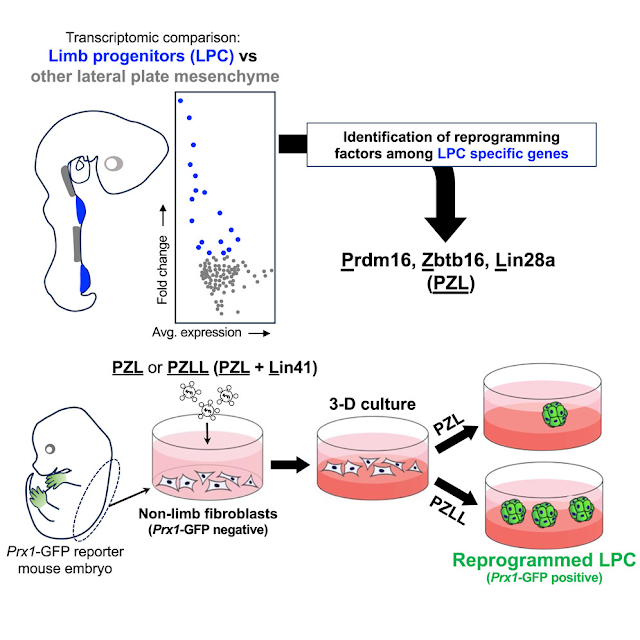
The team found that a combination of just three proteins — Prdm16, Zbtb16, and Lin28a — is necessary and sufficient to turn certain non-limb-forming stem cells into limb-forming ones. A fourth protein, Lin41, speeds the process along.

Part of a family called gene transcription factors, these proteins activate a handful of genes inside certain cells in embryonic tissue known as mesenchyme, the researchers revealed. This change in gene activity is what transforms the cells into limb progenitor cells, the team showed. ..."

From the highlights and abstract:
"Highlights
• Established a primary 3D limb culture system that maintains early limb progenitor cells
• Used a reprogramming approach to identify factors imbuing a limb progenitor state
• Together, Prdm16, Zbtb16, and Lin28a can convert non-limb cells to limb progenitors
• Trajectory analysis identifies Lin41 as facilitating reprogramming by the other factors
Summary
The early limb bud consists of mesenchymal limb progenitors derived from the lateral plate mesoderm (LPM). The LPM also gives rise to the mesodermal components of the flank and neck. However, the cells at these other levels cannot produce the variety of cell types found in the limb. Taking advantage of a direct reprogramming approach, we find a set of factors (Prdm16, Zbtb16, and Lin28a) normally expressed in the early limb bud and capable of imparting limb progenitor-like properties to mouse non-limb fibroblasts. The reprogrammed cells show similar gene expression profiles and can differentiate into similar cell types as endogenous limb progenitors. The further addition of Lin41 potentiates the proliferation of the reprogrammed cells. These results suggest that these same four factors may play pivotal roles in the specification of endogenous limb progenitors."

The Surprisingly Simple Recipe for Starting to Grow a Limb | Harvard Medical School Study illuminates development, could inform limb regeneration efforts


Graphical abstract


Thursday, January 06, 2022

Coaxing Jellyfish, Flies, and Mice to Regenerate Body Parts

Recommendable! Amazing stuff! Impressive!

"... none of the species in the study had ever been shown to regrow limbs after certain injuries. The work suggests the ability to regenerate is somehow innate across various species and can be triggered under the right conditions. ...
Though Drosophila have never been shown to regrow limbs, the team found increased insulin and leucine in the fly food led to some regrowth in 49 percent of flies. ...
The team performed amputations below the fingernail, across the distal portion of bone, and gave the mice leucine and sugars in their drinking water. Ten percent of mice were then able to regrow at least part, and in a few cases nearly all, of the amputated digit. ..."

From the abstract:
"Can limb regeneration be induced? ... This study reports a strategy for inducing regenerative response in appendages, which works across three species that span the animal phylogeny. In Cnidaria, the frequency of appendage regeneration in the moon jellyfish Aurelia was increased by feeding with the amino acid L-leucine and the growth hormone insulin. In insects, the same strategy induced tibia regeneration in adult Drosophila. Finally, in mammals, L-leucine and sucrose administration induced digit regeneration in adult mice, including dramatically from mid-phalangeal amputation. The conserved effect of L-leucine and insulin/sugar suggests a key role for energetic parameters in regeneration induction. The simplicity by which nutrient supplementation can induce appendage regeneration provides a testable hypothesis across animals."

Coaxing Jellyfish, Flies, and Mice to Regenerate Body Parts | www.caltech.edu Caltech researchers have discovered certain conditions that enable different laboratory animals to regenerate amputated appendages. Upon consuming a diet high in sugar and an essential amino acid, three different species—the moon jellyfish Aurelia coerulea, the fruit fly Drosophila melanogaster, and common laboratory mice—all demonstrated some ability to regenerate appendages after amputation.