Amazing stuff!
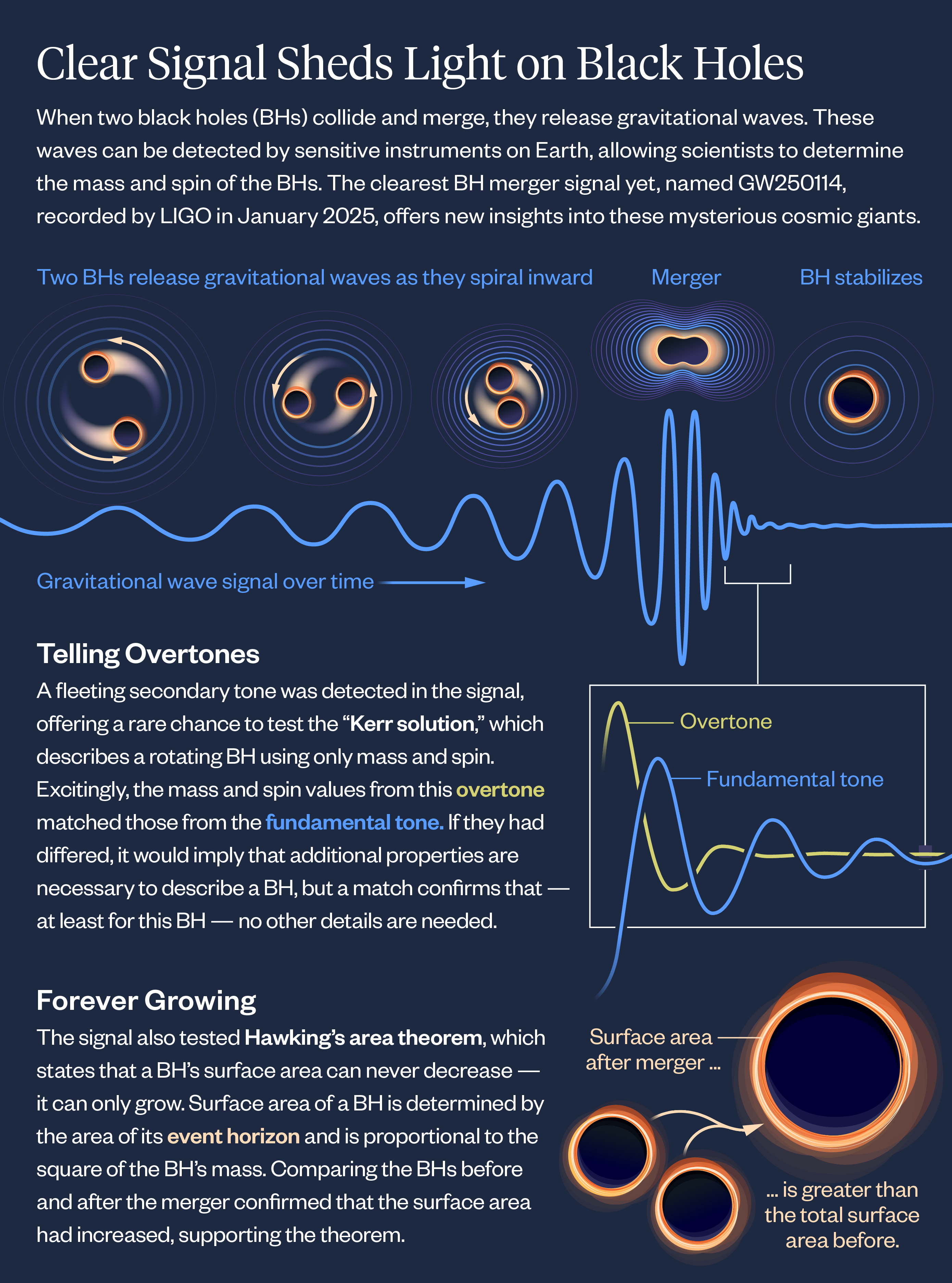
"A decade ago, scientists first detected ripples in the fabric of space-time, called gravitational waves, from the collision of two black holes. Now, thanks to improved technology and a bit of luck, a newly detected black hole merger is providing the clearest evidence yet of how black holes work — and, in the process, offering long-sought confirmation of fundamental predictions by Albert Einstein and Stephen Hawking.
The new measurements were made by the Laser Interferometer Gravitational-Wave Observatory (LIGO) ... The results reveal insights into the properties of black holes and the fundamental nature of space-time, hinting at how quantum physics and Einstein’s general relativity fit together. ..."
From the abstract:
"The gravitational-wave signal GW250114 was observed by the two LIGO detectors with a network matched-filter signal-to-noise ratio of 80. The signal was emitted by the coalescence of two black holes with near-equal masses 𝑚1=33.6+1.2−0.8𝑀⊙ and 𝑚2=32.2+0.8−1.3𝑀⊙, and small spins 𝜒1,2≤0.26 (90% credibility) and negligible eccentricity 𝑒≤0.03.
Postmerger data excluding the peak region are consistent with the dominant quadrupolar (ℓ=|𝑚|=2) mode of a Kerr black hole and its first overtone. We constrain the modes’ frequencies to ±30% of the Kerr spectrum, providing a test of the remnant’s Kerr nature.
We also examine Hawking’s area law, also known as the second law of black hole mechanics, which states that the total area of the black hole event horizons cannot decrease with time.
A range of analyses that exclude up to five of the strongest merger cycles confirm that the remnant area is larger than the sum of the initial areas to high credibility."

No comments:
Post a Comment