Good news!
"Key points
- Previous research has shown that chronic low-grade inflammation—known as inflammaging—worsens as we age.
- Yale researchers found that certain immune cells that regulate fat metabolism and control age-related inflammation decline during aging.
- They also newly identified a subtype of immune cells that expressed high levels of inflammatory markers and emerged during aging.
...
Research has shown that chronic low-grade inflammation—known as inflammaging—worsens as we age; however, the exact cause of this inflammation is still not fully understood.
Now, new research ... has identified how the nervous system might contribute.
Earlier work ... revealed that macrophages—immune cells best known for engulfing pathogens—display unusually high levels of neurotransmitters, chemical messengers typically associated with nerve cells, when they are within fat tissue. ...
The answer lies with a specialized group of macrophages, known as nerve-associated macrophages (NAMs), which reside on the fat tissue and help regulate fat metabolism and control age-related inflammation.
In their new study, ... team found that these NAMs decline as we grow older while another macrophage subset emerges. Their findings shed light on how immune and nervous system interactions shape metabolism and inflammation across the lifespan. ...
Focusing on the visceral adipose tissue—the deep tissue that surrounds vital organs—the team imaged macrophages in both young (2-month-old) and aged (22-month-old) male and female mice.
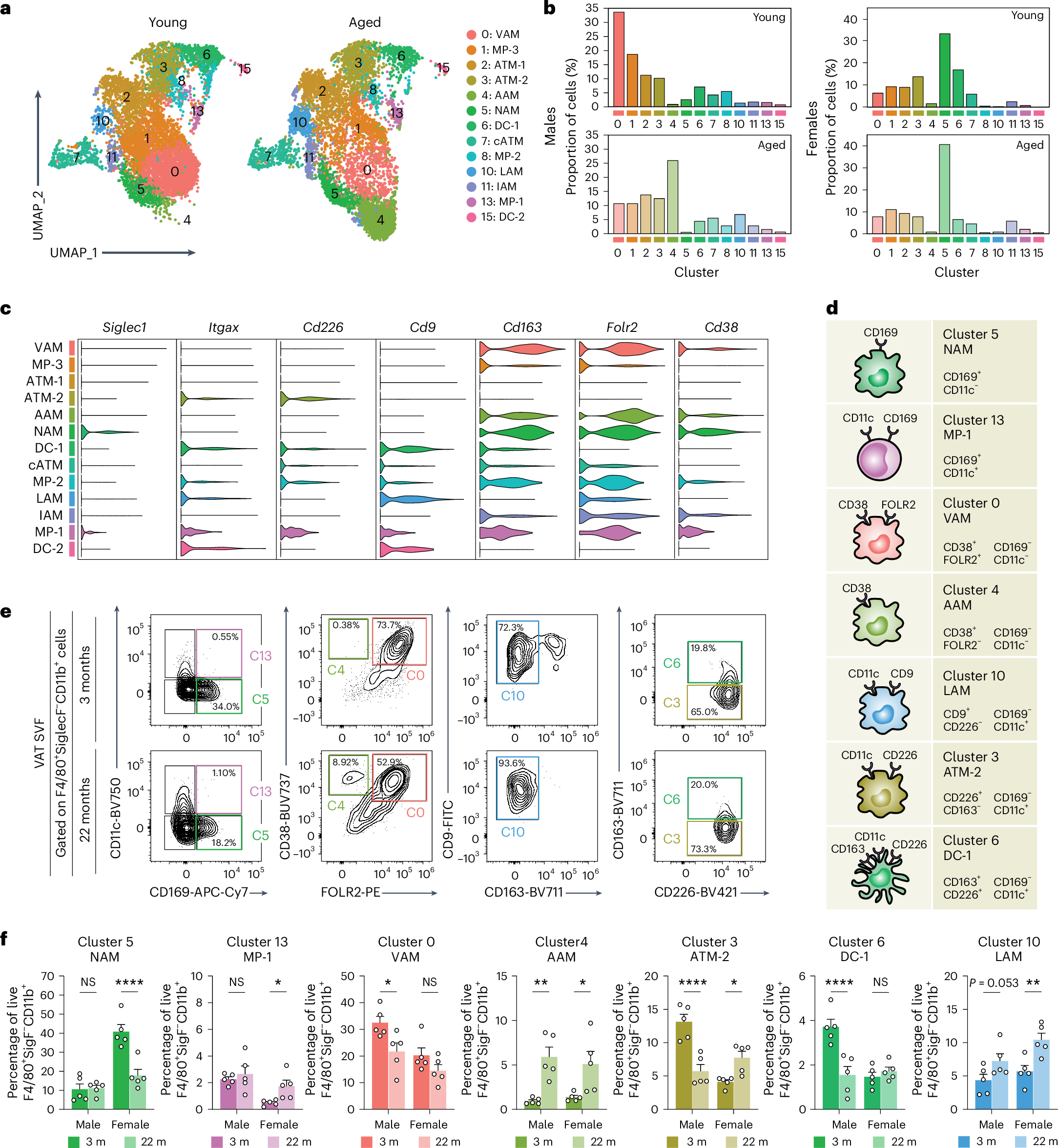
To tell apart macrophages that circulate in the blood from those living in fat tissue, the researchers tagged the circulating ones and left the resident ones unmarked. They then isolated the resident cells and read their RNA, which shows which genes are switched on. This allowed them to sort the fat-residing macrophages into 13 distinct groups, including NAMs and another they dubbed age-associated macrophages (AAMs).
“We found 13 different macrophages, all with different cellular machinery,” ...
The AAMs were found exclusively in aged mice. They expressed high levels of inflammatory markers and genes linked to inflammaging, indicating that they may drive age-related inflammation. ..."
From the abstract:
"Age-related inflammation or ‘inflammaging’ increases disease burden and controls lifespan.
Adipose tissue macrophages (ATMs) are critical regulators of inflammaging; however, the mechanisms involved are not well understood in part because the molecular identities of niche-specific ATMs are unknown.
Using intravascular labeling to exclude circulating myeloid cells followed by single-cell sequencing with orthogonal validation via multiparametric flow cytometry, we define sex-specific changes and diverse populations of resident ATMs through lifespan in mice.
Aging led to depletion of vessel-associated macrophages, expansion of lipid-associated macrophages and emergence of a unique subset of CD38+ age-associated macrophages in visceral adipose tissue with inflammatory phenotype. Notably, CD169+CD11c− ATMs are enriched in a subpopulation of nerve-associated macrophages (NAMs) that declines with age.
Depletion of CD169+ NAMs in aged mice increases inflammaging and impairs lipolysis suggesting catecholamine resistance in visceral adipose tissue.
Our findings reveal NAMs are a specialized ATM subset that control adipose homeostasis and link inflammation to tissue dysfunction during aging."
Nerve-associated macrophages control adipose homeostasis across lifespan and restrain age-related inflammation (open access)
Fig. 2: Aging remodels resident adipose tissue macrophages.

No comments:
Post a Comment